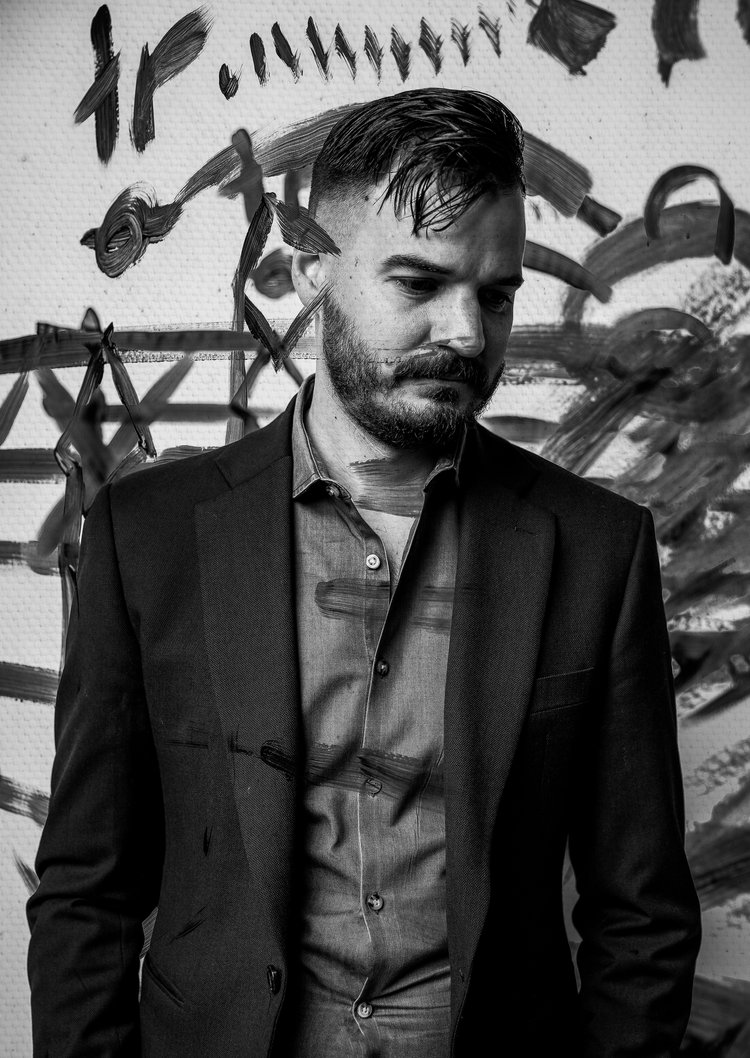
Published
Name: Aaron Helgeson
Nationality: American
Occupation: Composer
Recent release: The Book of Never for release on Navona Records in 2026.
Recommendations: Richard Miller’s The Structure of Singing / David Osmond Smith’s Playing With Words: A Guide to Luciano Berio’s Sinfonia / Thích Nhất Hạnh’s A Miracle of Mindfulness / Shelley Carson’s Your Creative Brain
If you enjoyed this Aaron Helgeson interview and would like to stay up to date with the project visit www.aaronhelgeson.com
Do you think that some of your earliest musical experiences planted a seed for your interest in sound?
Definitely! When I was a teenager, I’d sneak out of school and hop on the bus to this CD store where they had a Used Classical section. It was the only music that you could listen to for free, which was important for me since I didn’t have money to be buying lots of music.
So, I’d browse every inch of those two shelves, pick out a big stack of discs, and hunker down for a couple hours to listen. And hidden in between some awful recordings of classics (think Bach’s Greatest Hits Vol. 10) were these gems of contemporary music that people had listened to once and just thrown away. Some of them still had their packaging.
That’s how I was introduced to composers like John Cage, Phillip Glass, Pauline Oliveros, Milton Babbit, Arvo Pärt, Louis Andriessen, Karlheinz Stockhausen, Eleanor Hovda…there were even a couple Ornette Coleman and John Coltrane albums. Twenty-five years later, I know how important these composers were. But back then I had no idea what I was listening to!
Teenagers always crave new experiences, and listening to piles of discarded CD’s was my fix. That was my ritual. When I think about it, those were the most important composition lessons I ever had. And I literally learned them from listening to other people’s garbage.
For your own creativity, what were some of the most important things you learned from teachers/tutorials, other sound artists, or personal experience?
When I was 14, a local Bank of America branch in Oregon decided to sponsor a tuition-free composition course, offered through a community music school and taught by graduate students at the University of Oregon. I decided to enrol. There were three of us in the class. We were asked to bring in recordings we liked, so I saved up some lunch money to buy a few of my Used Classical finds and brought them in. We took turns writing our own music like it, and played it together on whatever instruments we had available. We were explorers in a frontier of endless possibilities. Our lives were permanently changed.
For some, music equals sound, to others they are two distinct things. What is the relation between music and sound for you? Are there rules to working with sound, similar to working with harmony, for example?
I used to think there wasn’t much relationship, outside of basic rhetorical structures having to do with anticipation and resolution (a chord progression ending on the five chord similar to the sound of a door opening but not closing). For a while my music was like what Helmut Lachenmann calls Musique Concrète Instrumentale…Essentially sound art that’s played on musical instruments. I’d transcribe environmental sounds for instruments like a clarinet or piano, exactly how you’d transcribe a jazz solo. Then I’d cut up the transcriptions and make music out of it that relied on rhetorical structures from our everyday listening like cause and effect, ambiguity and disorientation, or silence. But one day I started thinking, “Isn’t music part of that everyday sound? What if I transcribed music, but then subjected it to those non-musical structures?” So now I use the same structures as before but with wax cylinder recordings of fiddle playing, or baroque overtures, or Billboard chart hits from the ‘60s. I call it musical collage, but I guess you could call it Musique Concrète Musicale!
How and for what reasons has your music set-up evolved over the years and what are currently some of the most important pieces of gear and software for you?
I used to be just a paper, pencil, and ears person. These days I’m still mostly making acoustic music, but software is more and more involved. Sure, I make mock-ups now that the instrument sample libraries are a lot better. But it goes beyond that. Right now, I’m making this piece using folk song recordings from a Depression-era prisoner in Santa Fe. To make the audio part, I’ll cut a couple words from the end of one song, then put it next to a few words from the beginning of another song in a different key, add a word from the middle of another song, and string all this together to make one long song that’ll be played back live with orchestral accompaniment. But the recordings have a lot of noise in them, and the edits sound pretty jarring. So, after I make an edit, I’m using AI voice transformation software in a weird way where instead of changing one voice to another, I’m having it use the same guy’s voice. It’s kind of like if I had him sing the same song, but recorded on more modern equipment.
Could you describe your creative process on the basis of one of your sounds, pieces, or live performances that's particularly dear to you, please?
I’ve been writing a lot of vocal music lately, and I’ve developed this process partly inspired by David Bowie’s Verbasizer software that took pre-existing text, cut it up, and re-arranged it. It’s similar to something you get in opera librettist Paul Griffiths’ book Let Me Tell You, a 100-page novel that retells Shakespeare’s Hamlet from Ophelia’s perspective using only re-arrangements of the words from her mad scene.
My choral piece The Book of Never uses the heck out of that. It’s based on the Novgorod Codex, a wooden book of psalms from 999 A.D. owned by a monk sent as a missionary from Kyiv to the city of Novgorod (annexed later by Russia in 1478) and subsequently excommunicated for combining Pagan ritual with Orthodox Christianity. He saved his culture by pouring layer after layer of wax over the book, on top of which he wrote his liturgy, his alphabet, these searing retaliations, and his visions of the apocalypse. The result’s somewhere between a prayer, the chanting of a vindictive spell, a recitation of sins, and a grammar lesson with lines like “smashing and smashing, and smashing and smashing, and tearing and smashing, and tearing and tearing, and smashing and splitting, and tearing and tearing, and tearing and appeasing, and lying and teasing…”
That spoke a lot to me about what’s going on now: war, banishment, religious tension, banning of language, you name it. I wanted that resonance to show up in the lyrics to The Book of Never, so I decided to mash up the Novgorod Codex with words from more contemporary writers in various states of exile like Gertrude Stein, Oscar Wilde, Pablo Neruda, Angela Davis, Thanhhà Lại, and The Rolling Stones.
First, I put all that text into a huge database that catalogues individual words using number of syllables, scansion, vowel sounds, and parts of speech. Then I put that aside and stitched the music together from fragments of ancient melodies from the Stichera Alphabetica, a collection of hymns that would have been sung alongside the psalms from the Novgorod Codex, each starting with a different letter of the alphabet. Once the music was finished, I re-assembled the text on top of it, word by word. Each movement combines parts of the codex with one of the contemporary texts in way that preserve some of the tone and narrative of the original, but in a much more vernacular and stripped down way.
For example, the second interlude of The Book of Never combines a refrain phrase from the Novgorod Codex's Spiritual Instruction from the Father and Mother to the Son (“The world’s a town where _______”) with words from television interviews with philosopher and political activist Angela Davis, after she was found not guilty in 1972 of charges stemming from the use of a gun she had purchased in the Marin County Courthouse kidnappings, resulting in her release after two years in the segregated wing of the court’s Women’s Detention Facility. I interlace those words with lyrics from The Rolling Stones’ song “Sweet Black Angel” written about Davis’ arrest during the Stones’ period of self-exile in Paris while avoiding tax debts on their previous albums in England. The resulting lyrics in the interlude go like this:
You ask me if the fires are burning down my land
(The world's a town)
You ask me how I sleep at night
(The world's a town in which we'll never breathe)
You ask me if my brothers falling one by one has broken me
(The world's a town we learn)
You ask me whether I approve of hate
(The world's a town where people cannot pay their way)
You ask me if the crimes I've made are pure
(The world's a town we leave)
You ask me if the judge they murdered could have known
(The world's a town)
You ask me if the judge that they then stole will chain me in a cage
(The world's a town in which my petty anger lives)
You ask me if the world makes any sense at all
(The world's a town we'll burn)
The world's a town!
When you're writing song lyrics, do you sense or see a connection between your voice and the text? Does it need to feel and sound “good” or “right” to sing certain words? What's your perspective in this regard of singing someone else's songs versus your own?
Part of the reason I came up with this way of writing lyrics is I never felt comfortable working with other people’s poetry. Not as they wrote it, anyway. The way I see it, poems are already so tightly packed with meaning that there’s not really any room to add music on top of it. All you’re doing is muddying the waters. And besides, the kind of music I write doesn’t fit well to someone else’s poetry. It’s too fragmented. I also never felt like I could write my own lyrics from scratch. Because I found it intimidating, overwhelming even. But I always really wanted to do both of those things, because I’m a literature hound who likes to write. That’s why I came up with this method of deconstructing a source and using its guts to make my own lyrics. John Cage called this “writing through” someone else’s words, and did it himself with Finnegan’s Wake. That made sense to me, somehow. It put me at ease with lyric writing.
Singing is an integral part of all cultures, and traditions. Which of these do you draw from – and why?
I work with all kinds of traditions in what I’m doing. There’s the church singing and Southwestern country ballad stuff I was just talking about. In a piece called Snow Requiem I collaged with Norwegian folksong from the “tralling” tradition, a kind of nonsense syllable singing (like scatting) used a lot in their children’s songs. The piece is a response to historical creative non-fiction writer David Laskin’s book The Children’s Blizzard about a brutal 1888 storm in Homestead-era Minnesota and the Dakotas. Its immigrant narratives tied into my own Norwegian ancestors who came to the United States during that period. I wanted to tap into the sonic imagery Laskin talks about in his book – folk songs of a teacher that kept her schoolchildren's spirits up while they waited out the night underneath a frozen haystack; hypothermia-induced aural hallucinations people felt as the temperature of their prairie-trapped bodies fell below 87 degrees, the wordless hymns of a woman on her deathbed, the deafening roar of the wind and snow, and the even more deafening quiet that surrounded it.
What are the things you hear in a voice when listening to a vocalist? What moves you in the voices of other singers?
I like personality. Corsican chant that’s really chesty and florid, Norwegian songwriter Ane Brun singing Monteverdi in English, Tom Waits doing his gritty thing, the intimate breathy side of Tori Amos, the twangy patina of bluegrass singer Ralph Stanley in his eighties. I like to feel how the voice sounds in my own body. I’ve got a music theorist friend, Arnie Cox, who’s developed this model of how we subconsciously mimic the music we listen to. So when we listen to something, our muscles move in tiny ways, like they would if we were going to make the sounds. Our throat and tongue are actually doing the thing we’re hearing in the singer’s voice. It doesn’t even have to be vocal music. We hear a flute and our lips move undetectably like they’re going to whistle, or we have little micro-movements in our fingers when we listen to a piano. It’s wild.
Have you ever been in spaces with extreme sonic characteristics, such as anechoic chambers or caves? What was the experience like?
I love being in really reverberant places…St. Paul’s Cathedral in London, tunnels under footbridges in Central Park, rock formations in Bryce Canyon. There’s something about how sounds are suspended and melt together in those environments. It’s the same reason I also love the whole “Slowed 1000%” PaulStretch meme thing on YouTube.
That became part of my process in The Book of Never. I recorded a friend singing the hymn fragments I was working with, processed them with completely bonkers reverb that had a decay time of something like 40 seconds, and then transcribed that by ear for four voices so you get the same effect but in a purely performative way. It’s a way of stretching space and time using the human voice. That’s a big part of the storytelling of the piece.
It’s funny, musicians are really picky about their acoustic. David Hykes did this bizarre thing for his overtone singing with his Harmonic Choir back in the ‘70s. He really liked this one cathedral in Paris, so sometimes in live performances they’d mic the singing, broadcast the signal to a speaker array in the actual cathedral, pick up that sound with binaural mics, and then pump the sound back into the concert hall they were in. Now you’d just run everything through the computer using convolution reverb with impulse responses from the place. But back then it was a super innovative (and probably expensive) way to get the same result.
What happens in your body when you're listening? Do you listen with your eyes open or closed?
It depends on what I’m listening to. I listen to a lot of Sia, ideally her live performances and music videos. They’re so layered with visual and performative identity that I feel like I have to watch with eyes open. But most of the time, I listen with eyes closed and lights dimmed. It helps me connect myself to the music. My breathing. My pulse. My thoughts. It’s my form of meditation. And I never put on music in the background when I’m doing anything else. Not when I’m cleaning. Not when I’m on long road trips. Not when I’m running. Never. I’d miss all the detail, and besides I like silence.
Do music and sound feel “material” to you? Does working with sound feel like you're sculpting or shaping something?
It does actually, mostly because like I say I start from pre-existing material, like you would make beats from samples in hip-hop. Kind of like a multimedia sculpture if I were mashing together clay, food, clothing, and anything else that was lying around. The challenge is making it all sound unified. For me that’s done mostly with harmony. I’ll take a two or three note fragment and figure out a scale to put it in, usually one that’s not so expected. So if the original was in D Major then maybe I put it in some kind of mode that comes from F# melodic minor but with C# or something as the root. Then I find some other pre-existing material that has different notes than the first fragment, but still fits within that new scale I made. The harmony ties all the material together and recontextualizes it. Kind of like a Bob Rauschenberg print.
“You have the possibility with electronic music to generate any texture, and any sound. So why would any musician want to limit themselves?” What's your take on that and the relevance of limitations in your set-up and process?
You know, back in 2001 when I was in college, I went to a lecture the composer John Adams was giving. There was a Q&A at the end and I asked him an admittedly non-sequitur question. “Technology is getting to the point where you could make orchestral music all on a computer, so why do you still write orchestral music for live orchestras?” He said it was a silly question, that electronic instruments would never be as good as acoustic ones, and that there’s no point in making music just for a recorded medium. I mean, he was dead wrong. To be fair, the sampling and synthesis weren’t as good as they are now. But I know young composers who are making music in Logic using virtual instruments where the performance quality is better than what they’d get with a studio orchestra.
As far as how it affects my own process, I’m someone who needs limitations. Free reign is too overwhelming. I used to always start the process from silence, a blank page, nothing. And it was excruciating. But with this musical collage stuff, now I start from a full page. I start from something. And it’s such a relief.
Tell me about some of the albums or artists that you love specifically for their sound, please.
Oh, there’s so many. For the raw human end of things, Nick Cave did this great live recording of Black Hair during COVID. It’s so simple and pared down. Breathy. Really intimate. On the more maximalist end, I dig Björk. She’ll use anything and everything – lo fi beats, flute choir, jazz orchestra, silly synth sounds, whatever. In terms of mixing, I’m fascinated by pop orchestral stuff from the 60’s, like Ennio Morricone’s film music. The perspective is all over the place. The strings sound distant, you’re standing above a choir, but also there’s an annoyingly loud trumpet right next to your ear. I also love the combinations of acoustic and electronic sounds you get in Tristan Perich’s piece Drift Multiply for string orchestra and sine tones. In a similar vein, there’s also The Books. The way they blend old speech recordings and contemporary electronic sounds feels so alive!