Published
Name: Abigail Toll
Nationality: British
Occupation: Composer, sound artist, researcher
Current release: Abigail Toll's new album Idol is out November 7th 2025 via Superpang.
Recommendations for Berlin, Germany: I feel Berlin is a bit of an open book these days, although my happy place currently is 20NINE30, a venue in an old church on Paul-Linke Ufer run by some dear musician friends Tengal and Timo Kreuser.
Topic I am passionate about but rarely get to talk about: I’ll reveal my hidden passions in this interview regarding extrasensory perception and my developing interest in non-verbal relationality between species. It’s something I want to dedicate my life to, and am developing artistic research around this concept: exploring how folk music and pastoral traditions around the world translate the way in which species communicate with one-another.
If you enjoyed this Abigail Toll interview and would like to stay up to date with her music, visit her official homepage. She is also on Instagram, Soundcloud, and bandcamp.
Where does the impulse to create something come from for you? What role do often-quoted sources of inspiration like dreams, other forms of art, personal relationships, politics etc play?
The impulse to create is almost always triggered by an encounter these days. I find that when I clear my headspace of all the daily clutter, I “download” inspiration.
It could come from anything that is mundane to spiritual: I’ve been inspired by an encounter with a flock of sheep, a neolithic temple, data, and delivery men transporting empty gas canisters.
I could talk about this question endlessly. But the common denominator is it always comes to me when I am most grounded and attuned to the worlds around me – both visible and invisible.
For you to get started, do there need to be concrete ideas – or what some have called a 'visualisation' of the finished work? What does the balance between planning and chance look like for you?
When I first started making music, I just played intuitively, translating whatever emotions I was feeling through sound.
Then I completed an MA in a music academy which transformed my process into something far more rigorous and “evidence” based. I felt I had to analyse and back every aesthetic or conceptual decision I made – which is a helpful process – I just allowed it to displace intuition which is a fundamental part of my practice.
During that period, I told myself that I must begin with a concrete concept and then methodically develop it. This current record Idol traces that process, as I started composing it in 2019. I wanted to take impulse response signals from inside the temple to base my “study” around, but wasn’t allowed as the site is too old and fragile, so I tried to compose based on aesthetic associations. It took a long time to decondition myself from a more rational way of approaching composition.
Eventually, everything clicked into place in 2023 where suddenly I hit a flow state and managed to complete all five tracks over the course of a week because I had left the process up to chance and allowed myself to access the idea of the space emotionally..
Is there a preparation phase for your process? Do you require your tools to be laid out in a particular way, for example, do you need to do 'research' or create 'early versions'?
Most of the time there is a research process involved.
In some instances it can take years. Sometimes an idea can be immediate.
Do you have certain rituals to get you into the right mindset for creating? What role do certain foods or stimulants like coffee, lighting, scents, exercise or reading poetry play?
I turn the lights off, light candles and also journal every morning to work through different thoughts, ideas and record dreams and inspirations. But I for sure need a calm, organised environment and mood lighting / scent.
There was a period when I was composing with graphic scores, whether that was with drawings or poetry.
For Idol, what did you start with? If there were conceptual considerations, what were they?
For Idol, I began with the Hypogeum’s resonant frequency, 70 Hz, and then built up the compositions from there, using the harmonic series as the tuning system. I also visualized each track as a graphic score to determine what was happening aesthetically in each one. This developed alongside the composition process itself.
Other conceptual considerations included the general atmosphere of the Hypogeum and its mysticism ... Such as the mother goddess sculptural figure that was found inside.
I was in awe of the energy within the Hypogeum. It’s impossible to articulate how it felt when visiting, the only earthly thing I can equate it to is a kind of overwhelming static made up of impulses and chatter, but from other dimensions.
Since then, I’ve become extremely interested in the extrasensory ways that beings can relate to one-another across time, geographies and species. Though it’s becoming a more popular topic, it’s led me to dive deeper into quantum and its possibilities (and mysteries). This essence runs throughout my music.
Talking about extrasensory associations of quantum feels like a vulnerable position because even now it’s considered esoteric and irrational within the patriarchal, white supremacist Western European imaginary.
But I’m inspired by Black Quantum Futurism, Ce Ce Hennix, Sun Ra, Eliane Radigue and many other artists who are all orbiting around these themes.
Many writers have claimed that as soon as they enter into the process, certain aspects of the narrative are out of their hands. Do you like to keep strict control or is there a sense of following things where they lead you?
I often begin with what I believe is a clear plan and then surrender to the chaos :)
In all seriousness, it can be intimidating to let go but I find that this is the most fertile state in which to create. It feels like a possession – you are just a vessel receiving a greater force that is being mediated through you.
There are many descriptions of the creative state. How would you describe it for you personally? Is there an element of spirituality to what you do?
In some ways, this record is helping me to return to myself.
For all my resistance, I guess I acclimatised to Berlin over the course of a decade to a certain degree, and it dimmed a huge part of my spiritual tendencies in the process.
But this is why I love making music, because it’s like excavating and awakening a part of your spirit every time you do it.
Once a piece is finished, how important is it for you to let it lie and evaluate it later on? How much improvement and refinement do you personally allow until you're satisfied with a piece? What does this process look like in practise?
My dear friend Leng Seong said that he knows a piece is finished when he experiences goosebumps, and I know what he means. Everything kind of clicks into place where suddenly the arrangement feels complete. Again, it’s a completely intuitive thing.
Sometimes I enter into this possession mode I mentioned, and record analog instruments in the quickest way possible to make sure I capture the idea before I forget or miss the moment. Which means that often, it can be an extremely low fi recording. When it’s electroacoustic and not involving an ensemble, I’ve learned to embrace this as an important part of the piece, as it can often be impossible to recreate the same atmosphere and emotion in more professionally treated environments.
Sometimes when working with an ensemble, you have to ensure that everyone is happy with the quality of the recording so it’s necessary to re-record it, however that process is equally as exciting because you’re inviting players to apply their incredible depth of knowledge to the piece.
How do you think the meaning, or effect of an individual piece is enhanced, clarified or possibly contrasted by the EPs, or albums it is part of? Does each piece, for example, need to be consistent with the larger whole?
I think about this often, but believe it only really matters in a commercial context. It’s probably easier to brand or market your music if it’s part of a wider “cohesive” collection but I think it’s a personal thing.
I love to explore different styles through collaboration and whilst it sometimes feels uncomfortable to detour from your usual style, it’s also quite liberating. Each piece will always have some kind of red thread.
What's your take on the role and importance of production, including mixing and mastering for you personally? In terms of what they contribute to a song, what is the balance between the composition and the arrangement (performance)?
I think it’s important to know the basic principles of mixing in order to achieve your aesthetic goals as independently as possible. It’s really amazing to create music in community, and it’s a myth that it’s possible to do so alone, but it’s important to have some level of autonomy when mixing.
That said, if I know that a record isn’t quite hitting the mark then I will ask a friend to bring it to that place if I can’t get it there – which I have Leng Seong to thank for that.
Caterina Barbieri also did this for me for my first ever EP Old World | New Ruins during a mentorship with Amplify Berlin which was founded by my partner Shub Roy.
It was the first time I had made music – I explained my vision and she showed me how to realise it.
For this new record, I composed and mixed it then had Lucy Railton create another mix for it. I really appreciate the knowledge she brought to this process and think it took the album to a whole new level.
[Read our Caterina Barbieri creative profile]
Music and the accompanying artwork are often closely related. Can you talk about this a little bit for your current project and the relationship that images and sounds have for you in general?
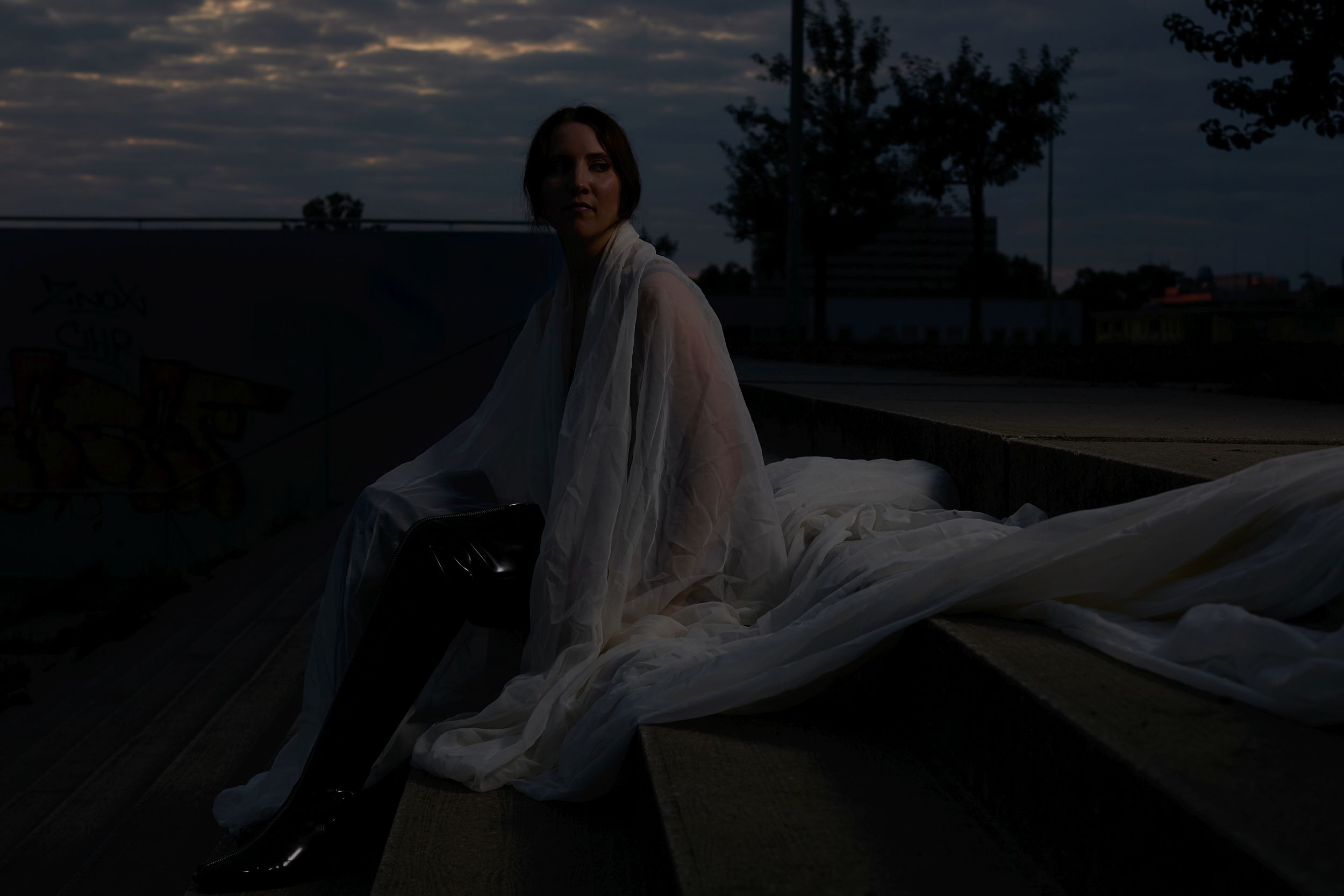
The image of the veil runs through the artwork and also is realised spatially as an exhibition that opens on 13 November at HOLON Berlin. It refers to the statue of the mother goddess found in the Hypogeum, and the metaphorical veil which is said to mask a greater comprehension of consciousness.
I was always really interested in the “Veil of Maya” which is a philosophical concept that appears in Hinduism and Buddhism as a means to refer to the illusory nature of our limited perception of reality. This was another reference point that I’ve carried with me for over a decade.
After finishing a piece or album and releasing something into the world, there can be a sense of emptiness. Can you relate to this – and how do you return to the state of creativity after experiencing it?
I’m intrigued to see how it feels once it’s out in the world. I’ve released it with huge support and encouragement from Chris (Superpang) – I really appreciate his enthusiasm and respect for the collaborative process.
I feel a huge amount of love and abundance for what this album has brought me so far, just on a personal level. It’s enabled me to create deeper bonds and learn from collaborators and friends including Ella Schoefer Wulf, Merma Suelo, Anton Filatov, Caleb Salgado, Lucy Railton and Maria Horn.
I’m excited to see where it goes.
[Read our Maria Horn interview]
I would love to know a little about the feedback you've received from listeners or critics about what they thought some of your songs are about or the impact it had on them – have there been “misunderstandings” or did you perhaps even gain new “insights?”
So far, people have responded most emphatically to the final track ‘Afterimage’, which is nice to hear, as I feel like that encapsulates the atmosphere of the Hypogeum the most. It’s a capacious sound world and, to me, quite cosmic, so I’m happy that people are also receptive to this.
Also, when I perform the album live, people often respond to the 35Hz bass in the track ‘Utterances’ and tell me that they could listen to that one frequency for hours.
It’s really interesting to learn about because you can then take this one isolated element and use it as the foundation for a deeper exploration in a new piece.