Published
Name: Adam Werderits aka Adwer
Nationality: Hungarian
Occupation: Producer, DJ
Current release: Adwer's Gospelkrautfunk EP is out via Bolygó.
Shoutouts: One artist comes to my mind and his name is Floating Points. I am probably not shedding any light on something new for most electronic music enthusiasts because he’s one of the most respected producers/live acts out there for a good reason, but I think what he does is the modern reincarnation of kraut and Pink Floyd style psychedelic stuff at a genius level, both in his productions and the way he performs live.
If you enjoyed this Adwer interview and would like to know more about his music, visit him on Instagram, Facebook, and Soundcloud.
How would you describe your personal relationship with Krautrock? When and how did it start?
My earliest memories are seeing kraut rock, space rock being mentioned in this hard cover book that I had when I was a kid, called ‘A cartoon history of the first 30 years of rock.’
Some years later my interest grew and started listening to Kraftwerk and Tangerine Dream, that my Dad aptly called ‘nerd music’.
[Read our Tangerine Dream interview]
[Read our Tangerine Dream interview about improvisation]
Tell me about one or two of your favourite Krautrock records please.
Although I’d definitely list some of the early Kraftwerk here, like the ‘Ralf & Florian’ album, let’s do something less obvious.
Manuel Göttsching of Ash-Ra Tempel went solo and put out some albums that were more electronic, one of them is Ashra - New age of Earth.
This album puts me into and indescribable and very pleasant state, sometimes I even doze away, and I put the record on for an intentional nap.
This album has all the right balance of kraut elements but it is devoid of the motorik beat, it is more of an ethereal, relaxing, meditative affair a bit closer to Tangerine Dream than the early kraut works that were impro heavy with a lot of harsh sounds - and that’s why it has a lot of appeal to me, it is easy on the ears.
[Read our Manuel Göttsching interview]
I’d also like to mention Harmonia’s ‘Deluxe’ album.
This was a ‘supergroup’ where some great musicians of the kraut scene joined forces. I like almost all of their releases, but this album has ‘Notre Dame’ that is an absolute gem.
[Read our Harmonia's Hans-Joachim Roedelius interview]
[Read our Harmonia's Michael Rother interview]
Krautrock always seemed like a phenomenon connected to a very specific era in German history. What about this music and its time do you connect with?
I think ‘hope’ would be the right word. This music was born in a post war Germany by hopeful, optimistic and experimenting youngsters. Those sweet phasing synths and guitars and heartwarming melodies yearn for a bright future.
I am also a very nostalgic person, even though I wasn’t alive when this happened. There are certain themes of nostalgia that resonates with me, for example Kraftwerk singing about ’Neon Lights’ - I am actually missing those vintage neon signs that were still there when I was a kid in the 80s in Budapest.
Many of the original Kraut musicians loved blues, rock, and psychedelia; they were intrigued by electronics and improvisation; they rebelled against virtuosity, classical education and the superficiality of Schlager on German radio. How much of that do you recognise in your own creative preferences and interests?
I believe these are very present in my music. My Dad played music and was very much into blues, funk, beat and the music of the 60s & 70s and I think I sucked in the essence of music with mother milk.
To me, psychedelia became the key factor in my music. I’ve found psychedelic elements in quite different genres - I had this experience once listening to a live flamenco performance that was absolutely ecstatic.
Recently I am listening to a lot of records from the 70s and I can totally hear the influence of certain psychedelic substances on many performances and I found them very appalling.
A lot of the Kraut spirit came to life through musicians living in communities, playing and recording together every single day. Have you ever tried working and creating in such a constellation? Is it possible to emulate this process from a home studio?
I have tried something similar with musicians, although not in a community, just studio jamming and it is a lot of joy.
Emulating this in a studio alone only gets you to a certain point. It’s not the same thing, you are basically jamming with the computer, setting up a drum beat and some harmonies and you just play along with the synths or guitar - this is something I usually do.
What, to you, are the main elements that make something “Kraut?” What are the practises of the musicians from the 70s that inspire your own practise today?
There are definitely certain elements that make a song ‘Kraut’ - but I would separate the highly experimental pieces from the melodic ones - I am more into the latter.
In that case, the motorik beat, warm phasing string machines, guitars, flutes, oboe sounding Arp omni style leads and overall psychedelia would be the Kraut cocktail.
What instruments or equipment are you using to create your music? Are there any vintage instruments that you find essential to get your sound right?
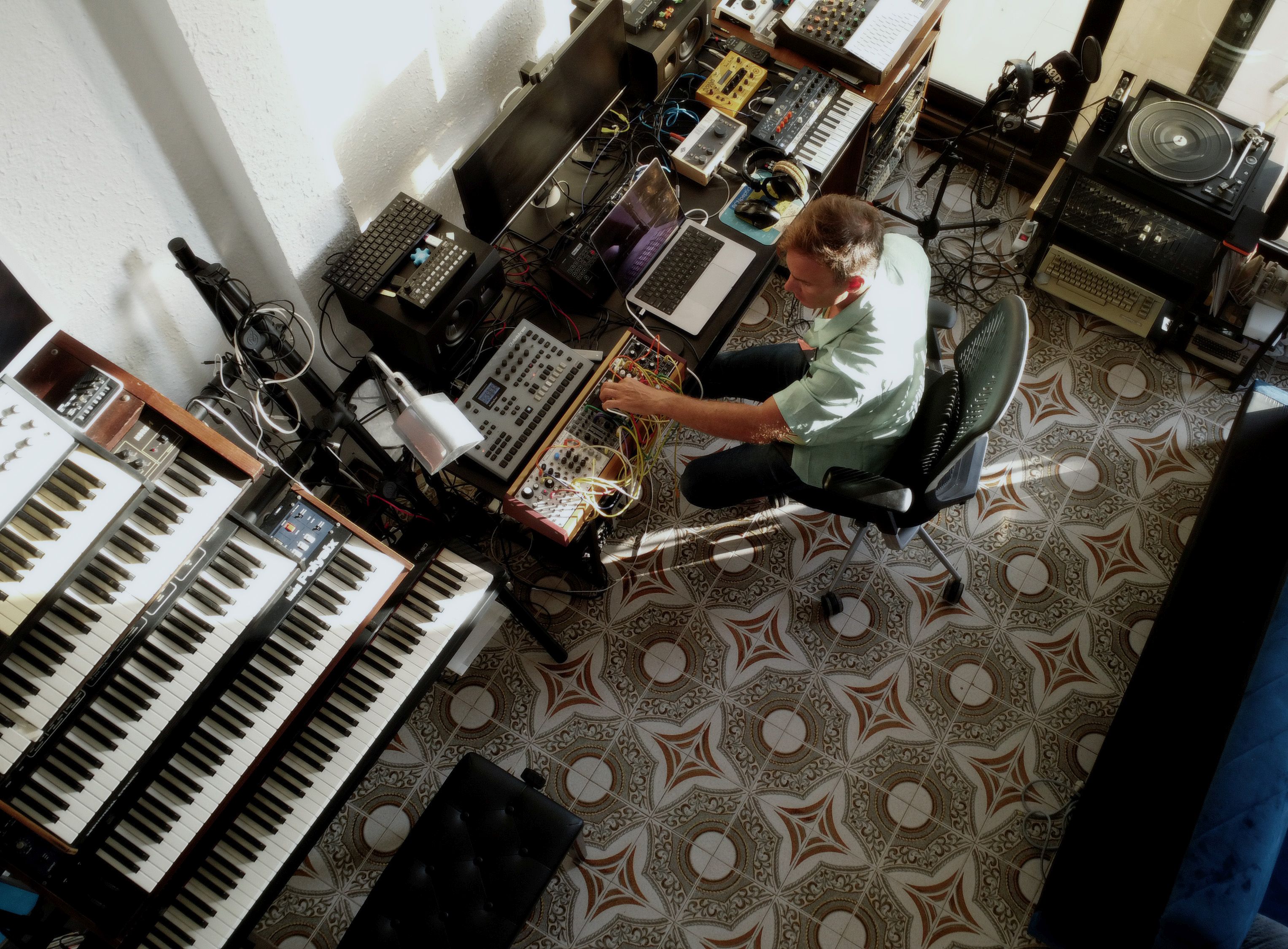
I have a bunch of vintage stuff. Korg Polysix, Sequential six Trak, Oberheim matrix 1000 and I have a broken Korg Lambda that I need to fix for the gorgeous strings and vox humana.
I also have an Akai s1000 sampler although I don’t really ever turn it on. I also have 2 reel-to-reel tape machines and 3 turntables but these are not really taking part in my music production.
Could you describe your creative process on the basis of your most recent Kraut-leaning release?
My latest EP is called ‘Gospelkrautfunk’ because it is quite eclectic and blends genres and it is basically the mixture of most of my influences into something new.
The kraut influenced track is called ‘Kraut Komet’ and it was the basis for this entire EP, even if it is almost 3 years old. It was a top favourite of Dixon who gave it a lot of spins in clubs and festivals around the world.
The whole song is like a live jam, with many of the synths played live and very little editing. I think the listener will probably hear the live feel and I hope people will appreciatethat it is not a formulaic dance floor track that is still danceable.
I got into Kraut via Tangerine Dream and early Ash Ra and to me, the motoric beat was never quite as important. Today, it seems as though it's the defining element. Are you interested in it? Are you making use if it? What makes it special to you?
I’m sure some purists would go into a deep analysis about this, but I am probably more like you, because the ‘kraut’ that I like the most is leaning more towards that new era/esoteric/kosmische sound, not so much the early very experimental, abstract pieces.
In fact, I cannot really enjoy those, although I value them. They had their time and place, but I find them to be heavily acid infused, self fulfilling experiments - musical masturbation, as some would call it - not really at-home listening profoundly musical pieces.
Did you ever visit one of the birthplaces of the genre – Berlin, Düsseldorf, Munich – or any spaces related to the history of Kraut? Do you own any paraphernalia from the era?
Yes I did, I was in Düsseldorf a few years ago and I walked to the place where Kraftwerk’s Kling Klang studio was. That old “Elektro Müller” sign is still there, and there were two traffic cones in the court.
Although not from the ‘era’, but I have a blue Autobahn t-shirt and a Tour de France theme cycling jersey.
Several of the original Kraut pioneers recently passed away or withdrawn from making new music. If some of your personal favourite artists were affected as well – can you share a little what did their music meant and means to you?
Indeed, the generation of those greats is leaving us behind. In recent years Edgar Froese, Florian Schneider, Manuel Göttsching passed - all of them were a great inspiration to me.
I have been a Kraftwerk and Tangerine Dream fan since my teenage years, while Manuel’s projects have not reached me until a couple years ago but Ash Ra - New age of Earth became one of my top favorites.