Published
Name: Agriculture
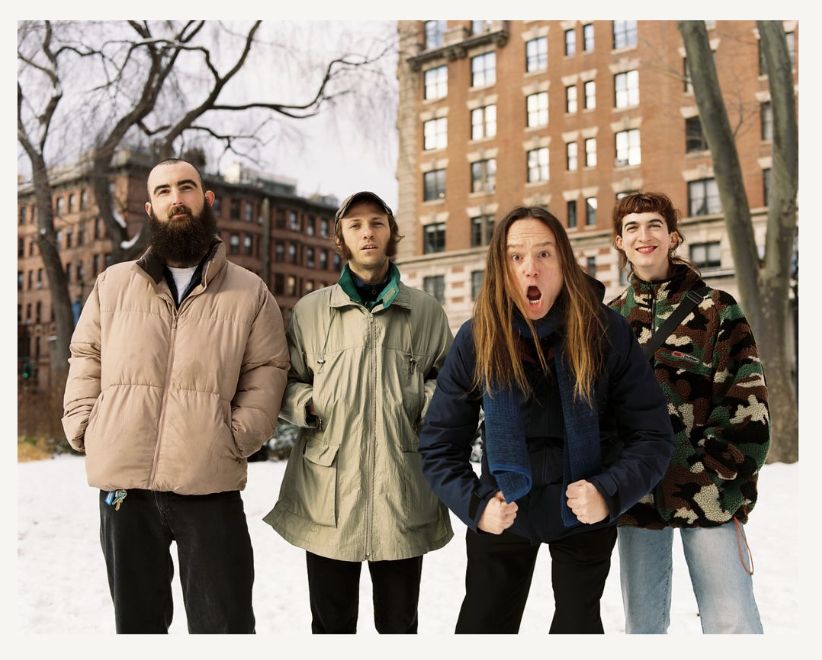
Members: Dan Meyer (guitar, vocals), Leah B. Levinson (bass, vocals), Richard Chowenhill (guitar), Kern Haug (drums)
Interviewee: Leah B. Levinson
Nationality: American
Current Release: Agriculture's new album The Spiritual Sound is out via The Flenser.
Current Event: Agriculture are currently on an extended tour. Catch them live at one of the following dates:
Oct 8 Brooklyn, NY — Union Pool (Record Release Show)
Oct 27 San Antonio, TX — Paper Tiger $
Oct 28 Austin, TX — Mohawk $
Oct 30 Atlanta, GA — Masquerade $
Oct 31 Saxapahaw, NC — Haw River Ballroom $
Nov 01 Silver Spring, MD — The Fillmore $
Nov 02 Philadelphia, PA — Union Transfer $
Nov 04 Louisville, KY — Zanzabar
Nov 06 Oklahoma City, OK — 89th Street
Nov 08 Albuquerque, NM — Launchpad
Nov 09 Phoenix, AZ — Valley Bar
Nov 11 Denver, CO — Hi-Dive
Nov 13 Salt Lake City, UT — The State Room
Nov 14 Boise, ID — Neurolux
Nov 16 Seattle, WA — Madame Lou’s
Nov 18 Vancouver, BC — Fox Cabaret
Nov 19 Portland, OR — Mississippi Studios
Nov 21 Sacramento, CA — Cafe Colonial
Nov 22 San Francisco, CA — The Chapel
Dec 04 San Diego, CA — Soda Bar
Dec 05 Los Angeles, CA — Lodge Room
Topic I am passionate about but rarely get to talk about: I’ve been really interested in comics lately and I’ve been working on writing a comic. I think it’s a form that doesn’t get the credit or attention it deserves, and, when it does, it’s not for the reasons that really make it interesting (its formalism, its relation to adolescence, and its accessibility from a creative standpoint). Instead, the world at large tends to value comics only when they resemble and uphold the popular values of prose literature or when they can be adapted to movies or TV. I think comics and poetry have a lot in common and I’m interested in what more comics can do.
If you enjoyed this Agriculture interview and would like to know more about the band and their music and upcoming live dates, visit their official homepage. They are also on Instagram, facebook, tiktok, and bandcamp.
Do you think that some of your earliest musical experiences planted a seed for your interest in writing lyrics or poetry?
The first music I loved as a kid was rock and pop music. Songwriting came naturally from a love of that music and a desire to play in bands.
How and when did you start writing?
My friend and I started what became my first band when we were 11 or 12. We wrote songs together (including lyrics) and eventually played shows through my teenage years. Writing songs for a band emboldened me and got me in the habit of writing and recording songs by myself.
Eventually that habit seeped into writing poetry and, eventually, non-fiction, criticism, and (more recently) fiction. It all feels pretty inseparable for me. For a while, I wrote poems as album reviews for the experimental music newsletter Tone Glow.
More recently, I’ve approached lyric-writing more like writing poetry that I later adapt to song form. They all feel like similar types of creativity for me.
Entering new worlds and escapism through music and literature have always exerted a very strong pull on me. What do you think you are drawn to most when it comes to writing?
When looking at an overall piece of writing (or song or album), I’m most drawn towards structure and form. I like to think about the balance of a work and how I can maintain, shift, or interrupt it.
Zooming in, I tend to be interested in degrees of legibility and illegibility: choosing when, what, how, and how much to communicate. This tends to be guided by my feelings towards the subject I’m writing about and the tone I want to strike.
What were some of the artists and albums which inspired you early on purely on the strength of their lyrics?
Punk music hit me early on. Artists like Ramones, Suicide, Iggy Pop, Crass, Devo, Velvet Underground, and Lou Reed all struck me lyrically and I still revisit some of them for inspiration today.
What I got from punk was how simplicity can lend itself either to directness or abstraction. A simple lyric can make a specific point or it can leave a million questions around it.
Iggy’s “I Wanna Be Your Dog” or Lou’s “I’m So Free” are great examples of songs that are incredibly simple but leave you with more questions than when they started.
Ramones’ “I Wanna Be Your Boyfriend” is a great example of a simple song that says exactly what it wants to say and nothing more.
“Chain Saw” and “I Don’t Wanna Go Down to the Basement” are Ramones songs that are just as simple but open up more questions.
A funny but important early influence when I started writing songs was They Might Be Giants. I think the way they write from unusual and absurd perspectives and the way they let a song’s premise unfold (and often never become totally clear) is kind of genius.
It’s a style of writing I’ve rarely attempted because I think it’s pretty difficult to do well.
What moves you in the lyrics of other artists? Have there been song lyrics which actually made you change (aspects of) your life? If so, what do you think, leant them that power?
Sometimes a lyric sticks in my head and becomes a sort of mantra for me.
A lot of Lou Reed’s and Leonard Cohen’s lyrics work that way for me and help me process difficulties with things like spirituality, relation, and sexuality in my daily life. I repeat them in my head or out loud around the house, driving, or walking my dog.
I can’t share examples because all the ones I can think of are a little too revealing of my own personal complexes, but a lot of times having a lyric like that makes me feel less insane.
It is sometimes said that “music begins where words end.” What do you make of that?
Music has the benefit of being both immediate and abstract. Two things I think language often fails at.
Dan and I often talk about the benefit of extreme music that screamed or guttural vocals are often unintelligible to a listener. It lets the listener respond to the music without the baggage of language while also feeling the presence of the human voice, especially in those extreme states.
I think this is one of the reasons the whole blackgaze thing happened, because a lot of classic shoegaze and dream pop uses mumbling or whisper-singing or effects to make the lyrics more unintelligible. I’m especially thinking of My Bloody Valentine and Cocteau Twins.
We’ve toyed with using my voice that way at various times with clean singing at the end of “Living Is Easy” and in the verses of “Bodhidharma.”
Even the way we use spoken word in “Flea” and “In The House of Angel Flesh” has toyed with having the presence of the human voice without exactly being able to follow the text. It’s its own kind of hook and challenge to a listener.
I have always considered many forms of music to be a form of poetry as well. Where do you personally see similarities? What can music express which may be out of reach for poetry?
I think of poetry as the arrangement of images, themes, and affects with a particular focus on form and structure rather than content. It’s less about what’s being said and more about how you say it.
In that sense, I think any medium can be approached more or less “poetically,” and I think music is particularly well-suited to the poetic.
One thing music can do that poetry can’t (for the most part) is affect us on a more bodily level. It can move us before we’ve even consciously noticed it’s happening.
That said, pieces of writing about gore or extreme violence (by David Wojnarowicz or Dennis Cooper, for instance) have made me wince or have to stop my reading. Writing can also cause tears, arousal, laughter, etc. It’s never made me dance though.
The relationship between words and music has always intrigued me. How do you see it? In how far can music take you to places with your writing you would possibly not have visited without it?
When I’m writing lyrics to a song, the music often completely guides the tone and form of the lyrics. This can limit the writing or can inspire me to write something I wouldn’t otherwise.
The lyrics to “In the House of Angel Flesh” and “Micah (5:15am)” are fairly simple and repetitive. To me, that simplicity was demanded by the form the songs arrived at.
Those simple structures allowed me to be a little more absurd or inventive than I would otherwise. In “Micah,” I toss off the image of Satan in a fairly sudden and non-dramatic way.
In “In the House of Angel Flesh,” I refer to characters with unlikely and playful names. I think of it as a cartoon logic where a simple form can more easily allow a more flexible and vibrant subject.
“In the House of Angel Flesh” also led me to write what became “When You Were Born,” a spoken word track that ended our second EP.
That text came together somewhat spontaneously as a contrast to the contained simplicity of the lyrics before it. It’s a very florid and ornate piece of writing in a way that is pretty uncharacteristic of me.
I think I let myself write in that way because of the simplicity and edge of the music surrounding it.
What are areas/themes/topics that you keep returning to in your lyrics?
A lot of my lyrics for Agriculture have to do with relation, whether that’s to others or to the world around me.
I find relation and understanding to be pretty difficult, so I think it’s become the site for a lot of my spiritual experience.
I think all my lyrics on The Spiritual Sound deal with this in different ways.
On the basis of a piece off The Spiritual Sound, tell me about how the lyrics grew into their final form and what points of consideration were. Do you tend to start writing with what will be the first line of the finished lyrics? The chorus? At a random point? What are the words that set the process in motion?
The lyrics for both “Flea” and “The Weight” both took more effort and focused writing time than my lyrics usually would. I often find most of my lyrics through either spontaneous inspiration or through the repetition of learning, arranging, and playing a song, and then I’ll edit from there.
With those two songs, however, I tried many drafts and attempts before I arrived at what became the final song. I knew I wanted the songs to be about daily struggles in my own life and the lives of my friends. I also knew I wanted the tone of the lyrics to contrast the drama and intensity of the music. Metal and extreme music so often draws on fantasy and horror imagery, but I wanted to treat my subject in a more naturalistic way.
After many failed drafts and ideas, I eventually turned to an older inspiration for me, poet Ted Berrigan’s book The Sonnets. In that book, Ted Berrigan took the heightened poetic form of the sonnet, and, through collage, made more quotidian and contemporary poetry about the world he and his friends inhabited.
In a lecture he once gave about the book, Berrigan talks about giving everything in the poem its proper weight, maintaining a balance throughout the poem that allows him to juggle images and themes more freely.
Inspired by this, I wrote two “sonnets.” “Flea” starts with one of these and uses it as a launching pad for writing that is more free verse.
The other sonnet is the entirety of “The Weight” except for a few lines I adlibbed in the studio during the song’s guitar solo.
These are two of my favorite lyrical moments on the album and they came from having completely internalized their songs’ forms to the point that I could write without thinking about the songs. Just writing first and setting it to the music later.
I'd love to know how you think the meaning or effect of an individual song is enhanced, clarified or possibly contradicted by the EPs, or albums it is part of. Does the song, for example, need to be consistent with the larger whole?
I tend to think of songs as formal units in the larger work of an album. I think they can be colored by their placement in an album’s sequence.
If I’m working on a song, I often have an idea about what role it might serve on an album and how it might fit into the larger form. I don’t often think about building a larger point lyrically over the course of an album.
When you're writing song lyrics, do you sense or see a connection between your voice and the text? Does it need to feel and sound “good” or “right” to sing certain words? What's your perspective in this regard of singing someone else's songs versus your own?
I sing some of Dan’s songs and he sings a few lyrics of mine. I think it can help to know what voice I’m writing for even if it’s just one of my own voices (screamed vs. spoken vs. sung vs. shouted, etc.)
As a singer it usually doesn’t make a huge difference whose words I’m singing, as long as I can relate to or understand aspects of them in the first place.
I’m usually approaching things from a technical and physical perspective when I sing or scream. It’s only in a few rare instances where the lyrics I’m singing really register for me on an emotional level.
I would love to know a little about the feedback you've received from listeners or critics about what they thought some of your songs are about – have there been “misunderstandings” or did you perhaps even gain new “insights?”
I’ve had a few fans make art using lyrics from “In the House of Angel Flesh” and “When You Were Born,” which has honestly meant the world to me.
At the same time, the meaning to some of those lyrics are kind of abstract, even to myself. Having fans respond in that way makes me feel seen and also makes me glad I’m not often engaging in one-to-one direct communication with my lyrics. I like that fans can make of them what they will.
Maybe that aspect is part of what inspires the continued creativity of the art they make with the lyrics.
Creativity can reach many different corners of our lives. Do you feel as though writing song lyrics or poetry is inherently different from something like making a great cup of coffee?
I get a certain sense of internal peace and satisfaction from sustained focus on creative activities that I don’t necessarily get from the smaller creative moments you’re referencing.
When writing or working on music, I often seek aspects I can dig into and sustain attention on. Getting lost in the work is how I stay interested and invested in it.