Published
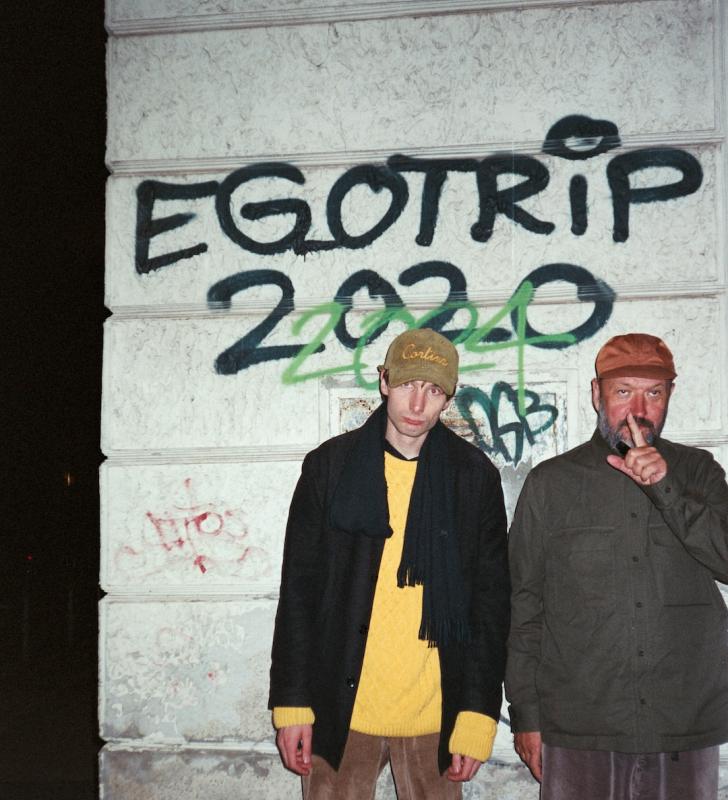
Names: Raul Saaremets aka Ajukaja & Mart Avi
Nationality: Estonian
Current event: Ajukaja & Mart Avi will perform at 2024's Reeperbahn Festival. For more information about the Estonia spotlight of the event and for buying tickets, go here.
Current release: Ajukaja & Mart Avi's “Somewhere in Time” is out via Porridge Bullet.
Recommendations: Music: Michael J. Blood; Artworld: Edith Karlson at the Venice Biennale; Literature: “Japanese Death Poems: Written by Zen Monks and Haiku Poets on the Verge of Death”, compiled by Yoel Hoffmann
If you enjoyed this Ajukaja & Mart Avi interview and would like to stay up to date with their music, visit Ajukaja on Instagram, and Soundcloud; and Mart Avi on Facebook, and Soundcloud.
What were some of your earliest collaborations? How do you look back on them with hindsight?
We’ve been doing this for roughly 13 years without publicly releasing much.
In reality, we’ve got a cellar full of bottled songs. Some are meant to be uncorked on special occasions, while others may never see the light of day. It’s a different approach compared to our other musical endeavours, where we’ve been more open and immediate with our work.
But soon, a rare occasion will call for us to open the cellar doors. In late 2024, we’ll release our double album, Death of Music, through Porridge Bullet. We believe in this record and it will arrive like a howling bullet.
Here’s the title track:
There are many potential models for collaboration, from live performances and jamming/producing in the same room together up to file sharing. Which of these do you prefer – and why?
Our methods are convenient and simple. We rarely think about models, not even supermodels.
Sometimes we make music together and sometimes we don’t. It does involve a lot of back-and-forth file sharing, but it’s important to note that simply hanging out, without doing anything particularly musical, can also inspire songs later on – especially in the lyrics or the tonality of the tracks.
How did this particular collaboration come about? Describe your creative partner in a few words, please.
We’re long-time friends, so it was only natural to happen. Although our starting points couldn’t have been more different as Ajukaja, aka Raul Saaremets, was already a pioneer of the Estonian underground scene (incl. being the founding member of Estonian indie pioneers Röövel Ööbik that Mart was a fan of) when I (Mart Avi) was just a toddler.
By the time we finally met, it was a new century and I was the new kid on the block (as a frontman of artrock group Badass Yuki whose antics caught the attention of Raul). Estonia’s compactness didn’t hurt — those who are meant to meet will meet, so to speak.
What did you know about each other before working together?
A lot.
But most importantly, we knew we could do it. Sometimes certainty can be often elusive, but in our case that’s what matters the most.
Tell me a bit about your current instruments and tools, please. In which way do they support creative exchange and collaborations with others?
Tools are just tools. Even the sharpest scythe is useless in the hands of a bear.
While every exchange is influenced by its means of transmission, cyberspace has significantly accelerated things, eliminating distance as a barrier. However, this increase in speed and efficiency can also weaken creative resolve — much like riders on a carousel, who often end up dizzy and disoriented.
Overall, we've managed to find a good pace in this world.
Before you started making music together, did you in any form exchange concrete ideas, goals, or strategies? Generally speaking, what are your preferences when it comes to planning vs spontaneity in a collaboration?
None of that. When it comes to music, we simply do our best, striking like a twin-clawed scorpion when the time is right. It’s not even spontaneity — more like intuition or instinct, a gut-checked sense of immediacy.
Like that:
Describe the process of working together, please. What was different from your expectations and what did the other add to the music?
We are the music makers, and we are the dreamers of dreams. Sometimes it feels like walking into a pub, other times like stepping into a church.
Here’s a little glimpse from one of our final album sessions that we did in the summer:
After a thorough night out at Mutant Disco (the legendary underground dance/electronic music series co-founded by Ajukaja aka Raul Saaremets), we took a ferry to Ajukaja’s island home in Hiiumaa. Plenty of mousework during the day — editorial decisions, finalising mixes … Ajukaja recorded some final organ bleeps, while also working on a terrific pasta dish. Later on, we had a feast, watched Formula 1 and called it a night.
Is there a piece which shows the different aspects you each contributed to the process particularly clearly?
Here, we summoned some sonic dolphins from Ubatuba, Brazil, where Ajukaja often flies to during the winter to tune in to rare birds. I haven’t been there myself, but I tried to imagine and channel how it might feel like in my vocal delivery.
What tend to be the best collaborations in your opinion – those with artists you have a lot in common with or those where you have more differences? What happens when another musician takes you outside of your comfort zone?
Time is too valuable and life isn’t long enough to intensively or extensively collaborate with people who just aren’t a good fit.
We don’t cling to comfort zones much – it can be satisfying to discover that you are now able to enjoy something you once avoided, whether in the past or in a different context.
Decisions between creatives often work without words. How did this process work in this case?
We listen and speak like humans do. We don’t talk much about our own music, at least not in emotional terms. We simply acknowledge whether something works or doesn’t.
It doesn’t mean we’re detached — many tracks cut us deep. And there’s a lot of music in the world made by others that moves us deeply, makes us weep or prance.
What are your thoughts on the need for compromise vs standing by one's convictions? How did you resolve potential disagreements in this collaboration?
Creative decisions are usually built on mutual trust and the aforementioned certainty that you can really do it. We don’t need or want to compromise for someone else’s sake, so there really isn’t much hassle on that front.
Was/Is this collaboration fun – does it need to be?
We have plenty of fun – see above about the importance of simply hanging out, without doing anything particularly groundbreaking and serious –, but overall fun ain’t so essential.
Both collaborators need to be slightly hungry so they could bake a cake and eat it too.
Do you find that thanks to this collaboration, you changed certain parts of your process or your outlook on certain creative aspects?
As the late, great John Peel used to say about The Fall, 'Always different, always the same.'
That constant pulse of changing and evolving with time and context yet maintaining the very core sums us up pretty well, too.
Collaborating with one's heroes can be a thrill or a cause for panic. Do you have any practical experience with this and what was it like?
We can all be heroes.
Over the years, we’ve both met many influential international artists whose music has played an essential role in our lives. It’s usually easy to connect with them, as we’re all part of the same game we call music.