Published
Name: Alan Niblock
Nationality: Irish
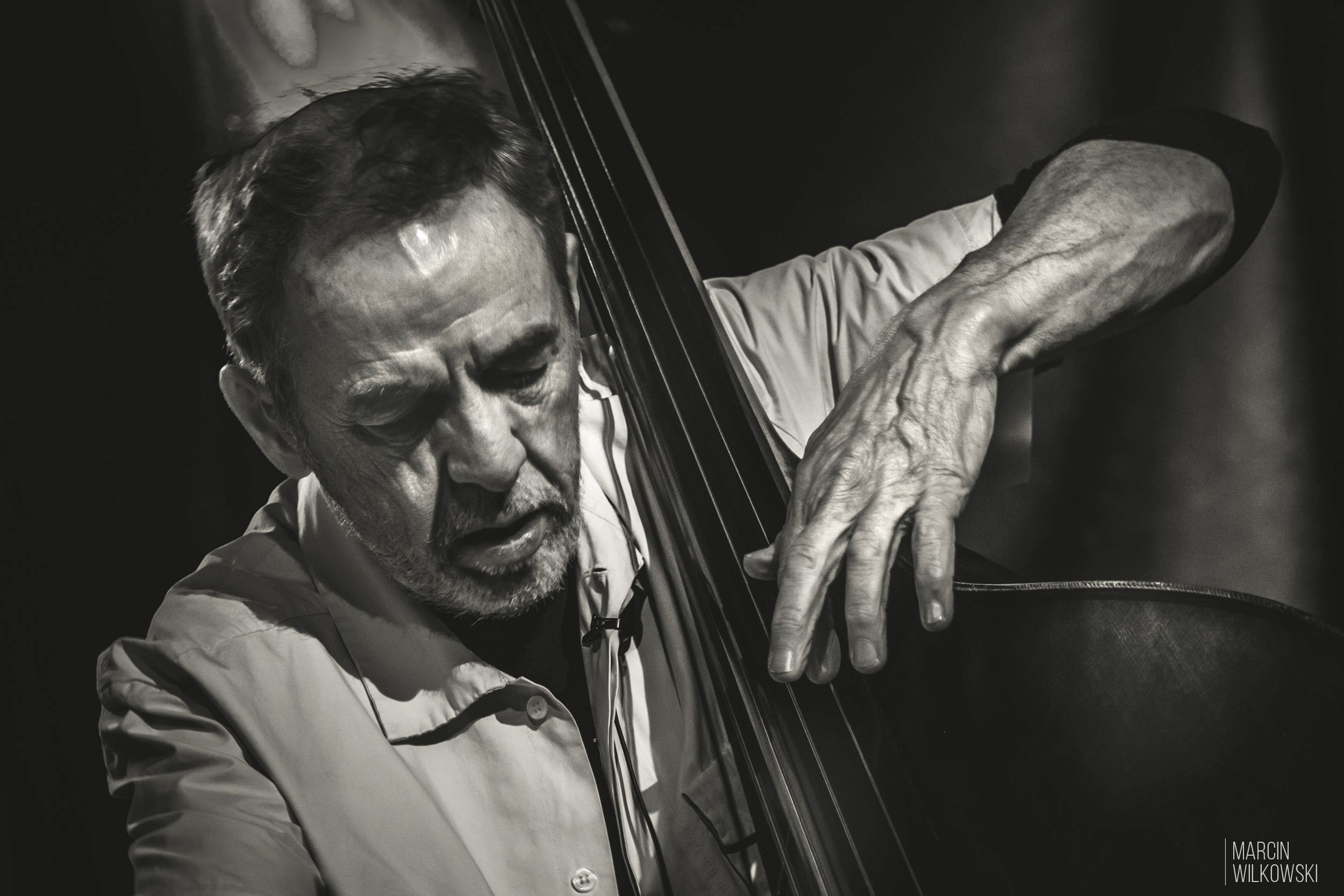
Occupation: Bassist, composer, improviser
Current release: Alan Niblock teams up with John Butcher and Mark Sanders for Tectonic Plates, out via 577.
Global Recommendations: Go to the website of Moving on Music in Belfast for their wonderful live music events!!
Topic I am passionate about but rarely get to talk about: I run 40/50km a week. I started at 60years and it’s become my new norm.
[Read our Mark Sanders interview]
If you enjoyed this Alan Niblock interview and would like to stay up to date with his music, visit him on Instagram, and bandcamp.
When did you first consciously start getting interested in musical improvisation? What was your first improvisation on stage or in the studio and what was the experience like?
Around ‘96, I was offered a session on several educational workshop performances and recordings. This eventually led to the formation of my group Ambient Forces.
Since its inception in 2001 we have recorded four albums in real-time. Our first was entitled the ambience of a particular space, recorded on location in various spaces, such as St Anne’s Cathedral Belfast, Marble Arch Caves Enniskillen and Thornton Dome Armagh Observatory.
This was the beginning of an exciting journey in musical improvisation. Supported by: The National Lottery & Arts Council of N.I.
Tell me about your instrument and/or tools, please. What made you seek it out, what makes it “your” instrument, and what are some of the most important aspects of playing it?
I got my first double bass in ‘78 when I was playing in a guitar trio doing covers, but sadly that didn’t last. My love for a DB was real and it wasn't until ‘92 when the School of Music, Belfast offered a space to practice on an old Boosey & Hawkes intermediate DB. From then it was all practice practice practice!!
You can hear this bass on my early Ambient Forces recordings.
In 2006, The Sound Post Ltd UK offered an endorsement of their Eastman Master Series bass B1035. I was excited and grateful to be an endorsee. An advertisement in Jazzwise magazine soon followed in 2007.
Tom Barrett from Seattle did a wonderful setup. He comes to Galway several months a year. Through time and patience this instrument has become my trusted friend/partner!!
How would you describe your own relationship with your instrument – is it an extension of your self/body, a partner and companion, a creative catalyst, a challenge to be overcome, something else entirely?
My relationship with the DB are all those and more.
The diverse sounds I’m searching for are within the instrument. We search, discover and bring them to life together.
Derek Bailey defined improvising as the search for material which is endlessly transformable. What kind of materials have turned out to be particularly transformable and stimulating for you?
My main focus is on sound as my work continues to evolve around it.
On my last solo album The Water Bearer from 2023 I tuned my double bass to 432hz on track 1 to 6, capturing a deeper soft sound and adding emotional depth …
... and 444hz on track 7 to 12 which delivered a higher, tense sound.
I also explored mixed structures that created a coherent pathway throughout.
I feel taking risks has the power to change everything. It can sometimes be a calculated decision but either way that’s what ultimately makes creativity stimulating for me!!
Do you feel as though there are at least elements of composition and improvisation which are entirely unique to each? Based on your own work or maybe performances or recordings by other artists, do you feel that there are results which could only have happened through one of them?
Yes, I’ve experienced reading various kinds of improvised scores within composition, from abstract imagery to psychological orchestration, as in John Butcher's Dublin Fixations that engaged the entire ensemble in a multifaceted group music. Specified solos, duos and small groupings were woven into the piece.
My solo improvisations can be varied as in my last solo album The Water Bearer. I recorded the album in real-time with spoken word. The words were composed just before the recordings and I improvised both the voice and the double bass together.
This experience felt like they were prearranged but that’s not the case, they were all unique real-time improvisations.
When you're improvising, does it actually feel like you're inventing something on the spot – or are you inventively re-arranging patterns from preparations, practise or previous performances? What balance is there between forgetting and remembering in your work?
I work hard to find my own musical language to improvise and communicate. Exploring new sounds and voices strengthen my individuality, which helps make the improvisations somewhat unique.
I try to forget and try not to remember!! These foundational processes are my pathways to spontaneous creativity.
Artists from all corners of the musical spectrum, not just “free jazz” have emphasised the importance of freedom in their creativity. What defines freedom for your improvisations?
Freedom is fundamental to musical improvisations.
The freedom to discover, to speak, to share, freedom from constraints, to spontaneity, to make change. Freedom to self-expression.
Taking your recent projects, releases, and performances as examples, what, would you say, are the key ideas behind your approach to improvisation?
From a solo perspective my improvisations keep changing. I really like that as it promotes new creativity.
My recent debut trio release Tectonic Plates features John Butcher and Mark Sanders. The album was recorded live in Belfast 2025. My intention was simply to listen and communicate within the collective.
During the performance I found space a wonderful tool for creativity. I sensed that feeling of holding back, creating tension and release to inspire new possibilities. I could go on, but that is the essence of what I try to do
In your best improvisations, do you feel a strong sense of personal presence or do you (or your ego) “disappear”?
My solo work is personal and I feed into that from all directions.
Performing in an ensemble is a shared space and the collective contribution determines when my support is needed.
Who are some of your favourite collaborators and how do they enrich your improvisations?
Musicians such as Lol Coxhill, a beautiful man/musician with an individual voice that transcends. Lol is a wondrous improviser. When performing with him I found myself free to ponder carefully but somehow guided in my improvisations. A national treasure.
Evan Parker is a beautiful spirit with an abundance of talent. I soon realised it was time to get it together. Yeah, I learned a lot from Evan, a true master at work.
Paul Dunmall is simply a powerhouse and lovely man. I felt part of the unit at all times and his playing inspires you to stretch your limitations.
[Read our Paul Dunmall interview]
Mark Sanders is a close friend who I have performed with on several occasions. It's always a pleasure performing with Mark, he makes you listen and he is instinctively supportive. This settled me down to perform a more structured creativity. I deeply respect Mark.
I’ve known John Butcher for some time and got the pleasure to perform and record with him in our most recent release of Tectonic Plates. He is in a class of his own, a true spirit and lovely person to be around. He’s an exciting musician with vast experience. We shared openness, a sense of equality and a sound sharing process dialogue with social cues.
Performing with master improvisers such as these brings you into the real world of musical improvisation. A confidence boosting experience!!
In a live situation, decisions between creatives often work without words. From your experience and current projects, what does this process feel like and how does it work?
No need for words, just a lot of listening required. You will hear the direction the music is going in and you respond accordingly.
In real-time you are part of the music and that’s an exciting place to be. I love it and I care about it!!
Stewart Copeland said: “Listening is where the cool stuff comes from. And that listening thing, magically, turns all of your chops into gold.” What do you listen for?
I don’t intentionally listen for something, I just respond to the sounds or the silence of it.
There can be surprising moments during improvisations – from one of the performers not playing a single note to another shaking up a quiet section with an outburst of noise. Can you tell me about such situations from your own performances and how they impacted the performance?
I welcome surprising moments in musical improvisations as they create pathways to a story not yet told.
I feel the humanity and compassion of all things with regard to improvisations, that’s where the beauty lies. I listen with thoughtful responses.
As a listener, do you also have a preference for improvised music? If so, what is it about this music that you appreciate as part of the audience?
I don’t have a preference but as time moves forward so does my experience and ability to understand improvised music.
I listen for the narrative, the shifting energy and the general flow of things.
In a way, we improvise all the time. In which way is your creative work feeding back and possibly supporting other areas of your life?
Progressing as an improviser makes me happy. It offers a sense of belonging which slowly feeds positivity into my life as a whole.
Life’s what you make it!!