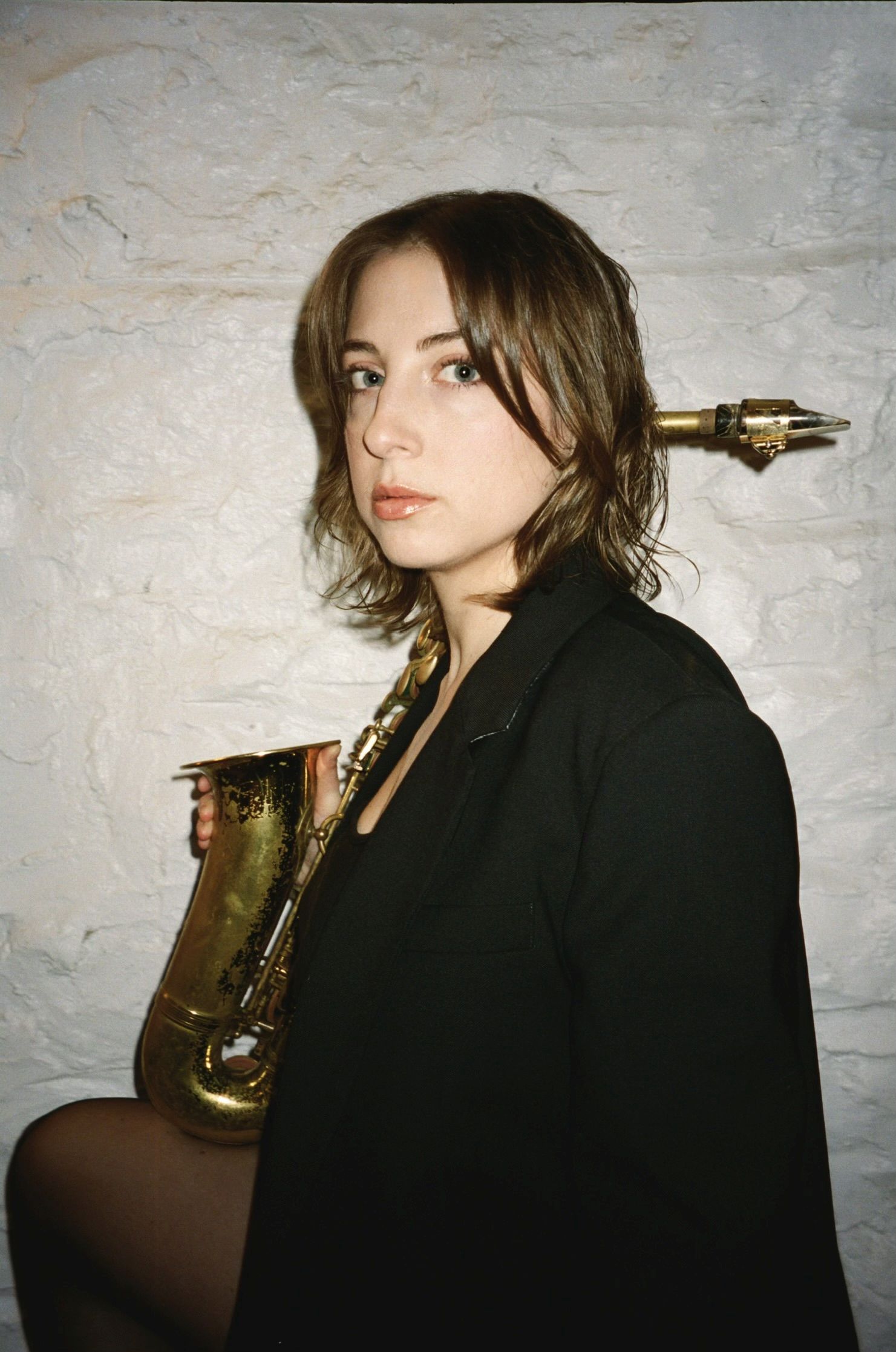
Published
Name: Alden Hellmuth
Nationality: American
Occupation: Saxophonist, composer, improviser
Current release: Alden Hellmuth's Tether LP is out via Nils Frahm's LEITER. Next to Hellmuth on alto saxophone, it features Logan Kane (bass), Miller Wrenn (bass) and Justin Brown (drums). Collaboratos include haana lee (sound design, effects and processing), Paul Cornish (piano), Sharada Shashidhar (voice and effects), Yakiv Tsvietinskyi (trumpet) and Caleb Buchanan (guitar and effects).
Recommendation for New York, USA: Walk! Over the Brooklyn or Williamsburg Bridge - through Central or Prospect Park. New York is such an amazing place to walk without any agenda. My favorite times have been walking through the city, observing the buildings and people. It’s a great way to happen upon something unexpected.
Things I am passionate about but rarely get to talk about: I love architecture and design. I love learning the historical context of buildings / neighborhoods / cities and admiring the carefully ornate details/retro features. I don’t know if it can be considered a passion, but I really love it!
[Read our Nils Frahm interview]
[Read our Paul Cornish interview]
If you enjoyed this Alden Hellmuth interview and would like to know more about her music, visit her official homepage. She is also on Instagram, and bandcamp.
When did you first consciously start getting interested in musical improvisation? What was your first improvisation on stage or in the studio and what was the experience like?
There are these two really defining moments with improvisation that I can remember.
The first was my junior year of high school. I had just transcribed a line from Cannonball Adderley's “On Green Dolphin Street” and successfully used it in my own solo, and in that moment it all made so much sense to me - the language of the music and how to learn it.
The second time, I was in my second year of college and was playing with some friends. I had been working on different major resolutions and when I played it in context it came out in such a unique way, but felt so genuine to what I was hearing - that was the moment I fell in love with the search and discovery.
Tell me about your instrument and/or tools, please. What made you seek it out, what makes it “your” instrument, and what are some of the most important aspects of playing it?
At this point I’ve played saxophone for 20 years and so I feel really connected to it. It genuinely feels like an extension of my voice.
I feel my best when I’m spending time with my instrument and really working through things. It’s a lifelong process / relationship.
How would you describe your own relationship with your instrument – is it an extension of your self/body, a partner and companion, a creative catalyst, a challenge to be overcome, something else entirely?
On the best days it feels like an extension of myself, but like anything, that sense of connection ebbs and flows.
As I mentioned before, I really feel my best (both musically and personally) when I’m spending time practicing. It is like a relationship in that I have to show up for it / myself everyday, whether I’m feeling particularly inspired or not.
Derek Bailey defined improvising as the search for material which is endlessly transformable. What kind of materials have turned to be particularly transformable and stimulating for you?
I love finding new sounds. My favorite type of practice is to sit at the piano, play a chord, and work through all the possible sounds (extensions / tensions) on my horn.
I also make a point to transcribe and analyze short phrases or ideas that excite me. If I can’t transcribe it directly, I’ll take notes. Sometimes it’s a timestamp to transcribe the line later or I’ll explain the idea to my future self (the direction of the line / the arc / the starting and ending points).
I do that same thing with compositional ideas and concepts. It ends up being an interpretation of an interpretation, which leaves a lot of room for discovery and transformation.
Do you feel as though there are at least elements of composition and improvisation which are entirely unique to each? Based on your own work or maybe performances or recordings by other artists, do you feel that there are results which could only have happened through one of them?
I feel my compositional and improvisational voice are absolutely related, but they can be very different.
I’m working on closing the gap between the two (working on playing solo these days), but I also think the level of meticulousness I have with my compositional practice wouldn’t translate well to improvisation. The imperfect is interesting.
Also within the last few years I started using more compositional prompts or systems/limitations, which has brought my pieces to completely new places. I approach soloing in a similar way in practice, but on the bandstand/with improvisation I try to throw the practice away and just play.
When you're improvising, does it actually feel like you're inventing something on the spot – or are you inventively re-arranging patterns from preparations, practise or previous performances? What balance is there between forgetting and remembering in your work?
Definitely a balance, but also ultimately it’s a letting go.
Most musicians will say that the ultimate state of improvisation is when you completely decenter yourself and really listen to the musicians you’re collaborating with. A lot of my practice is centered around the idea that I want to be as prepared as possible to just let go.
Thinking/over-thinking is my downfall as an improviser.
Artists from all corner of the musical spectrum, not just “free jazz” have emphasised the importance of freedom in their creativity. What defines freedom for your improvisations?
To me, freedom means being as present as possible. Acceptance of the moment, an absence of judgement.
Taking your recent projects, releases, and performances as examples, what, would you say, are the key ideas behind your approach to improvisation?
I really try to fuse the written and improvised material.
My favorite music achieves this seamlessness where ideas and improvisations unfold into strands that slowly weave back together and change the shape.
In your best improvisations, do you feel a strong sense of personal presence or do you (or your ego) “disappear”?
At my best, I feel the ego disappear. Always trying to get there.
What are some of your favourite collaborators and how do they enrich your improvisations?
I loved working with the band from this latest record (Logan Kane, Miller Wrenn, Justin Brown). Everyone is so impressive and distinct, but extremely thoughtful about their role in the ensemble.
Paul Cornish (featured on two tracks) is one of my favorite improvisers / collaborators as well - so intuitive and intentional, extremely reactive without playing too much, and constantly feeding the band with ideas.
In New York, I love playing with my band from my first record Good Intentions (Yvonne Rogers, Kanoa Mendenhall, Timothy Angulo). Similarly, there is an intuitive conversation of ideas and a shared understanding of what the music needs in that moment.
In a live situation, decisions between creatives often work without words. From your experience and current projects, what does this process feel like and how does it work?
I think it just takes time.
You develop a relationship with your band and you start to understand the nuances of each musician and person.
Stewart Copeland said: “Listening is where the cool stuff comes from. And that listening thing, magically, turns all of your chops into gold.” What do you listen for?
I think I listen for the unexpected or make me feel something unexpected.
It’s hard to explain, but I guess that’s the magic of music -there are no words to explain that feeling.
There can be surprising moments during improvisations – from one of the performers not playing a single note to another shaking up a quiet section with an outburst of noise. Can you tell me about such situations from your own performances and how they impacted the performance?
Those moments are always really special.
There have been many times I felt I made a weird choice or felt extremely uncomfortable while improvising, but those moments are always the ones that end up sounding the best/most interesting in retrospect.
As a listener, do you also have a preference for improvised music? If so, what is it about this music that you appreciate as part of the audience?
I really appreciate when the improvisers are so connected it sounds as if they are playing written material. That interplay is so special.
I recently saw Sylvie Courvoisier and Wadada Leo Smith play a duo set that was so magical. They way they asserted themselves while listening and making space for the other - it was a real masterclass.
[Read our Wadada Leo Smith interview]
In a way, we improvise all the time. In which way is your creative work feeding back and possibly supporting other areas of your life?
In all ways!
I really feel my best (in all aspects of my life) when I am playing and composing regularly.