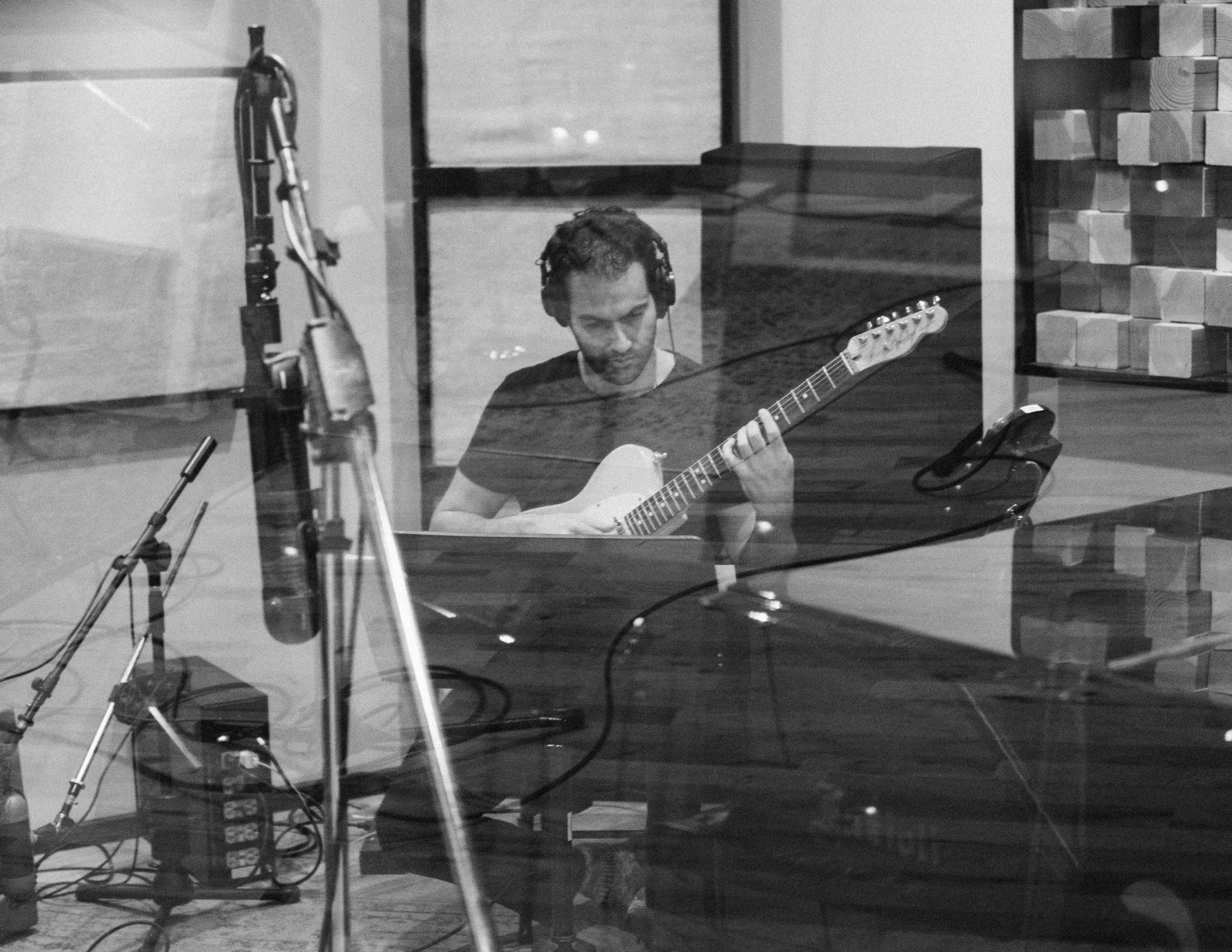
Published
Part 1
Name: Alec Goldfarb
Nationality: American
Occupation: Composer, guitarist
Current Release: Alec Goldfarb's new album Shadows is out via Long Echo. It features, among others, Agnesia Nandasari Nuringtyas, Doyeon Kim, Steven Crammer, Matt Muntz, and Giddeon Forbes.
Recommendations for New York City USA: Visit Closeup for a show! And then go to Jackson Heights or Flushing for food. Queens is the food capital of the world.
If you enjoyed this Alec Goldfarb interview and would like to know more about his music, visit his official homepage. He is also on Instagram, Facebook, and bandcamp.
When did you first start getting interested in the world of alternative tuning systems? Which artists, approaches, albums or performances using alternative tuning systems captured your imagination in the beginning?
I first became interested in alternative tuning systems through Indian classical music, which I began getting into in high school. I was fascinated by how the movable frets on the sitar and precise intonation when bending a string are not just technical choices but deeply expressive tools that serve the mood and atmosphere of each raga.
I can see now how this exposure to tuning as a fluid and expressive concept really planted the seed. I can also link it back to the way my favorite rock guitarists would leave their stamp on a solo with the shape and intonation of their bending, and other ornaments like slides and all that.
Sieh dir diesen Beitrag auf Instagram an
Encountering spectral music in college really expanded my scope and understanding of these things. That opened up a whole new world- thinking about the harmonic series, the physics of sound and our perception, and how different Equal Divisions of the Octave (EDOs) interact with all of that.
That path ultimately led me to explore Just Intonation more seriously.
Microtonal approaches and alternative tuning systems are an integral part of many cultures, and traditions. Which of these do you draw from in your playing – and why?
I’m influenced by so many musical cultures.
But on this album (Shadows) I am exploring threads of southeast Asian classical and folk traditions like Gamelan, Piphat, Chầu văn and cải lương, Lanna folk music, forms of music that accompany martial art forms pencak silat and muay thai, Jathilan, and more; and how these forms have interacted historically with Indian Classical music and beyond.
Shadow Puppet Theatre is something that appears in so many SE Asian cultures and serves as the unifying theme of the album, hence the name Shadows. These musics engage with tuning in so many interesting and beautiful ways!
For Shadows, what did you start with, including your choice of tuning system? If there were conceptual considerations, what were they?
Shadows began with a long-standing curiosity: how can Indian classical music be moved into new ecosystems in a way that feels genuine, not forced? For a long time, that was a hard question to answer.
But then I began looking into the musical histories of Southeast Asia, where Indian classical music had already entered other ecosystems centuries ago. That was my entry point—seeing these traditions as shaped, in part, by Indian influence.
But once I started listening closely, what hooked me wasn’t the historical connection, but their internal logic, their beauty, their uniqueness. I fell in love with the musics themselves.
Tuning systems in SE Asia are incredibly diverse and follow their own sets of logic, goals, and priorities. So, rather than settle on one tuning system from the start, I let the material guide me. The record incorporates Just Intonation, 22-EDO, 24-EDO, 31-EDO.
Various kinds of modal tuning derived from instruments like the gender, rebab, and other ensembles:
Sometimes I transcribed field recordings and retuned around them. Other times I composed within systems that could absorb the tunings I encountered- again like 31-EDO, which captures subtle inflections while remaining flexible enough for harmonization.
I would love to know a little about the feedback you've received from listeners or critics about your music written for different tuning systems. Were there surprising responses, did you perhaps gain new “insights?”
One comment I’ve heard more than once is that the music feels both strange and emotionally direct- like the listener doesn’t know exactly what’s going on harmonically, but they feel something. That’s exciting to me.
I think part of that comes from the tuning- these unfamiliar intervals hit differently, and I always think they hit harder when they’re grounded in real traditions and not just theoretical constructs.
Of course, tuning can be an alienating element to an audience, which is unfortunate, but it’s something I don’t worry about much. Music will always speak to some people and not others.
Terms like consonant and dissonant are used in school, but mostly with very limited understanding of what they mean. How has your own idea of these terms changed over time and how do you see them today?
Changing tuning systems is like shifting perspective. You don’t just hear new intervals- you hear new priorities, new logics, new aesthetics. A fifth in one context is sacred; in another, it’s just a step in a spiral.
The more I work across systems, the more I treat tuning not as a background detail but as a fundamental expressive tool, like timbre or rhythm. It shapes how emotion is felt, how everything is framed and expressed.
It’s everything.
What was your own learning curve / creative development like when it comes to alternative tuning systems - what were challenges and breakthroughs?
I think my path is similar to many others who’ve gotten into tuning.
At first, I was drawn to sounds with this gritty, gnarly, beating quality- things that sounded totally shocking and fresh coming from equal temperament. Like the sruti of komal re (minor second) in Raag Todi vs. Shri Raag, or the huge chords at the start of Grisey’s Partiels.
That visceral difference was what initially hooked me.
But over time, as I began to retrain my ears, it became less about novelty and more about expanding my sense of harmony. You start building a broader palette, hearing new kinds of consonance and dissonance. What does harmonic functionality mean in different contexts? What is the inner logic of each system?
One of the biggest challenges has been adapting all of this to the guitar. That’s still an ongoing process, but I’ve come a long way. I’ve developed my own approach to playing Indian classical music on the guitar, starting with drawing on techniques from instruments like the sarod and sitar, but now encompassing newer sounds like nadaswaram, veena, and more.
I’ve also found a way to play in Just Intonation using standard tuning, relying on bending to hit the intervals and build up bigger chords. That approach feels really good to me—it keeps tuning active and embodied, not just a matter of putting a finger on a fret. And it connects naturally to my Indian classical training, where pitch inflection and microtonal nuance via bending are foregrounded.
It’s been really exciting for me getting to connect these dots more and more.
In how far has working with alternative tuning systems led to creating different music for you personally? Are there creative ideas / pieces which you could not realise in equal temperament?
I always say my favorite tuning systems are Just Intonation and Equal Temperament- but maybe that’s cheating to say!
I find it hard to generalize about the emotional qualities of different systems, because I think there are many paths to the same musical affect. People often say that JI is the most peaceful or reposeful because it eliminates beating between tones—but that’s not always true. Any system can produce that kind of feeling.
Schubert’s Songs Without Words? Messiaen’s Vingt regards? All of Feldman?
There’s a profound stillness in those, and they’re not written in Just Intonation.
That said, one especially interesting tuning system I worked with was during The Tree of Heaven, a project with Josh Mastel, Austin Wulliman, and Daniel Hass.
We were lucky to use a beautiful French double-manual harpsichord, and for tuning we chose a well-established method: 1/4-comma meantone on the lower manual and the same temperament raised by about 38 cents on the upper manual. This approach gives you access to something that approximates both 31-EDO and Just Intonation, while preserving the rich, flavorful sonorities of 1/4-comma meantone.
The guitar and strings played primarily in Just Intonation, and the way those tunings related to the harpsichord created some really compelling harmonic relationships. This was partially inspired by the work of Nicola Vicentino, an Italian theorist and composer in the Renaissance. We will release an album of this music hopefully next year!
Sieh dir diesen Beitrag auf Instagram an
Another important tuning exploration came through my sextet project Fire Lapping at the Creek, with David Leon, Xavier Del Castillo, Zekkereya El-Magharbel, Chris Tordini, and Steven Crammer.
That project traces the hidden roots of the blues, and it opened up a lot of new tuning ideas for me.
I did a mountain of research into the genesis of the blues, tracing it back through the West Central Sudanic belt in Africa and beyond. That led me into a wide range of traditional musics and tuning practices, each with its own emotional and acoustic logic.
For Fire Lapping, I used a scordatura (alternate tuning) on the guitar based on the harmonic series, while the horns played in 24-EDO. But of course, the ensemble used their ears to place pitches, so much of the music lands in a Just Intonation-like space.
That blend of systems—fixed and flexible, theoretical and intuitive—was essential to telling the story I wanted to tell with the sextet.