Published
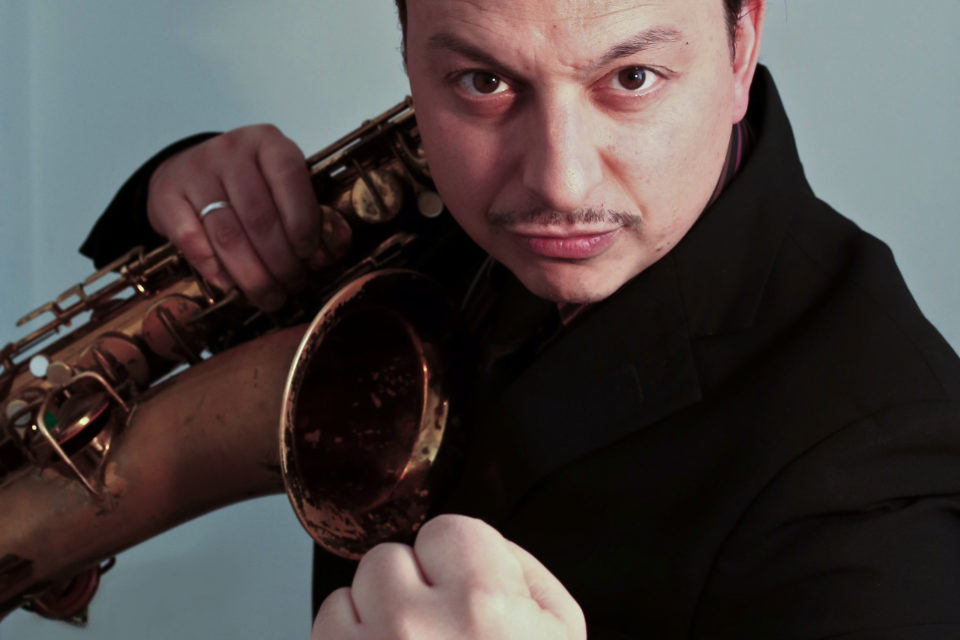
Name: Alex Garnett
Occupation: Saxophonist, composer, improviser
Nationality: British
Current event: Alex Garnett performs with his Quartet at Ladbroke Hall on Friday 4th April as part of their Friday Jazz Series. For more information and tickets, visit their website.
Current release: As part of The Ronnie Scott's Club Quintet, Alex has a new record, 1959, out on Ronnie Scott's very own label.
Recommendation for London: I was born and raised in London and I must say that as far as jazz clubs go the one I owe the most to is Ronnie Scott’s jazz club in Soho. I knew Ronnie Scott personally and also studied his playing, history. I know his journey. He was really a fantastic saxophone player and a great man and really stuck his neck out for other musicians generally. He left behind a legacy that everyone in the UK can be proud of and in fact, put London on the international touring map. He provided a legitimate bridge for the UK to America Europe and beyond.
I’ve been going since 1959 and is really a kind of an institution, the only really great dedicated jazz club in the UK that has stood the test of time. Check it out.
Topic I am passionate about but rarely get to talk about: I’m absolutely crazy about the cosmos, astrology, astronomy, the bigger question, pyramids, human history, all of the above - but we don’t have enough megabytes to get my full answer for that. Maybe another time! LOL
If you enjoyed this Alex Garnett interview and would like to stay up to date with his music, visit his official website. He is also on Facebook.
What were some of the musical experiences which planted a seed for your interest in jazz?
To begin with, my father was a saxophone player himself, quite prolific on the scene in the UK and abroad, straddling the jazz and rock to blues kind of bands of their day. His main passion was saxophone and jazz music.
He was kind of a well-known figure and there were always a lot of musicians in the house, people coming around to rehearse. He was fixing instruments as well so I got to meet a lot of great artists, predominantly jazz musicians.
Sometimes there would be parties at the house that would last for days on end with musicians jamming ... so live music was always in my blood.
What does the term jazz mean today, would you say?
The term for jazz has had a few changes over the years. In terms of the actual music known as ‘jazz’, the label never sat well, and the origin of the word is cloaked in mystery.
Still, essentially we’re talking about the American art form as the root source of improvised music, which spanned everything from New Orleans to Avant-garde. It’s been around 100 years now at least but is not as established as other musical forms.
A lot of people will call anything that has improvised sections ‘jazz’ music - it’s a very wide umbrella. I think it is one of America’s greatest gifts to the world.
As of today, what kind of materials, ideas, and technologies are particularly stimulating for you?
The home recording possibilities these days are amazing.
There was a lot of great stuff going on during Covid as far as being able to create music remotely with different people all around the world particularly and get very high recording qualities in the bedroom, so to speak. Recording equipment keeps getting better, more user-friendly and easier to create into a competitive product.
That also goes hand-in-hand with live streaming which enabled people to watch gigs in some of the most iconic jazz clubs around the world. It’s great to be able to eavesdrop on a completely different scene in another country and see who’s saying what.
This is particularly useful for inspiration rather than being hemmed into your own environment which can be very polarising.
Where do most of your inspirations to create come from – rather from internal impulses or external ones? Which current social / political / ecological or other developments make you feel like you need to respond as an artist?
What we do artistically is obviously affected by different factors and a balance between art and economic survival - the latter is making it harder to dedicate myself to pure art, shall we say.
In some respect, musicians have a responsibility to remember to communicate to an audience. That’s definitely a lost art form as far as the live scene is concerned. Whether people like what you do is neither here nor there to a certain degree, but as far as venues are concerned and generating a following, and contributions to the ‘scene’, I think it always helps to present whatever you do with a feeling of positivity, something good at its core message. Particularly in today’s climate there is so much negative energy out there.
Music is a force for good and jazz particularly, is great escapism, a place where people can elevate above the norm and get away from their problems as it were.
Music has become a lot more global, and incorporating elements from other parts of the world or the musical spectrum is commonplace. Do you still think there are city scenes with a distinct, unique sound? How does your local scene influence your work?
The local scene nowadays is highly influenced by three major colleges which are involved in intensive jazz courses.
They produce subsequent generations of musicians who grow up together, learning together, practising together and creating their own microscenes. Sometimes these scenes do crossover but these musicians are also highly influenced by each college's ethos, they have their own sound and approach. Each one is different according to the leanings of the teachers involved and their influences.
London also has a major influence on the way people play because there is enormous economic pressure to be able to stay in the city like this. It’s so expensive unfortunately, we still lose a lot of our great youthful musicians to Europe and America but less so. It’s hard to become a household name in your own country as far as the UK is concerned and as always homegrown talent is always taken a little bit for granted.
We have our own Jazz Masters but a lot of the originators and masters connected to that favourite European continent rather than the UK as a place to settle so I guess in certain respects we’ve generated our own scene and our own sound which is less directly influenced by that fact. Now things are slightly different with access to information via the vast data bank of the Internet but even so, British jazz has always had a different flavour which is a good thing it seems.
What role do electronic tools and instruments play for your creative process?
Digital recording provides a lot more scope to be creative, but sometimes too much of a good thing can be also bad in jazz. There is always an edge to something more spontaneous and immediate so a lot of people are going back to the old techniques of recording to rekindle that vibe.
I think live gigs are now more important than ever - there is so much music out there now because it is getting easier and easier to produce, but the content still has to be good. It’s no good releasing something just for the sake of profile or feeling you’re saying something just for the sake of it.
Still, I find being able to record myself well and do a bit of production at home allows me to work on composition in a completely different way. I think a lot of people are finding that and it’s leading to some very ambitious projects which would be otherwise financially impossible in a conventional studio setting.
Thanks to technological advances, collaboration has become a lot easier. What have been some of the most fruitful collaborations for you recently and what approaches to and modes of collaboration currently seem best to you?
During lockdown I was able to join in a few overdubbing streaming sessions that eventually led to the creation of an album. I did an online track with a young blade called Tom Smith who eventually expanded it into a full bigband album which we have just completed and is being released.
The band has since headlined at some great clubs, too, and looks like it will even be making a second album in the coming year. It was spawned out of having to find ways to keep the music alive when all the clubs were shut and was a positive outcome from those oppressive times.
Jazz has always had an interesting relationship between honouring its roots and exploring the unknown. What does the balance between these two poles look like in your music?
Some say there doesn’t seem to be a lot in Jazz that hasn’t already been done in one way or another but the beautiful thing about it is everyone has their own angle on it. As much as I am influenced by the iconic jazz greats, I’ll always end up sounding like myself.
As long as you nurture that but stay true to the things that turn you on as a musician, hopefully, that will come across in your music.
How much potential for something “new” is there still in jazz? What could this “new” look like?
Every so often in life you get people who come along who are innovators, leaders or catalysts and create a fundamental change to a certain branch of the Jazz tree - Charlie Parker, Miles Davis, Louis Armstrong, Coltrane, Sonny Rollins, Ornette Coleman, Mingus, Brubeck to mention a few.
Indeed, everyone involved in art is a part of the puzzle and also a part of its potential. Jazz has always found meaning and borrowed from many, many sources from the classical world through to African and Asian rhythms and beyond. We also need supporters too. Listeners, people who can enjoy and proliferate the message.
Sometimes things are rediscovered that happened many years ago that are suddenly relevant again or remained undocumented or dormant as it were until they reemerge at a particular point in time. I don’t think there’s anything such as ‘pure jazz’, it’s always been a fusion and a mix of sources which is its strength.
Jazz is still finding its way. New forms must also stand the test of time, fads come and go. Jazz will always find a way to survive and prevail that’s my belief anyway.
For many artists, life-changing musical experiences take place live. How do you see that yourself?
Well, we’re living, aren’t we? I think that live music is the best form. At least one of the greatest ways of being immersed in it, it’s all about feelings of course which is hard to transmit through audio alone.
Listening and performing in the collective is also a living experience. I guess with that in mind some of my favourite records are live recordings.
How, would you say are your live performances and your recording projects connected at the moment? How do they mutually influence and feed off each other?
Funnily enough, I’m not an overly prolific recorder of my own music.
I’ve done a lot of stuff as a side man. Extremely varied musically on various musical instruments. I like playing the ultimate sidemen it seems to suit my personality, even though I don’t mind leading a band and love performing in front of a crowd. I always seem to enjoy myself more at other people’s parties and in that sense, I’m more relaxed about how I present myself as a hired artist.
I have taken to recording myself a lot on gigs to add a little bit of pressure to my performance for my own reasons to try and get used to having the red light on as it were. Hopefully that gives me a little bit more experience to bring that level of immediacy and spontaneity to any future recording projects, especially of my own.
Improvisation is obviously an essential element of jazz, but I would assume that just like composition, it is transforming. How do you feel has the role of improvisation changed in jazz?
That’s a tough question really. But one thing I can observe is that the levels of ability are extremely high in students, probably higher than they’ve ever been overall.
Maybe this is due to competition but also access to information and the way people practice has led to greater expectations in ability. It’s now the norm to be able to play with the full dexterity and range of high-level classical musicians and to be able to operate in unusual time signatures and have a complex harmonic knowledge as standard. Seems to be expected of young musicians.
But still - the soul is the message that cannot be learnt and that has to be lived. When I hear young musicians these days it terrifies me and I think “my God I really need to practice”, it keeps me on my toes. But there are not so many that when I hear them, makes me feel that I want to play!!
What, would you say, are the key ideas behind your approach to improvisation?
Sound is everything. That dictates my concept and evokes ideas. I’m trying to use more space and interact more rhythmically with my band. With technique comes the burden of overplaying which I personally suffer in my playing.
Generally, though, I try to assert my sound first, then I can play less with more impact. I also practice playing more than I practice scales and patterns and keep my ears sharp. Listening is a vital part of playing.
Accepting work outside of my comfort zone keeps me focused.
Are there approaches, artists, festivals, labels, spaces or anyone/-thing else out there who you feel deserve a shout out for taking jazz into the future?
Another tough question but I guess it should be approached philosophically. The future is now so that anybody that is involved in this art form is essentially carrying the message forward and perpetuating its presence and existence.
It takes a certain amount of risk and faith to try and make it in this business. Stay focused and broad shoulders for disappointment and you’ll see how rewarding jazz is.
The Montreux Festival intends to preserve its archive of recordings for future generations. Do you personally feels it's important that everything should remain available forever - or is there something to be said for letting beautiful moments pass and linger in the memories of those that experienced them?
I don’t think everything should be slavishly recorded per se. Some artists play differently when under the spotlight, but now the archives are virtual you’re not taking up warehouses with tapes etc ...why not?
Art is still hanging on the walls of museums around the world bringing an experience to countless new generations - better than hanging in somebody’s bathroom or worse still locked in a bank vault.
Once the vibrations are out there, it should be everyone’s to share and enjoy or use as they see fit for the greater good.