Published
Name: Alex Remzi
Nationality: American-German
Occupation: Founder of several bars in Berlin, founder at Old Well Distillery, music organiser and curator
Current Event: The 8mm Festival, organised by Alex Remzi and his team, will take place at the 8mm Bar, Zionskirche, ACUD macht Neu, Kesselhaus and Maschinenhaus in Berlin October 10th & 11th 2025. The line-up includes A Place To Bury Stangers, Snapped Ankles, Divide And Dissolve, Zahn, Test Plan, Sexverbot and RIP Swirl. For more information and tickets, go here.
[Read our A Place To Bury Strangers interview]
[Read our Zahn interview]
What do you remember about the very first edition of the festival?
Not a whole lot. Those nights at Bassy were always foggy.
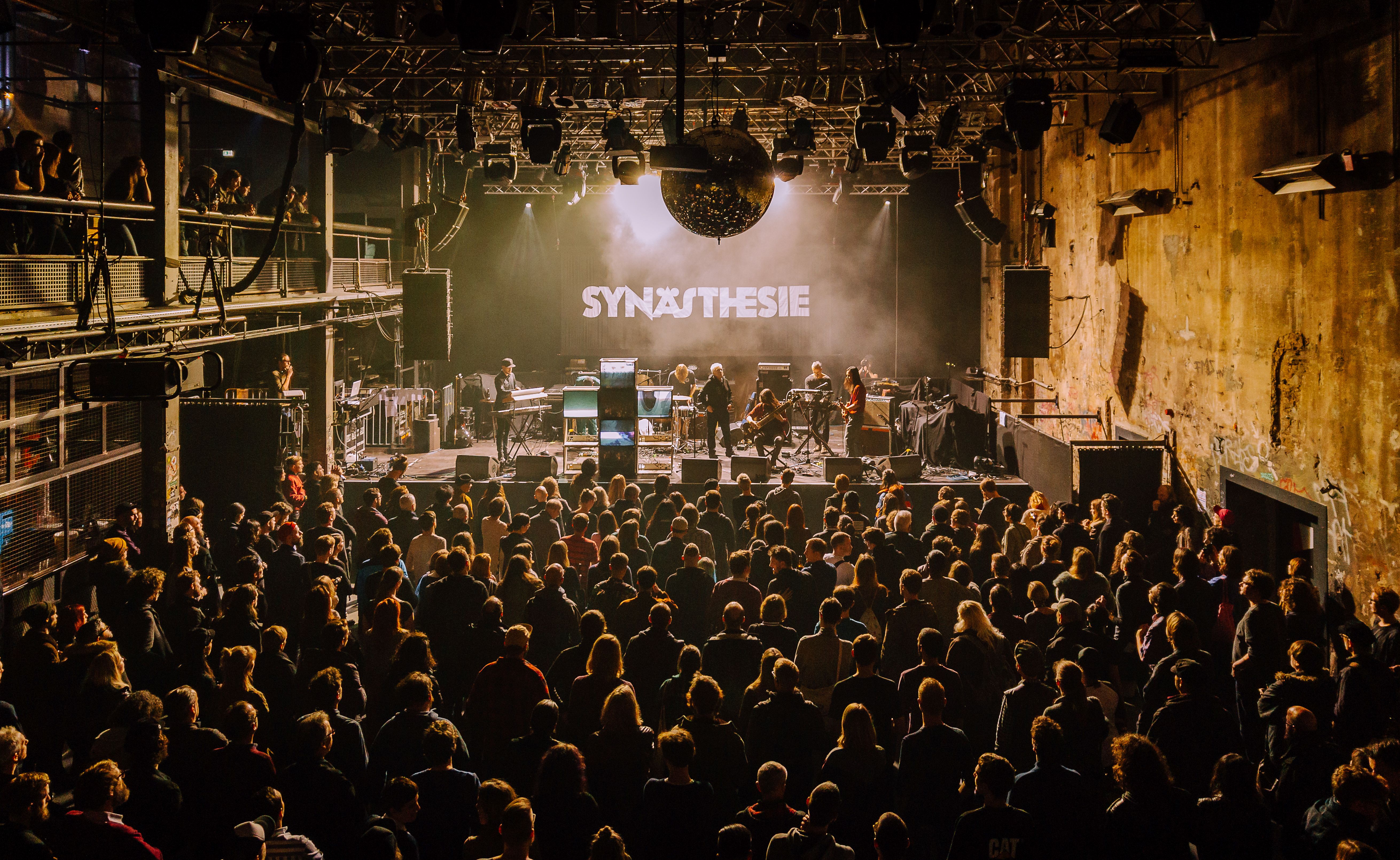
There were 3 of them, one week apart and we had some incredible bands including The Warlocks, Lumerians, Crocodiles. It was the next step from our 8MM Musik Nights series.
We did 50 of those, but this felt like it was the start of something new, a big next step. And it was. Synästhesie was born.
Can you tell me just a little bit about the 8mm bar which forms the spiritual core of the events?
8MM is special in its simplicity, it's nothing special, and people who don’t get the music won’t understand the fuss.
But it’s those who do that often go out and start new bands and make interesting new things.
How does the festival relate to the bar?
8MM is just the ice-breaker, and every healthy music scene needs that. The festival is a projection of that into the outside world.
The line-up you've put together for this year once again looks fantastic.
Thank you!
What are main differences between the 8mm Festival compared to Synästhesie and how did you approach the programming?
In a word: Budget. We haven’t received funding in 3 years, and in Berlin where every festival lives off funding it's pretty hard to stay afloat. But we always find a way to make something happen. Sometimes we just need to change the name a little!
I think what we are also trying to say with it is that 8MM has been a pillar of a diverse underground music scene for almost 25 years now, and we are still doing it our own DIY way.
8mm has entered a collaboration with New Colossus Festival. What's your impression of how New York and Berlin compare when it comes to their creative scenes, the importance awarded to the arts, and their approaches to supporting local scenes?
As far as I can tell it’s pretty opposite starting points.
Festivals like New Colossus in NYC don’t get any government funding and have to find a way to make it work by teaming up with venues who in turn live off selling drinks to the audiences the promoters bring. They don’t pay extra rent to venues, their rent is the work they do promoting the shows and getting audiences in the door. That’s the principle I brought to 8MM, where the bands get all of the door fees once we paid the sound engineer.
As far as our festival is concerned, after artist fees, the biggest part of our budget is renting the venues. But in Berlin most venues are subsidised, and some big venues have their venues set up as separate businesses so they can show hardship in order to receive funding.
Venues nor promoters make enough by ticket sales alone. They run the bar as a separate business for profit. Makes sense given the system, but as a promoter it makes it hard to have a fair business negotiation. In turn it makes it hard for young independent concert promoters to get a start when you have these big upfront costs. The rent is a significant hurdle.
Don’t get me wrong, it sucks in America just as bad with no funding and everything being super commercial by necessity and televisions everywhere you look in bars.
What, do you feel, are the things that local bands need most to thrive and grow?
I think Germany is a little bit of a black hole for bands. Bands used to move to Berlin because it was cheap and you could do whatever you want but careerwise its kind of a dead end. Now the rent isn’t even cheap.
As far as the German music industry is concerned, I often don’t know what these people are hearing when they listen to music. They don’t support the right bands for the right reasons as far as I am concerned. I think the success ratio for (non-electronic/techno) bands coming from the 8MM scene internationally is about as high as the entirety of the rest of the German music industry. But I have no data to back up that claim. I'm sure I am wrong, but probably not as much as you’d imagine.
Anyway, for whatever good it does, we try to use our influence to help the bands we like get some exposure in new places. Historically bands thrive off of cheap rent and beer.
How would you describe the importance of providing a physical space for music and the difficulties of providing this space in urban cities with, as you indicated, increasingly unrealistic rents?
Physical space to perform in a community is pretty goddamn important. If you want there to be music free of the big labels, they are essential and they fulfil many functions. It’s a stage, a meeting place, an escape and a place to take in genuine culture real time while supporting these artists who are devoting thankless hours honing their craft.
I think spaces like these are getting harder to justify financially as it seems more and more people live through their screens. But there will always be a core group of people that will understand the importance of these physical spaces.
Neighbours and rising rents are serious threats. To be honest it's never been easy and it feels like you are constantly dancing on a tightrope. Trying to keep sleep-challenged neighbours from calling the cops, finding a way to pay the rent through selling drinks, while catering to a crowd that is perennially broke.
It's not easy, but it’s a great and important role. At least when you get a chance to step away from it and see it from the outside.
The website of the festival speaks about “a particular East German music tradition” around which everything grows. How would you describe it?
When I started the bar, Prenzlauer Berg was still a very East German neighbourhood. Sure the gentrification had begun, and we certainly didn’t help with that, but I also found it very important to assimilate into our surroundings. As a child of immigrants you are always trying to fit in without rocking the boat.
Since I was coming back to Germany from America, and a lot of my friends spoke English, we had this reputation as an expat bar. But for me the defining moment was when I connected to the author and Ost-Punk documentarian Henryk Gericke, and he and his friends accepted us into the community. And this was done through a shared love of music. I learned a lot about the neighbourhood through that and an appreciation for what came before.
I include that as a major influence on 8MM, and it is why including the Zionskirche as a venue this year has such a deep meaning and is an honour for me. Look up Zionskirche in Berlin and the East German punk scene and you see what I mean.
The website also describes the experience of performances at the festival as making audience and bands become one. What does that look like in practise?
I think the fact that the vibe is such that the bands generally enjoy themselves enough to come out and join the party, and that most of the audience look like they should be in bands.
Most of them probably are.
Over the years, bands like Stereolab, Slowdive and Michael Rother have performed at Synästhesie … What are some of your favourite memories from a decade of performances?
Spiritualized was and will always be the memory I cling to. The arc of Jason Pierce as a musician and far as I can tell as a person has been an inspiration to me. Not because I wanted to make music, but the development.
I worked for several years to finally get them back to Germany (after 15 years!) and then it finally worked and we needed to make the festival a little bigger to do it. It's not often your childhood idols are actually that cool in person, but he was and it was nice having a drink with him after the show, where you could tell that the show and the audience made his night.
The moment I will never forget is getting locked in the smoking section of Kesselhaus with Luis Vasquez at the end of the night they headlined. We were stranded there, dumbfounded for 15 minutes until security unlocked the door. We weren’t even smoking.
Also a sweet guy and great musician that we sorely miss.