Published
Name: Alexandra Hamilton-Ayres
Nationality: Belgian
Occupation: Composer, sound artist
Current Release: Alexandra Hamilton-Ayres's new album Lucid Distance is out via INNI.
Recommendation for Bath, UK: The Bath skyline walk.
Topic I am passionate about but rarely get to talk about: In relation to my work - the visual aspect - all of the covers of my records have artwork that are hugely significant to place and time of experience.
Shoutouts: I think the scene is pretty safe at the moment though I always love the line up of Hidden Notes.
If you enjoyed these thoughts by Alexandra Hamilton-Ayres and would like to stay up to date with her music, visit her official homepage. She is also on Instagram, Soundcloud, and bandcamp.
For a deeper dive, read our earlier Alexandra Hamilton-Ayres interview.
The borders between producers, sound artists, and even songwriters are becoming increasingly blurry. What does being a composer mean today, would you say?
I think for me as an artist it’s expressing myself through music and sound.
No one wants to label themself particularly as this or that. Composer is a word I feel that helps explain to other people what you do, but the finer details vary so much when I think of what me and my friends are up to.
Many people perceive classical music and contemporary composition as having high barriers of entrance, both for listeners and musicians. What have your own experiences been in this regard?
I think there is a really stuffy side to classical music and it’s one of those things that I personally feel like I wanted to seek approval from for so long (for example having just written and workshopped my first opera) because I was brought up with that being THE classical music scene.
But now that world is dissolving a bit more into something fluid. There’s also now the commercial side of classical music which is the more corporate safe approach - honestly, I won’t hide that I really like listening to Classic FM when I’m not writing and I am sure I take influence from that.
Yes, they play mostly men and a small playlist of the same tracks, but it’s what I grew up with at my parent’s house and gives me a feeling of home. Take me into my headphones and into deep listening and I am in a completely different world - more experimental, emotional and harder beats depending on the day - but music more for my own headspace than what I would inflict on my family!
As of today, what kind of materials, ideas, and technologies are particularly stimulating for you?
I am interested in novel approaches and sounds. I like interesting stories and am more often than not surrounded by university professors forming novel ideas in science - so that is always interesting.
I think new classical has been stuck in a rut for a few years so it needs composers coming out of it and taking risks to try other things which just isn’t happening on the bigger labels and why I am so thankful for INNI’s and the PRS Foundation support.
I was fully prepared for this project idea to fail, but had to try!
Where do most of your inspirations to create come from – rather from internal impulses or external ones? Which current social / political / ecological or other developments make you feel like you need to respond as an artist?
Internal. So internal I don’t really understand them until the process is finished. Usually something happens and I feel the urge to write about it to make myself feel better. I can’t explain. It’s never really for anyone else unless I am collaborating with another artist.
Of my solo projects 19-88 was like a sort of birth into the music industry for me as a first release as an artist. 2 Years Stranger helped me deal with an episode when my dad went into a Coma and Play Echoes was written with my feelings around emptying my childhood home and a patchwork of memories.
Lucid Distance gave me a space to deal with depression, grief around a friend’s suicide and upcoming motherhood but I didn’t know it until I finished it.
There were moments when creating the album where for example for “Lifeform,” I recorded the doppler recording of my daughter’s heartbeat in the womb.
The first time we heard it and the first thing I did getting back from the midwife appointment was import this into a DAW and start playing with the sound because I was so fascinated you could have 2 separate rhythms in one living thing.
I guess it’s all just sort of becoming a portrait of my life. We all go through phases and I see these albums as answering different phases. I am definitely not the person I was 3 years back and maybe this album helped me with that.
Composing has always had an interesting relationship between honouring its roots and exploring the unknown. What does the balance between these two poles look like in your music?
I love the balance between traditional and new and honoured that I can use as much or as little classical music theory in my work as I like thanks to a rigid classical background.
I love to improvise live and in the studio. I think recordings are only really ever snapshots of a piece at that moment. Like a photograph capturing a person. I really enjoy breaking down this myth of strong composer intention when working with classically trained performers as I believe performers have much more to give than replicating a precise notation.
So it is such a gift to be able to open conversations around emotion and sentiment and really live through ideas with performers - particularly Alexander Parsons, Freddie Prest and Kezia Tomsett on Lucid Distance.
How much potential for something “new” is there still in composition? What could this “new” look like?
This is what I was trying to search for in my upcoming Lucid Distance album. I find it boring that a lot of music is recorded in the same spaces, using the same engineers, the same set up, the same instruments. Why not chase something different?
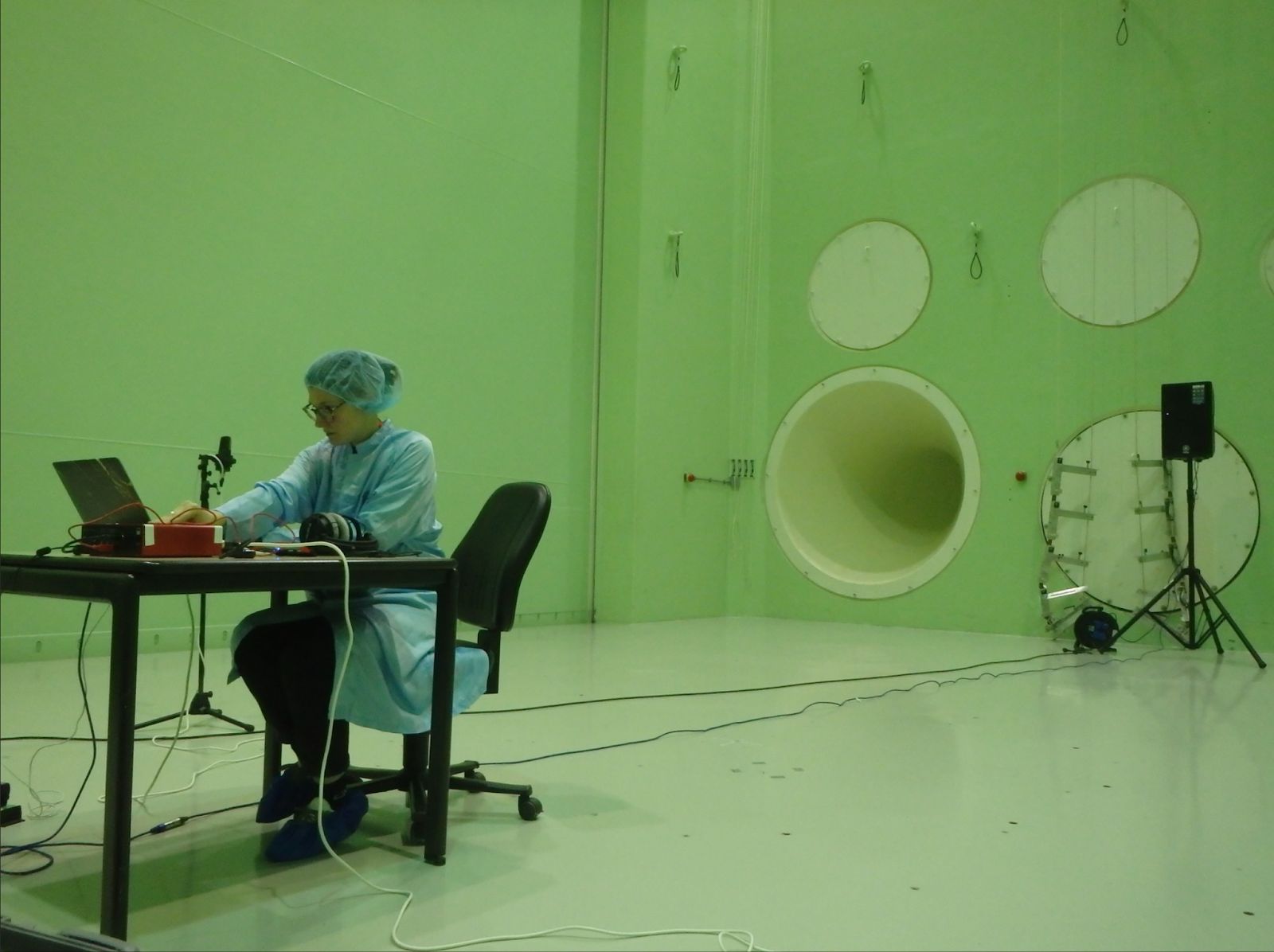
I wanted to explore how distance in music could be taken to the extreme and used as an instrument itself by re-amping the largest ever reverb chamber in Europe for the very first time and using it as an instrument. I’m proud of this album for being first in doing that!
What role do electronic tools and instruments play for your creative process? What does your creative space / studio look like and what tools does it contain?
Not sure I could list what’s in my studio. I do use a fair few synths.
In particular for this album I used my organ which you can hear a lot in “Into Darkness” and a Roland Aerophone borrowed from a lovely artist, Tawiah.
There’s a lot of things new and old here - I am looking around as I write haha. The space is lined with books, art, art supplies and various memorabilia from my life.
Actually I hope to do more art as part of my creative process and was proud of doing the graphics solo for this project. I used to paint a lot. And most of the paintings in my studio are either mine or my grandmas.
It is my impression that adding a conceptual, non-musical dimension to one's work is almost a prerequisite for commissions and grants. How do you view this tendency and how “conceptual” is your own approach to writing?
For me it is nothing to do with adding on a concept for the sake of grant writing. For which I actually have to thank Ellie Giles because trying to formulate what I wanted to do into bullet points as an artist is no easy feat. In fact I think it is one of the hardest things to do as an artist, to constantly try to sell your ideas. Especially if they come from a challenging mental place.
A concept for me is often part of the album creation and allows me to deep dive into a world. If you write a book you have a general outline so why not an album. I think it’s like going into a therapy session and outlining the things you want to work through. That evolves into a bigger thing eventually, but you still have an initial something you want to discover and loose ends that come together.
I like telling stories as a means for letting go of something I can’t express and in this album’s case it was a lot of pain and a desire for escapism. The last couple of albums were also from very vivid experiences I needed to channel somehow into a bigger concept. It helps me get my head around what I am dealing with in life sonically and visually.
Working with long forms, complex concepts or new vocabulary is potentially more challenging today because they require us to remember things that happened perhaps minutes ago – while most of us are finding it hard to focus even on what's happening right now. Both as a composer and as a listener yourself, how do you deal with this?
Writing music requires deep focus for me. I never expect to be remembering everything at once, but if something effects me strongly, it doesn’t get buried quickly.
Time and space in my own mind to think, is a huge part of the process. We are surrounded now by so much noise that doesn’t really matter so it’s important to let go of that to fully access my own mind.
For many artists, life-changing musical experiences take place live. Few works these days, however, are performed beyond their premiere. What, do you feel, does this mean for composers, and the music they write, and how does this reality influence your own work?
There’s a lot of tokenism in the industry giving everyone their 5 mins of interest in a sad tickbox process, but if something is worth another listen / commission / performance it happens.
Creating an album or recording allows access to a moment in time for something, whereas the concert world is very different. The brain chemistry involved with the live world is much stronger than the recording world, so it’s easy to see how it is so important to composer’s careers.
I also think though in the new classical world, so often solo artists are expected to just go out and play a combination of piano/synths on stage and basically fund it themselves in relation to a recording where some records are better off taking a completely new iteration live.
How, would you say are live performances of your music and your recording projects connected at the moment? How do they mutually influence and feed off each other?
Maybe a better question is between film work and artist work which often seem to feed well off each other - one defining my sound world which helps me pitch on films and find directors that really resonate with my work - makes more of a project than just replacing temp.
When I play live I improvise just as much as I do in recorded work - both are really a moment of that piece of music. I feel that music compositions change over time, just as I change perspective on what I experienced perhaps.
To some, the advent of AI and 'intelligent' composing tools offers potential for machines to contribute to the creative process. What are your hopes, fears, expectations and possible concrete plans in this regard?
I dislike AI and it has no place for me in my creations, but I think it encourages strong minds opposed to it to be individual and question their own originality.
The Montreux Festival intends to preserve its archive of recordings for future generations. Do you personally feels it's important that everything should remain available forever - or is there something to be said for letting beautiful moments pass and linger in the memories of those that experienced them?
I would love to perform at Montreux haha - tell my booking agent :)
I think great work should be archived if possible, but if it gets lost it’s usually for a reason. With live performances, it should be about being present in the moment. No phone footage on social media is going to recreate that visceral experience, either on stage or in the audience.
Having said that there are some live performance recordings of tracks that really do just work so well and make great vinyl.
So ... both ?