Published
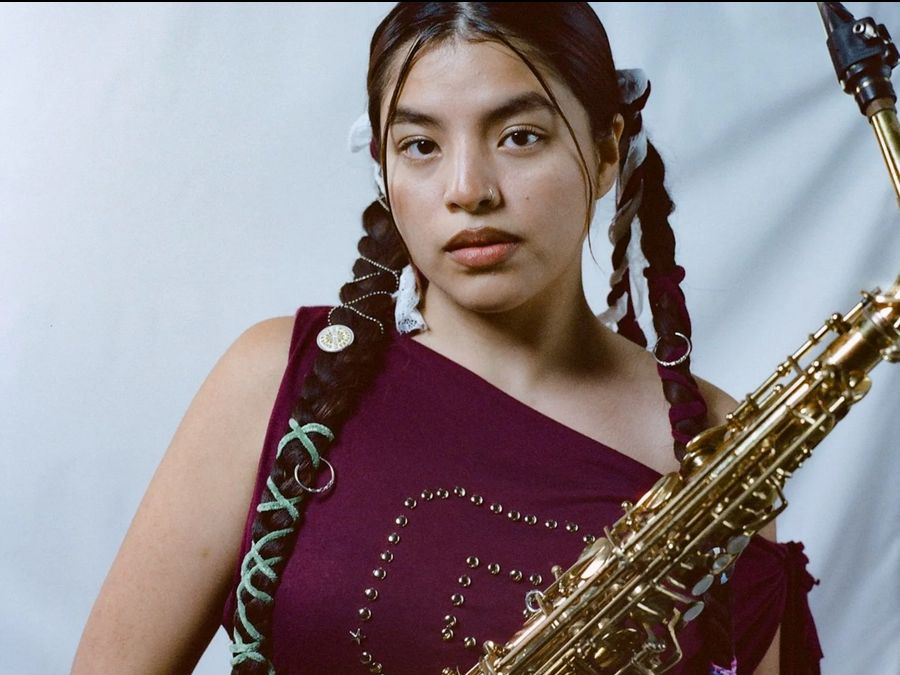
Name: Allexa Nava
Nationality: Peruvian, London-based
Occupation: Saxophonist, flautist, composer,
Current event: Allexa Nava is one of the artists featured in this year's La Linea festival. For more information and tickets, go here.
Current release: Allexa Nava's latest release is the No Language EP, out via Jazz Re:Freshed.
If you enjoyed this Allexa Nava interview and would like to stay up to date with her music and upcoming live dates, visit her official homepage. She is also on Instagram, Facebook, and bandcamp.
When did you first consciously start getting interested in musical improvisation? What was your first improvisation on stage or in the studio and what was the experience like?
I first became consciously interested in improvisation when I was studying at the conservatoire in Peru. We had a class called Musical Appreciation, where we’d listen to different kinds of music and discuss them openly. It became my favourite class. It felt less about “right or wrong” and more about listening and responding.
I remember we listened to a lot of film scores, especially Pixar soundtracks and there were moments where the you could hear the saxophone in some of them and it would mostly improvise over the orchestra. (ex. The Incredibles) That was the first time I thought, “I want to be able to do that!”
My first improvisation on stage was messy. I had been classically trained, so I was used to following a score. I remember trying to look calm, but inside I felt completely exposed. My fingers didn’t flow naturally because my mind was racing.
But even though it wasn’t polished, it was the first time I stepped outside the safety of the page.
Tell me about your instrument and/or tools, please. What made you seek it out, what makes it “your” instrument, and what are some of the most important aspects of playing it?
I actually didn’t choose the saxophone, I guess it chose me.
When I was at school, we were trying out instruments for the school band. The options were trumpet, clarinet or saxophone. I remember picking up the clarinet and barely being able to make a sound. The same thing happened with the trumpet. Then I tried the saxophone and a sound came out almost immediately.
Over time, that accessibility turned into something deeper. I play different saxophones, but the alto has always felt like home.
How would you describe your own relationship with your instrument – is it an extension of your self/body, a partner and companion, a creative catalyst, a challenge to be overcome, something else entirely?
I would definitely describe my saxophone as an extension of my body.
I’ve been playing the same horn for years and I know it so well. I know which notes tend to sit slightly sharp or flat, and I instinctively adjust without even thinking about it. I have my own alternative fingerings, little adjustments that feel automatic now. It’s autopilot. Every horn has its quirks, and I know mine inside out.
At the same time, it’s not like I’ve “figured it out.” completely. There are still altissimo notes that challenge me, still sounds I’m trying to access. But I actually love that.
So it feels like an extension of me, but also an ongoing exploration. There’s comfort, but there’s always more to discover.
Derek Bailey defined improvising as the search for material which is endlessly transformable. What kind of materials have turned to be particularly transformable and stimulating for you?
For me, transformable material often begins with something very small.
I’m drawn to melodic motifs that can be reshaped in multiple ways. A simple fragment can be rhythmically displaced, stretched across different registers and more.
Rhythmic material is equally stimulating because I tend to listen closely to drums. Tone also plays a big role for me. The same material can feel entirely different depending on articulation, dynamics, or intensity. In that sense, transformation isn’t always about new notes.
Do you feel as though there are at least elements of composition and improvisation which are entirely unique to each? Based on your own work or maybe performances or recordings by other artists, do you feel that there are results which could only have happened through one of them?
For me, composition has always come from exploration.
When I was a student, I used to listen obsessively to pieces I loved. If a song really stayed with me, I would analyse its shape, the form, the pacing and then try to create something of my own that followed a similar structure, but with different harmony and melodic ideas. It wasn’t about copying; it was about understanding how something was built, and then experimenting within that framework.
I rarely start with chords. Melody usually comes first for me. Many of my pieces have gone through several transformations before reaching their final version. They evolve through trial. Improvisation feels different. Even if you have vocabulary or certain phrases in your ear, it ultimately exists in the present moment. It responds to the room, the band, your emotional state.
So while composition and improvisation feed each other in my work, they produce different kinds of results. Composition allows me to build and refine. Improvisation demands presence and risk.
When you're improvising, does it actually feel like you're inventing something on the spot – or are you inventively re-arranging patterns from preparations, practise or previous performances? What balance is there between forgetting and remembering in your work?
When I improvise now, I genuinely try to invent something in the moment.
When I was younger, I was much more deliberate in a different way. I would practice specific lines or ideas at home and then consciously bring them to the gig. I think most jazz musicians know exactly what that phase feels like.
Over time, especially through playing my own music and performing regularly, I’m less interested in executing something I’ve already worked out and more interested in discovering something new.
Artists from all corner of the musical spectrum, not just “free jazz” have emphasised the importance of freedom in their creativity. What defines freedom for your improvisations?
For me, freedom in improvisation begins when I stop worrying about being “correct.”
Coming from music school, you’re taught to approach things a certain way and I value that deeply. There’s real importance in understanding harmony, language, and tradition. You need to learn the foundations before you can meaningfully expand them. I strongly believe that.
But at some point, if you’re constantly thinking about whether what you’re playing is right, stylistically appropriate, or aligned with what others expect, you restrict yourself.
I’ve realised that being emotionally regulated on stage plays a huge role in that. When I’m calm and not seeking approval, I can take more risks.
Taking your recent projects, releases, and performances as examples, what, would you say, are the key ideas behind your approach to improvisation?
Looking at my recent work and performances, one of the key ideas behind my approach to improvisation is “build up”.
From early on, I’ve always had loads to say through the instrument. When I first started improvising, that often came out in a messy way: too many ideas, too quickly, without enough space. Over time, I’ve learned how to shape that energy more clearly. I still feel that internal drive to build, to develop, to push a phrase forward, but now I’m more conscious of pacing.
So at this stage, my approach feels like a balance between expression and editing. I still have a lot to say but I’m learning to let the music breathe, so that what I do say carries more weight.
In your best improvisations, do you feel a strong sense of personal presence or do you (or your ego) “disappear”?
In my best improvisations, I’m not thinking about whether it’s going well at all. I’m not evaluating, I’m just inside it.
It feels like flow. There’s a clarity, but not a self-consciousness. I’m aware of the band, the structure, the direction of the phrase, but I’m not thinking, “This is good,” or “I need to impress.”
Interestingly, I rarely know in the moment whether I’ve played a “good” solo. I usually realise it afterwards when I listen back to a recording, watch a video, or sense the audience’s response. In the moment, I’m too immersed to judge it.
What are some of your favourite collaborators and how do they enrich your improvisations?
Some of my favourite collaborators are also people I’m lucky to call friends.
Alley Lloyd, for example, is an incredible bassist and someone whose presence on stage genuinely empowers me. What she brings isn’t just technical skill, it’s energy. When I play with her, I feel supported in a very real way.
There’s also Eliane Correa, who I admire deeply. She’s someone many of us look up to, not just musically but as a leader and human being. Being part of her projects has been incredibly affirming because I respect her standards.
With both of them, I feel musically held. They elevate what I’m doing in real time.
In a live situation, decisions between creatives often work without words. From your experience and current projects, what does this process feel like and how does it work?
There’s a kind of heightened listening that takes over.
The more you know the musicians you’re playing with, the more seamless that process becomes. It’s not that you can predict exactly what they’ll do, but you understand their musical instincts, how they respond to tension, when they’re likely to build, when they might pull back.
That shared familiarity allows you to “lock in” quickly. You meet each other in the moment without hesitation.
Stewart Copeland said: “Listening is where the cool stuff comes from. And that listening thing, magically, turns all of your chops into gold.” What do you listen for?
Of course harmony is important, but rhythm feels like the engine of the music. The way the drummer shapes it.
Whether they’re sitting deep in the groove, creating space, or shifting dynamics, it completely changes how I respond.
There can be surprising moments during improvisations – from one of the performers not playing a single note to another shaking up a quiet section with an outburst of noise. Can you tell me about such situations from your own performances and how they impacted the performance?
I’ve experienced moments in performance where something unexpected completely reshaped the energy of the piece.
One that stands out was during a gig in Paris. In one of my tunes, there’s a section where the drummer, Cassius, takes a solo. On that night, his solo was super interesting. He began with intensity, then gradually transitioned into a drum roll that became softer, slower, and quieter until he stopped completely. There was total silence. Then he began again, the drum roll returning, building speed until it went back into a full groove before returning to the tune.
Another moment happened with my pianist, Emile in a section where we cue into the final changes. It's a place that often invites more density and climax but instead of building up, he simply played one crochet per chord! Just one - and it felt so powerful.
As a listener, do you also have a preference for improvised music? If so, what is it about this music that you appreciate as part of the audience?
More than technical display or complexity, what moves me is the interaction between musicians in real time.
When a phrase is picked up or answered. Interplay.
In a way, we improvise all the time. In which way is your creative work feeding back and possibly supporting other areas of your life?
I think I’m still learning to apply improvisation to everyday life.
In music, I feel confident improvising. But in daily life, I’ve realised it requires a different kind of courage. Over the past year especially, I’ve been consciously trying to take small risks. Even something as simple as choosing something unfamiliar instead of the safe, predictable option has become symbolic for me.
Improvisation, for me, It’s about being willing to step into uncertainty without knowing the outcome. That can mean initiating conversations, expressing something honestly, or making decisions that feel uncomfortable.
Those moments often lead to unexpected growth. I’ve experienced situations that only happened because I chose not to stay in my comfort zone.