Published
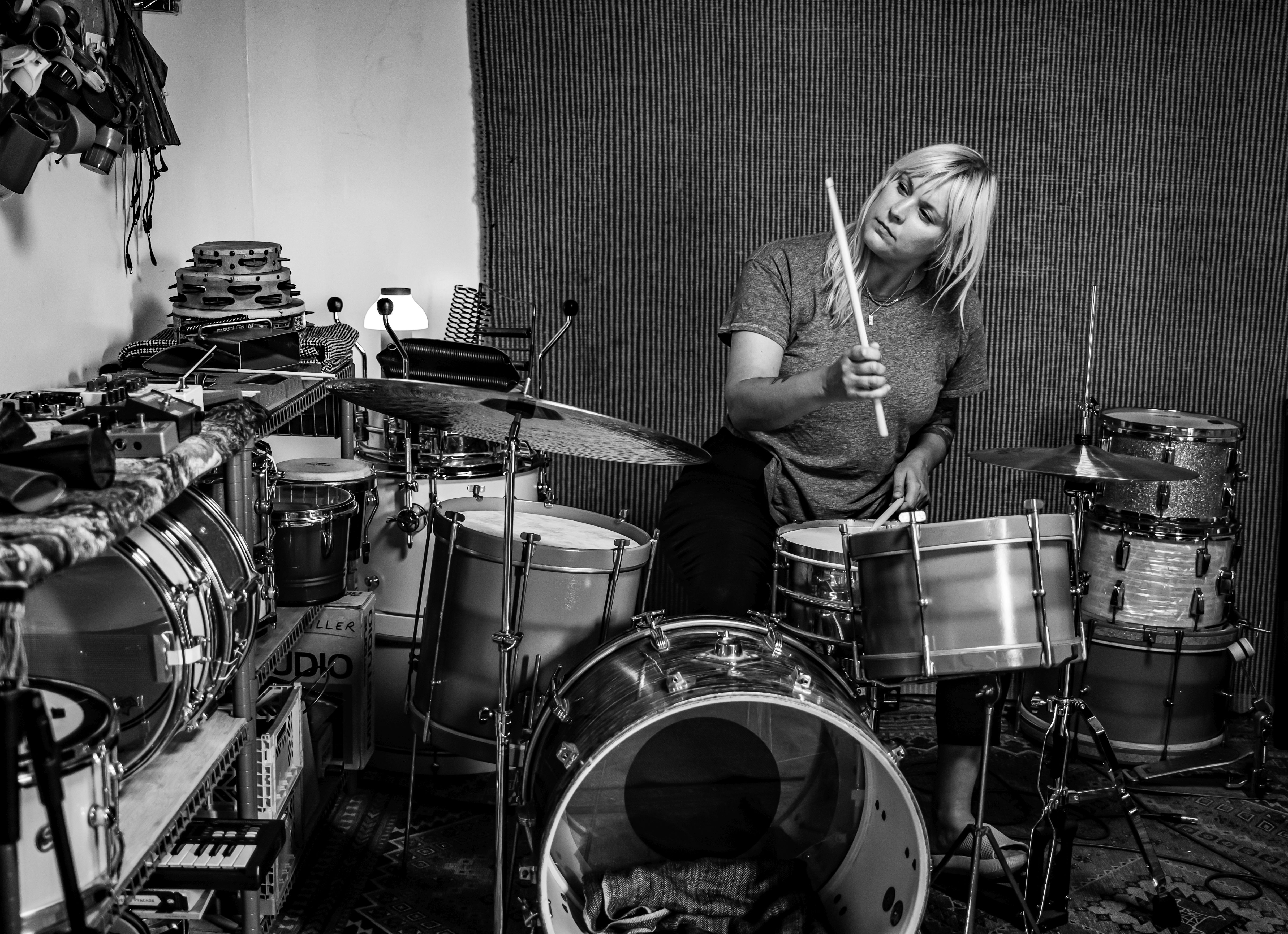
Name: Amy Aileen Wood
Nationality: American
Occupation: Drummer, percussionist, composer
Current event: Amy Aileen Wood's The Heartening is out via Colorfield May 3rd 2024.
If you enjoyed this Amy Aileen Wood interview and would like to know more about her music, visit her on Instagram.
What was your first drum set like and what are you using today? What, to you personally, are factors in terms of build and design that you appreciate in drums and percussion?
Back in the late 1980s, my dad scored a vintage 1960s Rogers kit from a friend, which became my first drum set. I cherished that kit for about a year until, on my 8th birthday, my dad made a well-intentioned trade for an 80s Tama kit, which I’ve been teasing him about ever since, given my fondness for vintage drums. Ironically, I find myself yearning for that Tama kit now.
Over the years, I’ve developed a deep appreciation for the craftsmanship and character of old drums. Pete Min’s studio, with its collection of amazing vintage drums is a dream. When it comes to drums and percussion, I’m drawn to the unique sonic qualities and individual character of each kit.
For instance, on certain songs, I’ve had the pleasure of using two distinct kits: a WFL and a Ludwig Clubdate. The contrast in sound between the two is fascinating and adds a layer of depth to the music that I truly appreciate. “Rolling Stops” is a good example of that.
Late Rush-drummer Neil Peart said: “The equipment is not an influence. It doesn't affect the way I play. It's an expression of the way I play.” What's your take on that?
I completely respect Neil Peart’s perspective, but for me, the equipment does serve as an inspiration. While it may not directly influence my playing style, the sound and setup of different drum kits can spark new ideas and encourage me to explore new techniques.
For example, experimenting with unconventional setups, like playing without a kick drum or trying a left-handed kit arrangement, or incorporating percussion pieces onto the toms and cymbals, can lead to unexpected creative avenues. Additionally, using specialized sticks, such as Dem Sticks African Fans, can inspire me to approach the drums more percussively and explore different rhythmic patterns across the kit.
An interesting experience was during the recording of “The Valley” with Pete Min, where he had me play his octobans and just asked me to play as much as possible on them. He then slowed them down with his tape machine.
Despite going all out on them, the slowed-down effect gave the impression of mallets on toms, showcasing how equipment choices can influence the overall sound and feel of a performance.
In relation to drumming, Stewart Copeland said: “Listening is where the cool stuff comes from. And that listening thing, magically, turns all of your chops into gold.” What do you listen for?
For me, listening is not just a passive activity; it’s a skill that shapes every aspect of my performance. When I’m in a band, particularly with a vocalist like Fiona, my ears are finely tuned to her delivery and phrasing.
My friend Sebastian Steinberg once imparted the wisdom that the singer is always right, and that mantra has stayed with me ever since. Fiona’s intensity drives the dynamics of our performances, and her spontaneous variations keep me on my toes, infusing each rendition of a song with freshness and excitement.
But it’s not just about the vocals. I also find immense joy in listening to the bass player, like Sebastian, and forging that deep connection where our rhythms intertwine and groove.
In a recording setting, listening takes on a whole new dimension. Reviewing playback of my own performances is a masterclass in self-discovery. It’s incredible how nuances that may have escaped me in the moment reveal themselves upon playback, reshaping my approach and enriching the musical tapestry.
Recording The Heartening was a unique experience devoid of the luxury of overthinking. It was raw, spontaneous, and exhilarating. Without the opportunity to prepare or second-guess, I tapped into a wellspring of authenticity and creativity. Pete’s swift decision-making propelled the process forward, resulting in a whirlwind of musical exploration and uninhibited expression.
It was a liberating journey, akin to exposure therapy for a habitual worrier like myself, where every moment felt like pure, unadulterated playtime.
Do you feel that honing your compositional / songwriting skills has an effect on your drumming skills?
Absolutely, refining my compositional and songwriting skills has greatly influenced my approach to drumming. It’s shifted my focus towards serving the song rather than showcasing individual prowess. Understanding the structure and dynamics of a composition allows me to tailor drum parts that complement and elevate the music as a whole.
Collaborating with Pete on The Heartening was particularly enlightening. Rather than adhering strictly to a set structure, we focused on creating a fluid narrative with three or four evolving sections that seamlessly worked together. It taught me the importance of balancing creativity with serving the song’s needs, a lesson that continues to shape my drumming style.
How has technology, such as drum machines and sequencers, impacted the way rhythm is created and perceived? Has it been a concrete influence on your own approach?
Personally, I find them incredibly inspiring and often turn to them when I’m feeling stuck or in need of fresh ideas.
One memorable experience that stands out is when Pete introduced me to programming a drum beat and routing each track’s MIDI to different synths like the Juno 106, Jupiter 8, and Jupiter 4. Each drum hit triggered a different synth, allowing me to run to each one and play a chord. This unconventional approach not only shaped the drum part but also sparked the creation of the song “Midnight Zone.”
[Read our feature on the Roland Juno 106]
Additionally, in another instance, we used a Simmons drum synth to initiate “The Number Zero,” tuning the toms to different notes.
These experiments with technology have not only expanded my sonic palette but have also influenced my approach to drumming, encouraging experimentation and pushing the boundaries of traditional rhythm creation.
Drums and percussion are remarkably often used for physical therapy / healing. What, from your point of view, makes them particularly suitable tools for this?
I wholeheartedly affirm the healing power of drums and percussion.
While I’ll touch on emotional healing, there’s also a profound physical aspect to their therapeutic efficacy. Engaging with drums allows for a deeply embodied experience, tapping into the innate satisfaction of using one’s body in rhythm and motion. In therapeutic contexts, the bilateral motion involved in drumming has been shown to promote healing on multiple levels, fostering a sense of balance and harmony within the body.
On a personal note, I’ve observed that playing drums is not just a pastime but a fundamental need for me. I find myself feeling out of sorts if too much time elapses without drumming. It’s a form of expression that transcends words, allowing me to immerse myself fully in the present moment. When I’m playing, the outside world fades away, and my focus narrows to the rhythm and the pursuit of what sounds best next.
The social aspect of drumming holds immense importance for me. The relationships forged through music are deeply meaningful and intimate. Collaborating with others in musical endeavors fosters a sense of connection and camaraderie that is unparalleled.
Many recording engineers have remarked that the drums can be particularly hard to capture. What, from your perspective, makes drums sound great on record and in a live setting?
I’ve definitely faced the challenge of getting that perfect drum sound both in the studio and on stage.
In the studio, it’s all about paying attention to the tiniest details. From choosing the right drums and cymbals to finding the sweet spot for each microphone, every little thing matters. And the engineers, they’re like magicians, turning knobs and pushing buttons to make everything sound just right.
When it comes to playing live, it’s a completely different thing. It depends on the room you’re playing in, whether it be a theatre or an outside venue. You’ve got to balance power and finesse, making sure your drums cut through the mix without drowning out the rest of the band.
What do you think you're doing different than other drummers?
I think what sets me apart is being self-taught. I never studied the drums in a traditional sense until recently. My dad, who is a musician, always encouraged me to listen and play from a place of feeling. As a kid, I played along to records and with as many people as possible.
I’m constantly pushing myself to think outside the box and craft unique, unconventional parts that elevate the music. This means I’m always experimenting with different tools – whether it’s sticks, drums, percussion instruments, or even everyday objects that happen to be lying around – anything that can inspire a fresh perspective and help me break out of my comfort zone.
I’m constantly mindful of how my drumming fits into the bigger picture and I thrive on listening to non-drummers’ ideas and collaborating, which is perhaps why I connect so well with artists.