Published
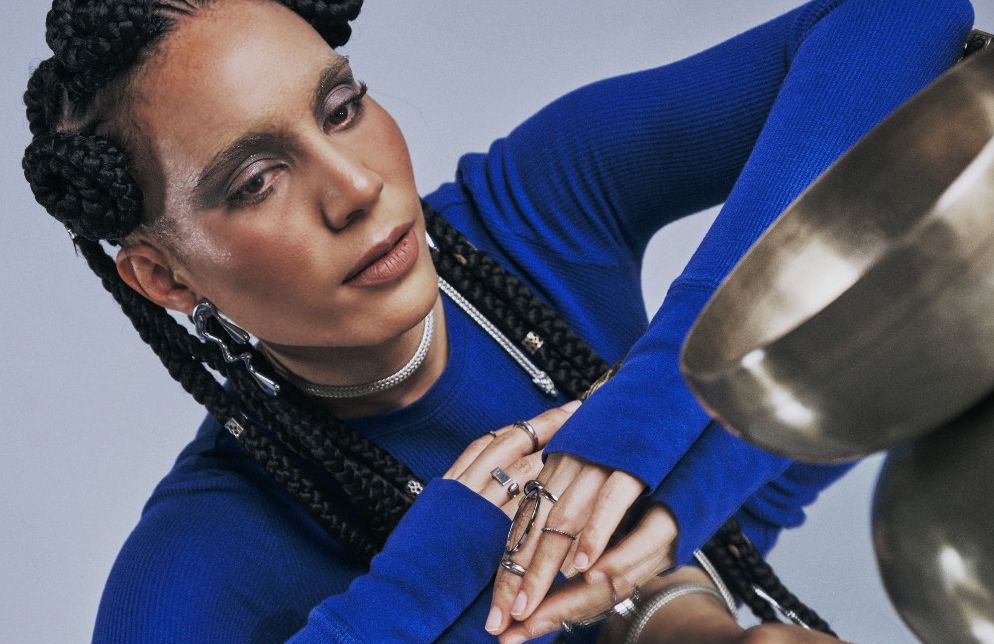
Name: Anaïs Maviel
Nationality: French-Haitian
Occupation: Composer, artist, vocalist, multi-instrumentalist
Current release: Anaïs Maviel's new album listen to the rain is out via protomaterial. Next to Anaïs Maviel on voice, kamele n’goni, and singing bowl, it features the string quartet of Leah Asher (violin, voice), Marina Kifferstein (violin, voice), Carrie Frey (viola, voice), and Meaghan Burke (cello, voice).
Recommendation for New York, USA: Go by the Hudson River on the island of Manhattan. It is an estuary. The Lenape people called it the river that flows both ways. My favorite spot is under the bridge going to New Jersey in Washington Heights. Look how the water swirls right there.
Topic I am passionate about but rarely get to talk about: Human Design and the procession of the equinoxes in astrology, as we enter the age of Aquarius. I believe humanity is a the brink of a huge evolutionary breakthrough and I live for this moment.
If you enjoyed this Anaïs Maviel interview and would like to stay up to date with her music, visit her official homepage. She is also on Instagram, bandcamp, and Facebook.
The borders between producers, sound artists, and even songwriters are becoming increasingly blurry. What does being a composer mean today, would you say?
A composer is someone who reorganizes sounds that already exist in ways that haven’t been heard before, therefore opening further horizons of listening.
Composers contribute to a larger picture of how music can expand one’s consciousness.
As of today, what kind of materials, ideas, and technologies are particularly stimulating for you?
Spiritual concepts and bringing them to sensory experiences. The incredible power of the human body. Feminine wisdom.
Tell me a bit about the sounds & creative directions, artists & communities, as well as the colleagues & creative hotspots of your current hometown, please. How do they influence your music?
I created several playlists in conjunction with each of “listen to the rain”’s 8 movements’s release. These illustrate the plasma, the cultural context in which I place this music.
There is much more beyond this particular project of course, but that’s for another time.
Composing has always had an interesting relationship between honouring its roots and exploring the unknown. What does the balance between these two poles look like in your music?
I see tradition as an evolving matrix, always responding to the current needs of a society, yet standing on the shoulders of transmitted knowledge.
That’s why oral transmission and improvisation are crucial in my work. The written part of music is more of a documentation than an artefact in my experience.
How much potential for something “new” is there still in composition? What could this “new” look like?
Infinite. We only use 10% of our brains, our consciousness is an infant.
Music will support us in exploring the unknown parts of our psyche. Music can heal and therefore make space for new world views to emerge and therefore new realities. Working with vibration means working with the very fabric of this universe.
I think “new” will get us deeper into the stakes of harmony and to grasp multi-dimensional experiences with our senses.
What role do electronic tools and instruments play for your creative process? What does your creative space / studio look like and what tools does it contain?
I have a fat voice memo library on my phone I refer back to a lot, because inspiration often comes unwarranted. My body is the main instrument. Silence is paramount.
For long stretches of work - a nice, open view is ideal. A piano to experiment with touch. A music notation software with a good sound library and speakers, as well as a software to record myself singing & playing various instruments.
I use electronics to fiddle with frequencies and alternate tunings.
It is my impression that adding a conceptual, non-musical dimension to one's work is almost a prerequisite for commissions and grants. How do you view this tendency and how “conceptual” is your own approach to writing?
I believe we are experiencing a separation between body and mind culturally, which is at the root of the discomfort we experience in our lives and when facing art that is conceptual without a sensory path for embodiment.
Concepts are amazing - we need them in order to expand our views, but they have not aesthetic value if they aren’t apprehensible through our senses, if their beauty cannot be physically experienced in the moment. We are at the end of a long cycle of dominance of rationality, to the point that it has become its own obscurantism, disconnected from reality. Think bias and belief-based science.
This is also connected to the so-called war of sexes, and as a society we are now engaging with balancing feminine and masculine energies within ourselves, so that we can integrate concepts into our lived experiences, and find a point of balance and unification of our logic and analog brains.
I think that music can play a major role helping this integration process. As artists working with intuition and mystery, we have to stand our ground as to not fall into the molds that have been created for us centuries ago that expect us to explain everything. Some concepts cannot be grasped with language and that’s why we have art with a big A.
Working with long forms, complex concepts or new vocabulary is potentially more challenging today because they require us to remember things that happened perhaps minutes ago – while most of us are finding it hard to focus even on what's happening right now. Both as a composer and as a listener yourself, how do you deal with this?
It’s a struggle, because I specialize in durational, long form music.
So basically, even if my music isn’t that “hard” to listen to - like, it has rhythm and melodies - people rarely hear it in the way I composed it, which is very structured. My stuff may sound random if not listened to intentionally, however I crafted pathways for the listener to gather precise clues over time.
I think part of the role of a composer is to accept that their music will have an impact later, once it will have been heard several times. That’s part of the durational aspect for me: Trusting everyone else’s timing.
For many artists, life-changing musical experiences take place live. Few works these days, however, are performed beyond their premiere. What, do you feel, does this mean for composers, and the music they write, and how does this reality influence your own work?
Again, it’s about artists standing our ground and refusing to create new work after new work, and instead be willing to prioritize development. As a composer, I don’t get a lot of commissions because I don’t position myself as an on-demand new work creator.
It’s more radical, because less momentum around newness, but the reward is that The Rhythm Method for example, who commissioned “listen to the rain”, got to perform it twice, record it and will perform it again for the release party on December 13 in New York.
Even the second performance, which was years apart from the premiere, was sounding so much better, and we could really enjoy ourselves performing it - which makes all the difference in terms of the audience’s experience! What a gift.
As a community, we have to make choices that reflect our priorities and act accordingly. Maybe it means sustaining ourselves from various sources and not just from commissions for composers and ensembles, which is possible in many cases.
The stakes of declining music business’ over consumption model are: sustainability and high quality music experiences.
The Montreux Festival intends to preserve its archive of recordings for future generations. Do you personally feels it's important that everything should remain available forever - or is there something to be said for letting beautiful moments pass and linger in the memories of those that experienced them?
Ephemeral is beautiful, but because I am the type of composer that works with long form, duration and extended timelines - I like archiving, preserving and long term transmission. Aren’t we grateful for having access to music from centuries ago?
Recording is one of the many ways, score is another, and oral transmission I believe is most powerful, because is has vibration embedded in the bodies that remember and pass on - this is how culture remains alive and evolving with the people it nurtures.