Published
Name: Anders Lauge Meldgaard
Nationality: Danish
Occupation: Multi-instrumentalist, composer
Current release: Anders Lauge Meldgaard teams up with Copenhagen Clarinet Choir for their new album Jeux d’eau, out via Conatala.
Recommendations for Copenhagen, Denmark: Fristaden Christiana
If you enjoyed this Anders Lauge Meldgaard interview and would like to stay up to date with his music, visit his official homepage. He is also on Instagram, and bandcamp. The Copenhagen Clarinet Choir can be found on Instagram.
The borders between producers, sound artists, and even songwriters are becoming increasingly blurry. What does being a composer mean today, would you say?
Being a composer today, to me, means shaping sound through many different approaches like experimentation, technology, writing, recording, editing, improvising and maybe most importantly, to follow intuition.
Sometimes I feel that the biggest part of the work is figuring out the right method or concept for a specific piece. Once that’s in place, the actual composing becomes easier.
I like to experiment with different approaches to composition and I am highly value intuition as a creative tool. Sometimes I try to speed up the process and go with whatever comes to mind first, in order to get the intuition involved, but that works best when there’s a clear framework to respond to.
In my work with the Jeux d’eau piece, the boundaries for what it means to be a composer, were stretched quite far, as I ended up building a heptagonal plexiglass fountain, that serves both as a sound source for live water sounds, a sculpture, and as a light that illuminates the clarinet players standing around it.
Many people perceive classical music and contemporary composition as having high barriers of entrance, both for listeners and musicians. What have your own experiences been in this regard?
Yes, I agree. I think contemporary composition can sometimes have a tough barrier to entry, but when I work on my own music, I want it to be multi-layered — something that feels spontaneously and immediately appealing, yet also carries deeper ideas and concepts to explore.
A lot of so-called contemporary music can be very advanced and hard for people to connect with, but I want to make music that hopefully touches something else than just the intellect, something that could be fulfilling for the heart and soul of humans. Whatever that means.
I guess that is part of the challenge being a composer: to always strive for magic in the music, something you can’t quite put your finger on, but gives you a sense of meaning, fascination or perhaps joy.
As of today, what kind of materials, ideas, and technologies are particularly stimulating for you?
Even though I love electronic music and often work with synthetic sounds, like for example, using an EWI (Electronic Wind Instrument), Eurorack equipment, or computer-based sampling and editing techniques, I still find acoustic instruments to have the highest degree of details and nuanced colors, and that is exactly what I love the most about music.
I feel like the more developed AI and computers gets in the task of generating music, the more valuable the human touch will become.
One really good thing about AI music making, could be that people will begin to value and appreciate the ones who dedicate their life to mastering a musical instrument. You might be able to prompt some superficial sound production using AI, but to experience a skilled musician produce fascinating sounds things right in front of you, can never be replaced.
Perhaps it will become even more relevant and valuable in the future, as we might start longing for human expression in an increasingly digital world.
In the past couple of years, I’ve also been working a lot on combining acoustic and electronic sound sources, just like on the new Jeux d’eau album. Earlier this year, I released another album titled Spirit, which features three string players, violin, viola, and cello along with me playing the New Ondomo and Eurorack electronics.
My hope in combining these two sound worlds is to create a beautiful space where all the nuances of the acoustic sounds remain intact, while allowing for greater freedom and a wider sound palette through the addition of electronic and processed sounds.
Where do most of your inspirations to create come from – rather from internal impulses or external ones? Which current social / political / ecological or other developments make you feel like you need to respond as an artist?
The inspiration for Jeux d’eau came from a trip to Villa d’Este in Tivoli, Italy — a place I first heard about from a friend whose wife is Italian. He had visited the gardens before me and told me how both Ravel and Liszt composed works titled Jeux d’eau, inspired by the magnificent fountains there.
While Ravel and Liszt approached the theme of flowing water in a more romantic way, my work was conceived as a tribute to water itself — and as a reflection on the fragile bond between humans and the natural world.
I wanted Jeux d’eau to be both a sonic meditation and a quiet call to action.
The inspiration began as something external, but over the course of working on the music in collaboration with the fantastic Copenhagen Clarinet Choir, it became more and more internalized.
On a political and human level, I hope the piece helps inspire a renewed sense of sensitivity toward the environment’s fragile beauty and an act of care toward the world it reflects.
Composing has always had an interesting relationship between honouring its roots and exploring the unknown. What does the balance between these two poles look like in your music?
In Jeux d’eau, I wanted to create a work that feels open yet structured, forward-moving yet repetitive.
The music draws inspiration from American minimalists such as Terry Riley and Steve Reich, but rather than simply echoing their pioneering work, I sought to explore new terrain — one infused with a lyrical touch of late-Romantic European sensibility, where flowing melodies and rich harmonies soften the rigor of repetition.
At the same time, I’ve been inspired by the clarity and delicacy found in the music of Japanese composers like Jo Kondo and Sueko Nagayo.
The result, I hope, is a sound world that is both playful and profound — one that continually shifts between pulsating momentum and delicate stillness. I think making new music is a fine balance between knowing and referencing what has come before and at the same time aiming at doing something completely new.
We’re dwarfs standing on the shoulders of gigants :)
How much potential for something “new” is there still in composition? What could this “new” look like?
I believe the potential for the new in music is limitless — only our imagination sets the boundaries. And yet, everything feels cyclical: ideas emerge, gain recognition, fade, and then return in new forms decades later.
Just recently, I was listening to the Componium Ensemble with music by Spencer Doran of Visible Cloaks. It sounded strikingly modern and high-tech, yet at the same time, it reminded me of Conlon Nancarrow’s automated piano works from many decades ago.
What I find will always remain new and relevant is a composer’s or artist’s sensitivity to the time they live in, and their ongoing, necessary effort to process the world around them through art. '
Since the world is constantly changing, so too must composers and artists evolve, responding to the present, without forgetting about the past.
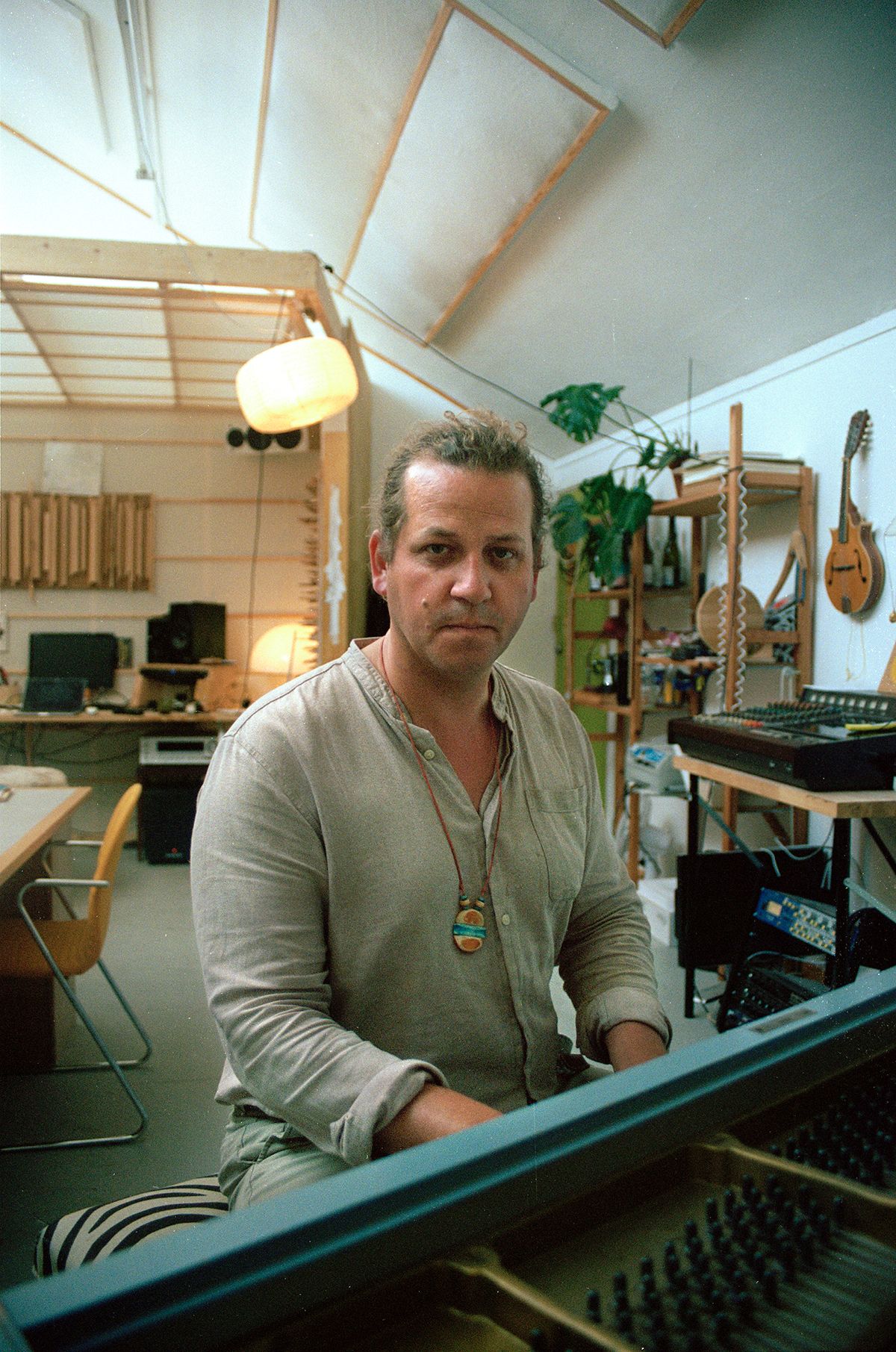
What role do electronic tools and instruments play for your creative process? What does your creative space / studio look like and what tools does it contain?
My studio is a mixture of acoustic and electronic tools.
I have a 100-year-old light blue grand piano from the Danish builder Hornung & Møller, which is an absolute joy to play. Because of its old age the sounds is somewhat of muted and I like that a lot, because I think some never pianos can be overly bright and a bit sterile sounding. For me, it’s all about the feeling — about getting an emotional response when I sit down to play or compose at the piano.
Besides that I use tools like a scoring program, a DAW etc. But I also really like to record sketches onto an old Sony cassette tape recorder I have. There is something regarding about the music getting connected to a physical object, something you have to rewind before play back, and something you can have fun colorize with an acrylic marker. A certain tape might remind my of a certain moment or feeling that occurred at the time of recording.
Since the COVID shutdown, I’ve also gotten into using Eurorack equipment. I used it on the Jeux d’eau album together with the New Ondomo — a Japanese take on the Ondes Martenot. What I love about the Eurorack is how it invites experimentation: everything is tactile, with knobs and patch cables, which makes it perfect for playing around and testing ideas.
On the Jeux d’eau album, I mostly used it for processing the New Ondomo and as a sampler — capturing clarinets, percussion and some water sounds.
It is my impression that adding a conceptual, non-musical dimension to one's work is almost a prerequisite for commissions and grants. How do you view this tendency and how “conceptual” is your own approach to writing?
As I mentioned earlier, I think an artistic concept can be a great help when working on a new piece of music.
But I don’t develop concepts just to apply for grants — I work with concepts because I want to create beautiful new pieces that can carry multiple layers of meaning.
Working with long forms, complex concepts or new vocabulary is potentially more challenging today because they require us to remember things that happened perhaps minutes ago – while most of us are finding it hard to focus even on what's happening right now. Both as a composer and as a listener yourself, how do you deal with this?
I actually think that the more time-consuming social media, short-form videos etc become, and the more time people spend isolated from others on their phones, the greater the potential and need for getting together and doing something meaningful, like experience a piece of music together and feeling how the performers can shape the music real time.
I think there can be a very special, magical power in the act of performing music and listening collectively, that can make people feel connected to each other and experience something beautiful and fulfilling.
When I first moved to Copenhagen, I spent most of my time with a bunch of music-loving friends, and most of the time we would hang out and listen to music. This collective sharing of thoughts and reactions to music is what I consider the most important part of my musical education.
For many artists, life-changing musical experiences take place live. Few works these days, however, are performed beyond their premiere. What, do you feel, does this mean for composers, and the music they write, and how does this reality influence your own work?
I often find myself split between two sides of the creative process. When I finish writing a new work, it’s incredibly exciting to hear it come alive with other musicians and to experience it being performed.
Having a new piece of music meet an audience is always a super exiting moment — it’s a chance to hear and feel how the work breathes, where its strengths lie, and where its vulnerabilities are exposed.
But the thing is, most of the time I’m already thinking about new ideas for the next piece as soon as one is finished. So I often feel torn between spending more time trying to get my works performed and moving on to writing new music.
How, would you say are live performances of your music and your recording projects connected at the moment? How do they mutually influence and feed off each other?
The new album Jeux d’eau has evolved through a continuous process of performing, recording, and then returning to performance.
We premiered the first version of the piece in 2024, but the music changed quite a bit after our time in the recording studio. In the studio, we had the freedom to experiment, to try out new ideas, and to explore more deeply what the music could become and how it might develop.
I often find performing a piece for the first time quite nerve-racking, as there are always elements I’m not entirely sure how will work in practice. With Jeux d’eau, it has been especially rewarding to have the opportunity to perform the piece first and then refine it further in the studio. The discoveries we made there are now feeding back into the new live version of the work.
An important part of the process has also been the decision, made together with Carolyn Goodwin (artistic leader of the Copenhagen Clarinet Choir), to perform the piece without sheet music — meaning that all the musicians must memorize everything. This approach allows the players to move freely within the performance space and enhances the visual and spatial aspects of the work.
Originally, this decision led us to omit some of the more composed sections I had written, but in the studio, where everyone could read from the score, we reintroduced some of these passages. Now, as the piece continues to evolve, we plan to incorporate parts of that material into the new live version, blending the freedom of performance with the structure developed through the recording process.
To some, the advent of AI and 'intelligent' composing tools offers potential for machines to contribute to the creative process. What are your hopes, fears, expectations and possible concrete plans in this regard?
Yes, I think machines can contribute to the creative process — and they already have for many years. Ever since the multitrack tape recorder was invented and put into use, machines have played a role in music creation.
I don’t fear the idea of AI in music-making, because I see it as an extension of the development that has already been taking place. Music production has become much more accessible over the last 20 years or so.
However, companies should not train their AI models on artists’ music without permission. I find it very disrespectful to do so, especially if they turn the software they develop into a product that can be sold based on the work of thousands of musicians and composers.