

Name: Anika Nilles
Nationality: German
Occupation: Composer, drummer
Recent release: Anika Nilles's new single “Float” is out now via Sakurai.
Current event: Anika Nilles is currently touring with her band Nevell. One of the highlights will be her gig at London's Ronnie Scott's. For more information about her performance and tickets, visit the club's homepage.
If you enjoyed this Anika Nilles interview and would like to stay up to date with her music, visit her official homepage. She is also on Instagram, and Facebook.
It seems as though most aspiring artists are drawn to the drums and percussion for one of two reasons: Creating sound/noise and creating rhythm. What captivated you?
For me, it’s really about creating rhythms. When I say rhythms, I mean those melodic patterns that just lock in with the music—that’s what I’m always chasing.
Of course, experimenting with different sounds and playing around with them is a big part of it too.
Everything around drums is based on touch, vibration, and movement. Does this mean that your own perception as a listener is also more connected to touch, vibration, and movement? What happens in your body when you're listening?
For me, music is all about emotion. On drums, that emotion comes through in dynamics—playing with sound and silence just as much as with notes. And of course, it’s also about the player’s touch.
When all those elements come together, that’s when I really feel the beauty of music.
Late Rush-drummer Neil Peart said: “The equipment is not an influence. It doesn't affect the way I play. It's an expression of the way I play.” What's your take on that?
I’d also add that equipment can be really inspiring.
Sometimes, if you have a drum that sounds unique—whether it’s great, unusual, or just different—it can push you out of your comfort zone. It makes you experiment with new sounds or rhythmic ideas you might not have thought of otherwise.
Still, no matter how great the gear is, it doesn’t necessarily make you a better musician. :)
What were some of the main challenges in your development as a drummer / percussionist? Which practices, exercises, or experiences were most helpful in reaching your goals?
Honestly, learning to push through frustration and staying focused on my goals has been really helpful—though definitely challenging at times.
Playing with lots of different musicians, in all kinds of situations and styles, has also taught me a lot. It really opened my eyes to what I need to practice.
And I think it’s always a great idea to play with people who are better than you—it pushes you to grow.
What is the relationship between harmony, rhythm and melody? How do non-percussion instruments contribute to the overall rhythmic texture of a piece?
What really brings together harmonic instruments, vocals, and drums or percussion is rhythm. Every instrument plays in rhythm—that’s what connects a band or an orchestra.
And often, the bass acts as the glue between the purely rhythmic instruments and the harmonic ones.
Drums and percussion are remarkably often used for physical therapy / healing. What, from your point of view, makes them particularly suitable tools for this?
Drums are such a physical instrument. It’s all about coordinating your limbs and having a clear idea of the rhythms and sounds you want to create.
For me, drumming often feels like yoga—it’s just me and the drums, and everything else fades away for a while. That’s really liberating.
Practicing, whether it’s drums or any instrument, also teaches you a lot about yourself if you really let it. You discover your strengths and weaknesses, not just in playing, but also in endurance, focus, confidence, dealing with frustration, and so much more. In a way, it can feel like therapy.

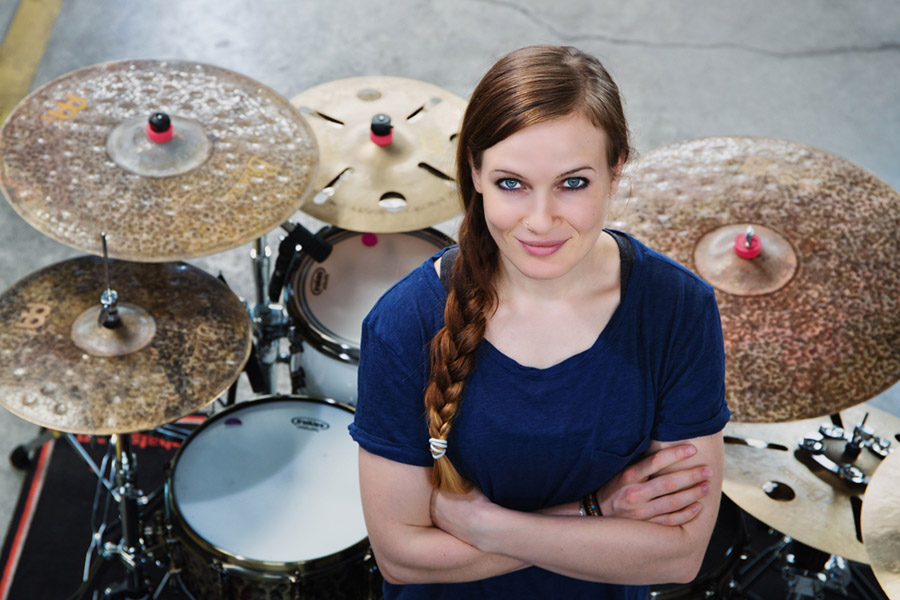 Anika Nilles Interview Image by Marius Mischke
“On drums, emotion comes through in dynamics—playing with sound and silence just as much as with notes.“
Video
