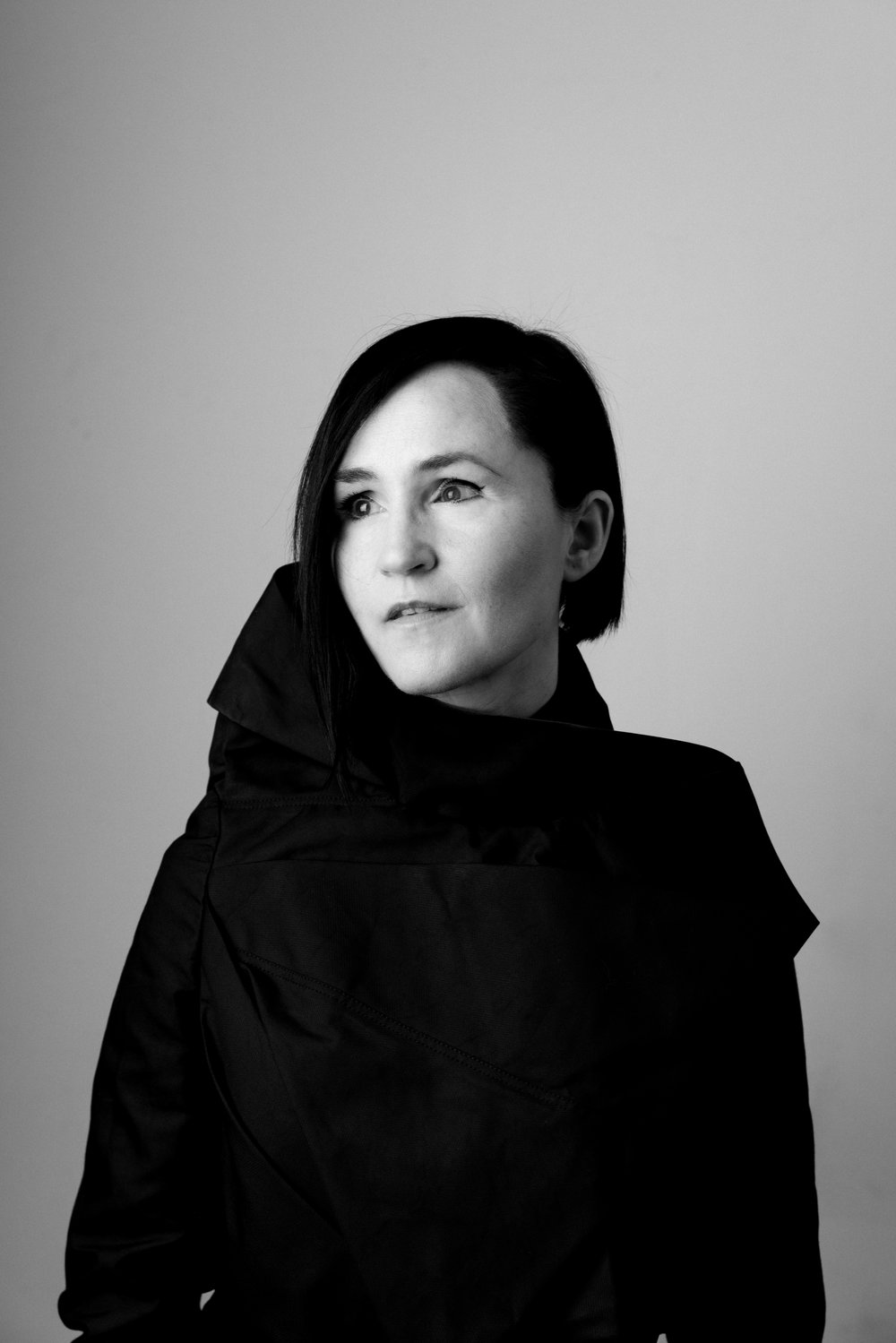
Published
Name: Anna Thorvaldsdottir
Nationality: Icelandic
Occupation: Composer
Current release: Anna Thorvaldsdottir's Ubique is out via Sono Luminus. It features an ensemble of Claire Chase (flute, bass flute, contrabass flute), Cory Smythe (piano), Katinka Kleijn (cello) and Seth Parker Woods (cello). Listen to the album here, and buy it from Sono Lominus here.
If you enjoyed this Anna Thorvaldsdottir interview and would like to find out more about her music, visit her official homepage. She is also on Instagram, and Facebook.
For a deeper dive, read our earlier Anna Thorvaldsdottir interview.
The borders between producers, sound artists, and even songwriters are becoming increasingly blurry. What does being a composer mean today, would you say?
There are of course many different kinds of composers and music makers and it varies what that means exactly for each and every one.
I have in the past certainly performed, recorded and mixed my own works, but for the most part this merging of roles doesn’t really come up much for me anymore as I have such a deep passion for writing larger pieces, for big ensembles and orchestras and am obviously not able to perform myself as a full orchestra.
So for myself being a composer means that I write music that others perform, and I really treasure that collaboration and the energy that can only be created by so many people working together to bring the music to life.
Many people perceive classical music and contemporary composition as having high barriers of entrance, both for listeners and musicians. What have your own experiences been in this regard?
From my perspective music is music, a living flowing art form that has such a wonderful potential for touching us in different ways, no matter which genre of music it might be, and what you find in it for yourself as a listener and as a performer is really what matters.
You can find something new in contemporary music and you can also find something old in contemporary music, just as you can find something new in older classical music, all depending on your own state of mind and approach each time you visit a particular piece. And there are so many different kinds of contemporary music - if you allow yourself to embrace the music you will find your own experiences in it, without any barriers.
In my own experience it is incredibly rewarding to hear people describe where the music takes them as they listen and what it is that they have found in the music. This quite often manifests in some sort of visual perceptions, where they find themselves transported to certain places or atmospheres, to certain feelings, thoughts and emotions as they listen and that is very powerful.
As of today, what kind of materials, ideas, and technologies are particularly stimulating for you?
The nuances of this vary quite a lot so it is perhaps a bit impossible to concretely talk about something as a continuous or constant in how the music is made.
In so many ways, especially with technology today, we have everything at our fingertips so perhaps really need to make an effort to not lose or forget the core essence of ourselves. What it is that we need as human beings. This is something I continuously come back to ideologically - what it is to be human, what it is to feel, to be in this life, in this existence. This notion I deeply connect with and come back to in various ways especially in various forms of inspiration behind my music.
We are surrounded by different technologies and all sorts of overflowing of stimulation so for me the most powerful thing is often to step completely away from that and to tap into the real essence of being in life.
Where do most of your inspirations to create come from – rather from internal impulses or external ones? Which current social / political / ecological or other developments make you feel like you need to respond as an artist?
This feels like a million questions packed into one. It varies incredibly where inspirations come from each time, but for an artist living in a particular time it is probably impossible to not, in one way or another, somewhat reflect the time in which you live.
When I find inspiration in certain things for music it is because I find qualities that are musically interesting for me. It is not about searching for elements to source inspiration but rather that a certain element sparks a musical inspiration organically. That is, I don’t sit down and try to get an inspiration from something, but rather when I am inspired by something that sparks a musical interest and creates ideas, this is when an inspiration becomes “the” inspiration behind the music.
Also, sometimes the music is an escape and where you might not want to be inspired by anything other than the core essence of music and how the music makes you feel - but of course it is sometimes not possible to escape the world and the things in it become an inspiration in one way or another, at times inspirations you wish you wouldn’t have to have.
Composing has always had an interesting relationship between honouring its roots and exploring the unknown. What does the balance between these two poles look like in your music?
For myself I truly don’t think about music this way. My music is always written from the perspective of the music, how the music sounds, how it feels, how it flows, the structure, the journey through the piece, the energy, this is what interests me.
From the perspective of specific materials I do enjoy working with a combination of sounds, nuances, textures, harmonies and lyricism. I organically enjoy to combine ethereal and tactile sounds, textures and nuances that may not be considered lyrical in and of themselves, with, at times, very lyrical materials and harmonies and where the materials are woven together in a way that they do become one.
This is something I have always done very intuitively and is a really big part of how I experience music, how I hear music and how I create my own music.
How much potential for something “new” is there still in composition? What could this “new” look like?
There is always room for new everywhere - always a potential for new. But the “new” is never conceived in a complete vacuum and there are various ways for something new to emerge, so there are constantly ever-growing possibilities for things to be created.
The “new” is also often created very organically without deliberately “trying” to create something new - it can look like anything.
What role do electronic tools and instruments play for your creative process? What does your creative space / studio look like and what tools does it contain?
In my own music I don’t use any instruments when working on the music - the process emerges from my head and I use paper, pencils and eraser to write the music.
I need to have as much openness and headspace as possible and this process allows for that beautifully. For the mind to be completely open. I am usually writing for so many different instruments, a whole orchestra or large ensembles, and I need to be able to listen inside the mind to every voice within that spectrum as I write the music.
So my studio has two desks, one large desk for handwriting the music and another for working on putting the score into the notation software. The walls are empty and I put the handwritten scores on the wall when I put the music into the software.
It is my impression that adding a conceptual, non-musical dimension to one's work is almost a prerequisite for commissions and grants. How do you view this tendency and how “conceptual” is your own approach to writing?
From my perspective I would never add anything, a conceptual idea, description, thought or a non-musical-dimension to a piece of mine that wasn’t there as I was writing the piece.
When writing a piece of music there are always going to be quite a lot of ideas and thoughts flowing throughout the process and a piece is at least always created from some sort of energy etc and these can be interesting to share at some point.
And yes, it is often “desired” that we explain the music or what it is “about”. My take is to talk about the core inspirations behind a piece each time, I don’t see any value in making up a dimension to a piece of music that isn’t already there. From my perspective the music is always first and foremost about the music itself and about what people find in it as they listen.
Working with long forms, complex concepts or new vocabulary is potentially more challenging today because they require us to remember things that happened perhaps minutes ago – while most of us are finding it hard to focus even on what's happening right now. Both as a composer and as a listener yourself, how do you deal with this?
This question is almost too big there are multiple ways to create threads within various different kinds of art forms and new music is no exception to this.
This approach lies in the way in which you structure a piece of music and how the materials relate to each other and within the structure and this is something I am myself absolutely obsessed with and have such a big passion for working on how the materials journey throughout the process of a piece.
For some composers it can be desirable to create clear threads for the listener to hold on to throughout the journey of a piece and for others it might be desirable not to do so. There are many different ways to approach this and to deal with, and perhaps at some points manipulate, this anticipated perception of remembrance.
It really doesn’t need to be difficult at all to follow a structure of a contemporary piece of music that has new elements, it all lies in the structure, the combination of materials and how the piece flows.
How, would you say are live performances of your music and your recording projects connected at the moment? How do they mutually influence and feed off each other?
There is of course always such a tremendous value in having recordings, especially of newer works both in order to have the music available and also so that there are references of the music for upcoming performances. Live performances are of course always very special, where the musicians put their fingerprints on the music each and every time they perform a piece and where it is never exactly the same at each performance.
It is really rewarding to record your music with people you have worked with and we make these recordings together. When you have a recording of a piece is when people have a reference to the work. My music is performed frequently all over the world and I am not able to be there in person myself, so it is incredibly valuable to be able to point people in the direction of a recording, especially as it would otherwise be like a premiere for the musicians playing in these different places.
Another aspect is that it makes it much more manageable for the composer (myself) not to be able to be there in person when people are performing the works as they have a reference to the music.
To some, the advent of AI and 'intelligent' composing tools offers potential for machines to contribute to the creative process. What are your hopes, fears, expectations and possible concrete plans in this regard?
I myself do not have any hopes or desire to use AI in creating my music - I haven’t tapped into this at all.
My music is created from a very human perspective, is handwritten and I don’t really see that changing at all for myself, and don’t see myself getting involved in such composing tools.
The Montreux Festival intends to preserve its archive of recordings for future generations. Do you personally feels it's important that everything should remain available forever - or is there something to be said for letting beautiful moments pass and linger in the memories of those that experienced them?
I am all for archiving music for sure.
There is of course nothing like experiencing beautiful music moments live and sharing them in the moment with others, but those experiences are not lost by having them documented and archived for the future.