Published
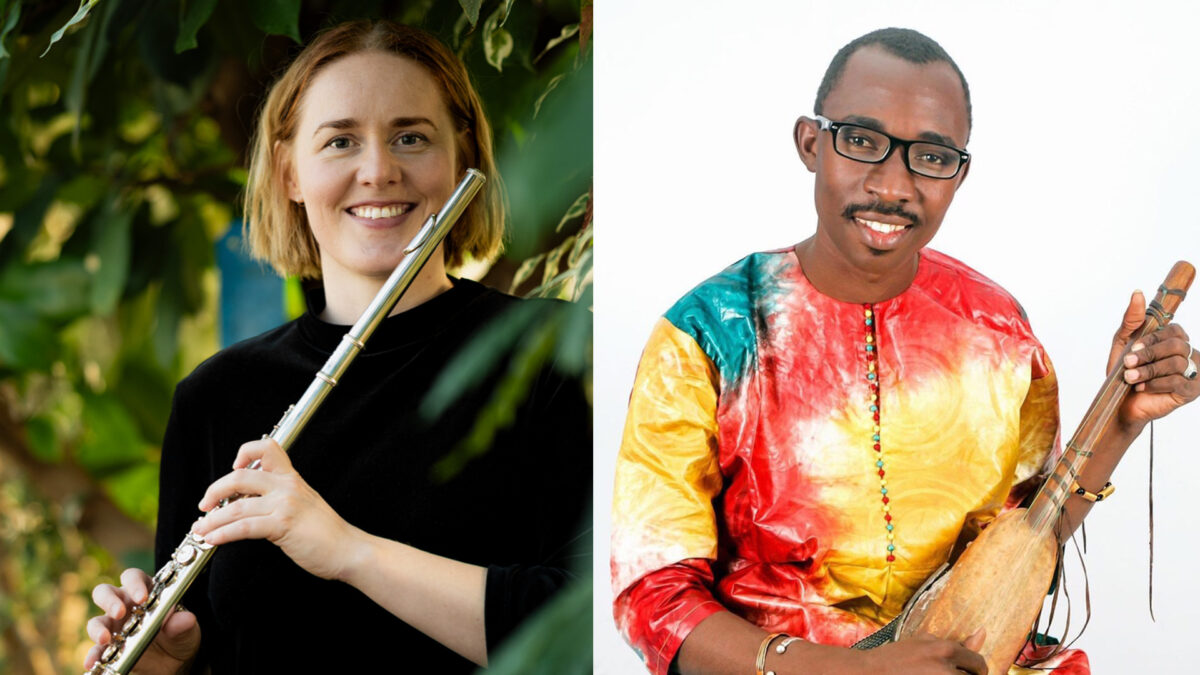
Names: Annarella Sörlin, Django Diabaté
Nationalities: Swedish (Annarella Sörlin), Malian-Senegalese (Django Diabaté)
Occupation: Flutist, composer (Annarella Sörlin), ngoni player, composer (Django Diabaté)
Current release: Annarella & Django's Jouer is out October 25th 2024 via We Are Busy Bodies.
[Read our feature on the ngoni]
If you enjoyed this Annarella & Django interview and would like to stay up to date with their music, visit Annarella on Instagram: Annarella Sörlin
How did this particular collaboration come about?
Both me and Diango are part of the group Wau Wau Collectif, comprising of both Swedish and Senegalese artists. I came to Senegal for the first time in 2016 but I didn’t meet Diango until November 2022 when we were touring in Europe with Wau Wau Collectif.
He was a new member to me then, but we had an instant connection, both musically and personally (even though we could barley talk to each other!)
While on tour, we noticed that our instruments - ngoni and flute - sounded really nice together. After a concert in Stockholm, we decided to make a record together. And now that has become reality!
What did you know about each other before working together? Describe your creative partner in a few words, please.
Diango is humble, faith-driven, spiritually evolved and has a presence that seems to belong everywhere and nowhere at once, making him feel almost ageless. We didn’t know each other at all before starting this project, but at the same time it felt as if we had known each other forever from the very beginning.
I think that Django and I work well together because we share kind of the same approach to creating music. We don’t try to hold on to the music with a clenched fist, but rather in an open palm, letting it float more freely. There's a deep trust in each other’s musicality and an openness to being surprised.
We have been giving each other a lot of freedom to develop each other's ideas and so far, we’ve always appreciated what the other has contributed. It's a collaboration that feels like a true blend of our individual styles into something entirely new!
There are many potential models for collaboration, from live performances and jamming/producing in the same room together up to file sharing. Which of these do you prefer – and why?
Our collaboration began with me sending some tracks that I had written to Diango, asking him to add ngoni to them. A few weeks to a month later, he sent the files back, and it was such a joy to open those files and hear how something I had created had been transformed and developed by someone else. Diango also sent me music that he had written that I started to develop and from there we continued to send files back and forth for many month, putting the album together piece by piece.
Working remotely has been something special. Normally, I prefer collaborating in person whenever possible, but when logistics or distance make that hard, file sharing definitely has its place—this entire project is proof of that! This arrangement has been giving us the flexibility to refine our ideas independently. By sending files back and forth, we’ve been able to combine our ideas and create something that has becomes greater than the sum of its parts.
Having that said, playing together in person when possible will always be my first choice. It is truly something special that happens when sharing the physical space and the flow of real-time interaction often leads to breakthroughs that are hard to replicate when working remotely.
Therefore, it was such a joy when Django recently came to Sweden, and we played concerts together in various cities. We even took the opportunity to record new music during his visit, and who knows—maybe (wink, wink) there’s another album on the way.
What are your thoughts on the need for compromise vs standing by one’sconvictions? How did you resolve potential disagreements in this collaboration?
When it comes to collaboration, I think it is so important that it truly feels like a joint creation. At the moment I am currently working on my own album in parallel. There, my individual style and preferences is meant to be at the center.
But when it comes to collaboration, it is really crucial to find the right balance between standing by your own convictions and being willing to compromise. It is important to be open to the others’ ideas and ready to adapt your vision for the collective outcome, but staying true to ones own artistic voice is equally important as it ensures that both people brings their authentic expression to the table.
I think we have excelled at this in our group, fostering an environment where we encourage and build on each other's ideas. And this extends beyond just Django and me to include the invaluable contributions from Karl-Jonas Windqvist and Lars-Fredrik Swahn who have helped complete the album, as well as our great guest artists.
We haven't had any major disagreements during our collaboration, just some minor things. In these moments, we have been able to feel when it is the right time to stand firm and when to take a step back. It has depended on how important something was to each of us – some songs are closer to my heart, while others are closer to his.
Generally speaking, what are your preferences when it comes to planning vs spontaneity in a collaboration?
I often start from improvisation while creating songs. It is the best way I have found that allows me to get hold of my unfiltered and intuitive ideas. I like to give the music room to grow naturally and too much structure can hold that back. However, some form of structure and planning is needed, especially in collaborations. I believe in having a loose plan but leaving plenty of freedom for the music to take its own direction.
On the subject of freedom, I’m particularly happy with one of the song titles on the album: “Degrees of Freedom.” It’s a term I first encountered in the rigid world of statistics during my psychology studies (it’s about the number of independent pieces of information used to calculate a statistic) but it carries so much poetic depth.
Musically, the melodies in the track evolve to become progressively freer. I originally wrote the flute melody with the Jungle Book in mind, a film I grew up with and have always loved. I identified myself a lot with the film, I saw Mowgli as the embodiment of my idea of freedom. I also feel that the title reflects the different forms of freedom—or lack thereof—that we experience globally, whether material, physical, mental, health-related, or in other aspects of existing.
It is the longest song on the album and is kind of an atmospheric soundscape with different voices to be absorbed by, inspired by, or just rest in. Also on that track, well-renowned Swedish folk-and world artist Ale Möller takes the role as the soloist on clarinet. We’re so happy to have him featured on the album.
What tend to be the best collaborations in your opinion – those with artists you have a lot in common with or those where you have more differences?
I really think that both have their place. The important thing is that you can find a common language. The beautiful thing about music—though it may sound like a cliché, but it's absolutely true—is that music is its own language! You don’t need to share the same spoken language (and we don’t!).
(bit personal)
Music, in my view, needs to speak for itself. At its core, musical or creative activity is all about expressing emotion and connection and are in many ways an antidote to intellectual discussions as it is a direct experience ... In fact, I've always felt a certain resistance to talking too much about music.
Throughout my life, I’ve found that language can sometimes reduce or even dull a feeling. When you try to capture a feeling in words, it’s like the essence shifts away from the emotion itself and settles into the words, risking to lose its raw energy and spark. Music is its own form of expression and doesn't need to be translated into words.
This is also part of why I moved away from contemporary classical music, where there was too much focus on conceptual art and too much talking. I prefer the direct, unmediated emotions and connection that music can create without the clutter of language).
After training as a composer in the avant-garde world of modern art music, I found myself longing to return to the roots. I felt a desire to explore more traditional and cultural elements in music because, in my view, they offer a way to tap into more primal, unfiltered emotions.
You could say that this project is also a part of that bigger movement, for me.
Was/Is this collaboration fun – does it need to be?
This collaboration has been a lot of fun! I believe that incorporating joy and playfulness is essential. Fun is tied to relaxation, and a relaxed atmosphere invites for experimentation and risk-taking. So that is a good basis.
Having said that, not every step in the process has to be fun (and often it is not!). The important thing is that the process feels overall meaningful at the end of the day.
I’m often drawn to music that sparks spontaneous joy but also has the power to break and heal the heart at the same time. I want the freedom to move through the highs, the lows, and everything in between!
Is there a piece which shows the different aspects you each contributed to the process particularly clearly?
We’ve each contributed to half of the songs on the album. Generally, on the tracks where I’ve laid the foundation, Diango steps in as frontman, and the same the other way around. For example, all songs with lyrics/vocals I laid the foundation for, such as "Dakar-Örebro”, "Magaphone," and "Sarajalela."
It is Diango and his wife Marietou Kouyaté that sings. Marietou truly has an incredible voice! When I first sent them over, they included guitar, piano, flute, and some rhythm. Diango and Marietou then connected with the tracks and added vocals. Hearing what they had added to the songs was such a great surprise.
I think Diango’s distinctive style shines through/stands out most in the tracks "Aaduna ak Asaman" and "Tankefigur” both of which I absolutely love. On these tracks, the ngoni really forms the foundation and drives the song forward.
On several of the tracks, Diango has layered multiple ngoni harmonies, which really enriches the sound. "No More," which Diango composed, highlights the strong Malian musical mode, while "Intro," which I wrote, probably showcases my Swedish influences the most.
((I think both of us tend to start with a core ostinato that sets the pitch, establishes the mode, and drives the rhythm. From there, we build melodies and improvisations on top of that structure)).
Please recommend two pieces of art (book, painting, piece of music) to our readers that they should know about.
I would like to recommend the Swedish painter Stina Wollter. I really appriciate her work. I think that she captures an authentic sense of humanity, often with women's experiences in the center. She often depicts things that are almost intangible and there is a strong sincerity in her work. If you're curious I highly recommend Googling "Stina Wollter art" to explore her work for yourself.
When it comes to music, I myself have a very broad taste and listen to everything from Stravinsky to Aphex Twin. I could recommend a group like Moscow Art Trio which I listened to a lot when I lived and worked in Norway in my twenties, especially the album Instead of Making Children appeals to me.
It is quite minimalistic with often just a few piano notes and vocals. (I rather rarely listen to such music as I am normally more of a "maximalist", but I think they manage to capture an authentic feeling that makes at least me calm and thoughtful. The music has a strong folk influence, with beautiful, slightly mysterious melodies.
As for literature, I really enjoy Dostoevsky's shorter novellas, especially The Dream of a Ridiculous Man and A Gentle Creature.