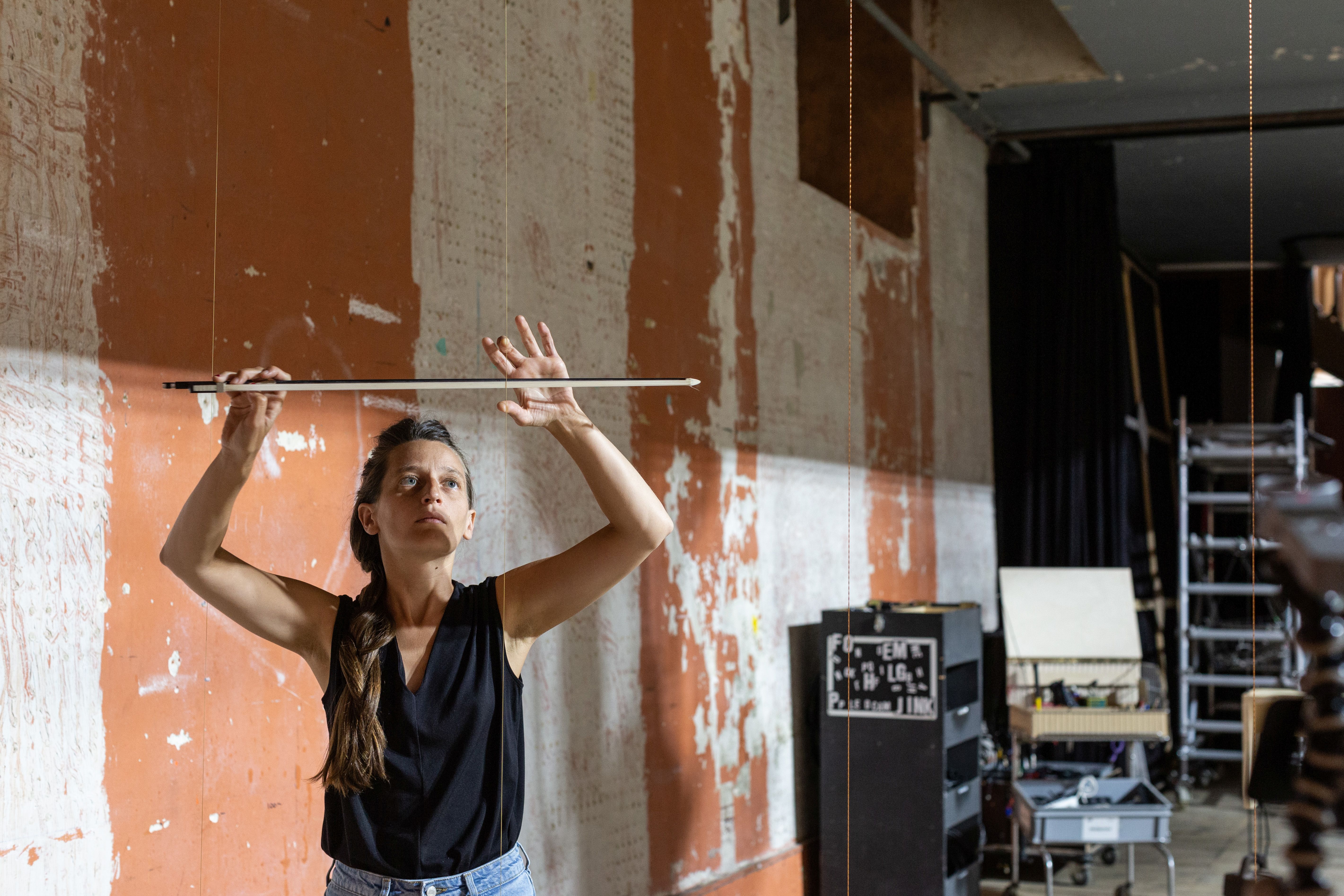
Published
Name: Anouck Genthon
Nationality: French, Switzerland-based
Occupation: Composer, violinist, ethnomusicologist
Current release: Anouck Genthon's new album aẓǝl, recorded by Genthon with Lionel Marchetti, is out via Sbire.
Recommendations for Geneva, Switzerland: Les Bains des Pâquis, an iconic place in a part of Geneva that is often overlooked.
Topic I am passionate about but rarely get to talk about: I love walking in the mountains; I often escape to the heights, and I now know how much I need these open outdoor spaces to nourish my creativity.
[Read our Lionel Marchetti interview]
If you enjoyed this Anouck Genthon interview and would like to stay up to date with her music, visit her official homepage. She is also on Instagram, and Facebook.
For you to get started, do there need to be concrete ideas – or what some have called a 'visualisation' of the finished work? What does the balance between planning and chance look like for you?
Yes, to begin with I need a fairly precise idea, or at least something that emerges and makes sense.
In the case of aẓǝl, it was the understanding of a lineage expressed through sound, connected to a past heritage. I became aware that something had passed through my body following my encounter and experience with the Tuareg community years earlier, and that it had transformed within my violin sound.
From that came the idea — the realization of a profound element of my story that I felt a strong desire to develop.
Is there a preparation phase for your process? Do you require your tools to be laid out in a particular way, for example, do you need to do 'research' or create 'early versions'?
I do indeed need to carry out research beforehand. In this case, it involved going through my personal archives from my fieldwork in Niger.
I first re-listened to several recordings, especially those of a specific instrument, the anzad (a one-string fiddle played by Tuareg women), which I had recorded in 2009. I reworked the idea of that sound from these recordings, then gradually moved away from them to continue developing what had emerged in my own playing.
I then worked by recording myself in many different contexts, including outdoors in contact with natural elements such as rivers. I would listen back to these recordings, take notes, and improvise again based on certain elements that I liked and that I gradually isolated in order to define them more clearly.
Do you have certain rituals to get you into the right mindset for creating? What role do certain foods or stimulants like coffee, lighting, scents, exercise or reading poetry play?
To create, I need to be in dedicated spaces that are conducive to concentration. I then set them up with all the elements I need in terms of content (books, scores, CDs, vinyl records). I like to use warm lighting, sometimes candles, to make myself feel as if I’m in a kind of den.
If I’m at home, I like to start my day by going for a coffee in a café, and then I ride my bike to my studio so I can feel the fresh, invigorating air outside before focusing in my workspace. I need to be alone in order to be fully absorbed, or else feel the co-presence of others who are equally absorbed in their own tasks.
For aẓǝl, what did you start with? If there were conceptual considerations, what were they?
I began from the understanding of this sonic lineage I mentioned earlier.
aẓǝl has its roots in an ethnomusicological research project I carried out from 2008 to 2012 in Niger on Tuareg music. This long-term immersion allowed me to discover the sound and use of the anzad. The distinctive quality of its timbre and playing technique remained in my memory, resurfacing many years later in my own violin sound.
It was from this imprint that this solo creation developed, retracing and extending this lineage from my position as an ethnomusicologist to that of a musician—from the sound of the anzad to that of the violin.
Tell me a bit about the way the new material developed and gradually took its final form, please.
I work through slow, long-term processes, accumulating layers that build upon one another. I would say that the idea for this solo first began to take shape in 2017, about eight years before the project was completed. I started by improvising and using recording as a working tool.
At each new stage of the process, I would listen back to the previous one, take notes, isolate elements to work on, develop, and refine. In this way, I compiled a number of fragments that I then tried to combine with one another to let a form emerge—one that was itself tested extensively right up to the final recording of the piece.
And this process is still ongoing; I continue to leave open the possibility that it may shift and evolve as the concerts unfold.
Many writers have claimed that as soon as they enter into the process, certain aspects of the narrative are out of their hands. Do you like to keep strict control or is there a sense of following things where they lead you?
I am an improviser; I like to let things flow and follow them wherever they lead me.
At the same time, for this solo project I felt the desire to establish a fixed form. I wanted to step out of improvisation in order to write a piece. I was determined to deepen a composition that I devoted myself to.
That said, not everything is strictly written within it—I keep a margin of freedom to let whatever may spontaneously arise under my fingers come to life in performance.
Once a piece is finished, how important is it for you to let it lie and evaluate it later on? How much improvement and refinement do you personally allow until you're satisfied with a piece? What does this process look like in practice?
It is usually quite important for me to let the material rest once I feel it has reached a point of completion. But once again, for this solo things unfolded differently.
During my last composition residency, I had the opportunity to record just a few days later, and I felt that the piece was ready to be captured as it was, still warm. Yet, as I mentioned earlier, this piece had been written over a very long period of maturation. Seven years passed peacefully between the first improvisations and the recording. As a result, I had completely let this material rest at the pace it needed, without any pressure or production goals.
In a way, I could say that it all came together almost in spite of myself. I even noticed, with some amusement, that every time I had the opportunity during those years to play this solo—which was nowhere near finished—it came through invitations, even though I had never communicated that I was working on a solo!
I have never experienced anything like that in any other project.
How do you think the meaning, or effect of an individual piece is enhanced, clarified or possibly contrasted by the EPs, or albums it is part of? Does each piece, for example, need to be consistent with the larger whole?
For this piece, it was obvious to me that it needed to be conceived as a single unit, without being segmented into separate parts.
I decided to make a vinyl record, and from that point on I wanted it to be a single-sided record so that the entire piece would be engraved on the first side, thus avoiding any interruption from having to flip it over.
The different underlying sections of the piece don’t have any reason to be separated from the whole, which is meaningful in itself. I think of them more as breaths.
What's your take on the role and importance of production, including mixing and mastering for you personally? In terms of what they contribute to a song, what is the balance between the composition and the arrangement (performance)?
The production work involved in mixing and then mastering is, for me, a crucial step in the finalization of a piece. It is where the balances are found. Working on the fixed object—giving it a colour, a thickness, the right sense of timing in the silent spaces, the right volume ratio. It’s the final touch that highlights the direction one wants to give to the work.
One can even consider that, at this stage, certain things may no longer be reproducible in live performance, or else one might try to get as close as possible to what can be done live.
I chose to work on this phase with a longtime friend and collaborator. We recorded and then mixed together in a context of great mutual trust, as he is someone who knows very precisely where I stand in my work. Being able to work this way is extremely valuable—thank you, Lionel Marchetti!
Music and the accompanying artwork are often closely related. Can you talk about this a little bit for your current project and the relationship that images and sounds have for you in general?
For this project, I worked on the visual cover with a friend, Wendy Gaze. A builder-artist, fresco painter, printmaker, and scenographer, we reflected together on what form this object— which I wanted to produce in vinyl format—could take. We imagined several possibilities, from the most extravagant to the most realistic!
It was the first time I worked on a project that concerns me personally, since all my previous records have been collaborative projects. I wanted it to be a creation by an artist whose work I love, and for the object to take shape through our exchanges, in mutual trust and shared understanding.
I hoped the result would be something that resembled me, and I’m really happy with how it turned out. It’s almost like an identity now: aẓǝl is this music but also this cover image.
I would love to know a little about the feedback you've received from listeners or critics about what they thought some of your songs are about or the impact it had on them – have there been “misunderstandings” or did you perhaps even gain new “insights?”
There is one thing that comes up almost every time I perform: the feeling that this music invites listeners into a kind of attentive listening that takes them inside themselves, like an invitation to a subtle yet powerful inner journey.
Some have even described it to me as therapeutic music, in the sense that it allowed them to reach something deep within themselves, sometimes provoking quite strong but positive emotions.