Published
Name: Anton Friisgaard
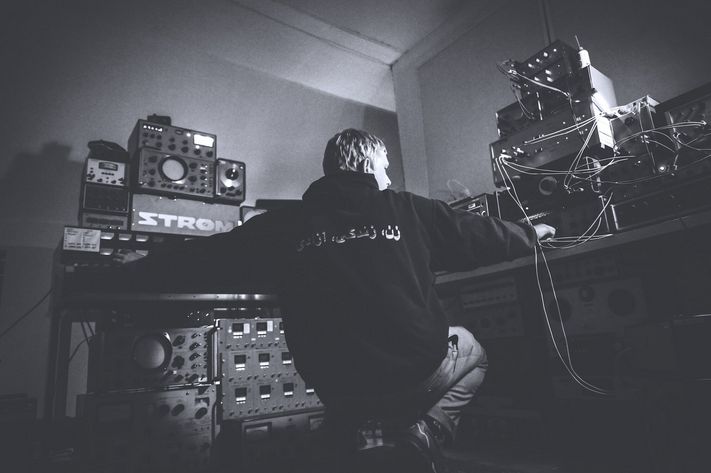
Occupation: Composer, producer, sound designer
Nationality: Danish
Recent release: Anton Friisgaard's new album Teratai Åkande is out via Stroom.
Recommendations on the topic of sound: On Gamelan, there's a really good and very accessible book called Balinese Gamelan by Michael Tenzer!
Other reads I really like are Michel Chions Sound, Mark Fisher's books because they’re so bleak, Simon Reynolds because he’s so enthusiastic.
If you enjoyed this Anton Friisgaard interview and would like to stay up to date with his music, visit his official homepage. He is also on Instagram, and Facebook.
When I listen to music, I see shapes, objects and colours. What happens in your body when you're listening? Do you listen with your eyes open or closed?
Sound can relate to shapes, colors and images for me too. Sometimes it can also place me in an abstract landscape of sorts. This synaesthetic property of music perception is one of the most interesting aspects of listening, I think.
With Teratai Åkande, I am trying to create this fictional landscape that’s is a sort of fusion between my musical surroundings from Denmark and my impressions of Gamelan Music. I’ve tried to imagine this fauna that is a mixture between the scandinavian and the Balinese Fauna. That's the reason behind the name for the album, and the track titles too. This definitely relates to my notion of being in an abstract landscape, while listening to music.
To answer the last question, I definitely prefer listening with eyes closed, sometimes even in places woth a lot of international visual input like concerts or parties. I find that the listening experience becomes way more intense and immersive with eyes closed - so I use it actively, to really focus my attention on the sounds.
How do listening with headphones and listening through a stereo system change your experience of sound and music?
Assuming the acoustics are good, I think music benefits from having a space to live in, so I really prefer to listen on stereo setups. Stereo setups will usually also allow for a bit more physicality in the sound.
Headphones and in-ears are great for walks though. I tend to walk in new directions and notice new things, when listening to different types of music. I really hope that someone will take the opportunity to go on a long walk while listening to Teratai Åkande. I haven’t done so myself yet, but I think the imaginative nature and compositional form of the album could lead to some interesting walks - this is an open invitation to send me your trip report if you do!
It's gotta be said though that I really believe that the next level stuff is spatial sound. I recently went to X100, a Iannis Xenakis anniversary in Kraftwerk Berlin, and I completely loved it! They had these huge speaker stacks in the corner of the enormous Kraftwerk space. The way the sound could kind of speak across the room reminded me of the grandiose musical experiences of symphonic orchestras. One of my strongest musical experiences for sure.
This is part of the reason that I decided to mix Teratai Åkande in Dolby Atmos too. It’s a format that has a bit of a commercial and hyped up vibe to it, but I love the fact that it made it possible to create a spatial experience from the album that can be listened anywhere basically.
I’m also going to make these spatial listening experiences with the album, in cinemas and other places with surround setups. First one will be in cph in september!
[Read our Bob Clearmountain interview about mixing in Dolby Atmos]
Tell me about some of the albums or artists that you love specifically for their sound, please.
I really like Huerco S’s For Those Of You Who Have Never (And Also Those Who Have), beautiful sound movements on that one!
Rashad Beckers Traditional Music Of Notional Species series is also just amazing.
I’m a total Tim Hecker fan too, especially for the sound of Virgins. I think his way of post-producing, reamping, stretching, bending and collaging instrumental takes and ideas is really interesting.
That approach is quite similar to the way I’ve worked on Teratai Åkande, which is recorded in Ubud, Bali in december 2018 and then post-produced over the following years. Back in Ubud, I had recording sessions in and around the city with a lot of acclaimed Balinese artists. When I was there, some ideas started accumulating but largely, I didn’t know what I wanted the final product to be.
The track ‘Kunyikke’ for example is a quite heavily edited improvisation I recorded with Galung Awan, Putu Septa, Badukz and Suryana Putra.
Back then I also listened a lot to Music For 18 Musicians by Steve Reich. That’s an album I’ve listened to a lot throughout the years. I really like that it feels really deep and profound, but it has this positive and life-affirming language.
Are there everyday places, spaces, or devices which intrigue you by the way they sound? Which are these?
I think that the otherworldlyness of the sound of suspended wires or thin-ice lakes is interesting. These sounds can kind of make me feel like a kid again.
What are among your favourite spaces to record and play your music?
I really like churches for their acoustics. I’ve had many opportunities to play church concerts, so I feel like there is a kind of bond between the church spaces and my music now. I’d really love to create a piece that interacts more with the music of the church space sometime.
I also really like to record outside too. All of Teratai Åkande was recorded outdoors. In some cases it gives a really clean recording, because there aren't any reverberating surfaces. In other cases, the music becomes intertwined with whatever sound is present at the moment of recording.
That gives these magic moments I think, that hold a lot of musical potential - although I admit that ambient noises has also caused some frustration in the editing process haha.
Do music and sound feel “material” to you? Does working with sound feel like you're sculpting or shaping something?
It does!
I think timbres, textures and movements really feel like properties of physical objects. I think since I’m used to working in a DAW, that also gives a feeling of sculpting, because I’m working with arranging and shaping sound objects.
To me, some of the intrigue of sound is that it can really feel like an abstraction of other experiences.
How important is sound for our overall well-being and in how far do you feel the "acoustic health" of a society or environment is reflective of its overall health?
I think that sound and music are one of the languages of the soul, so in a spiritual sense, I think it’s quite important - both for me and for the way we think and feel as a human community. I think it’s really important to be able to understand and to be curious about more complex, or maybe just different, sound languages - in order to explore our own, each others' and the common soul.
Talking about acoustic health, a noisey urban environment obviously has some really bad consequences for health and raises stress. That being said, there’s quite a lot of music in noise as well - the more I’ve learnt to appreciate the music of noises, the more it can become a pleasing aesthetic experience rather than something I experience as irritating and stressful.
Sound, song, and rhythm are all around us, from animal noises to the waves of the ocean. What, if any, are some of the most moving experiences you've had with these non-human-made sounds?
Actually, realating to experiences of urban noise, I was on a train today that had a beautiful sounding malfunction. The ventilation system had gone loose a bit and started singing this droney tone when the train roled out of the station. A metallic and stoic single-tone song, accompanied by a random rythm Pattern from the little metal piece that had gone loose. I just thought ‘damn, I wish I had composed that’. I immediately wanted to use the idea for a concert opening.
I think these kind of things are so nice, because all the stuff that goes on in the world randomly creates this sonic event that can then be perceived by our bodies and interpreted as beautiful in our minds.
It’s kind of the same mechanism in nature I think, a forest is made up of so many spontaneous situations and processes that end up becoming a kind of unified sonic or visual expression that we can aesthetically enjoy as humans.
Tinnitus and developing hyperacusis are very real risks for anyone working with sound. Do you take precautions in this regard and if you're suffering from these or similar issues – how do you cope with them?
Yeah - long studio sessions, concerts and club nights definitely take a toll! Luckily I don't have any damage done yet, but I think I might have a guardian angel. I listened to so much loud music before I started caring about the damage it can do.
Protect your ears!
We can surround us with sound every second of the day. The great pianist Glenn Gould even considered this the ultimate delight. How do you see that yourself and what importance does silence hold?
I think he’s right in the sense that it’s amazing how effortlessly we can change our surroundings and our state of mind with music nowadays. For me, because music touches something quite spiritual in me, I think it’s right to call it the ultimate delight.
Still, It’s hard not to think of Glenn Gould’s fellow student, R. Murray Schafer. I think that Schafer is right, that there’s a point of musical or sonic saturation and a kind of sickness to that aural saturation. If you always decide how your surroundings sound, you also lose another ultimate delight - the beautiful random moments of sound that life creates spontaneously. There’s a soundscape out there worth listening to, so I don’t always want any input that I choose myself.
In that sense, I think the ability to surround ourselves with music also comes with some responsibility.