Published
Name: Apifera
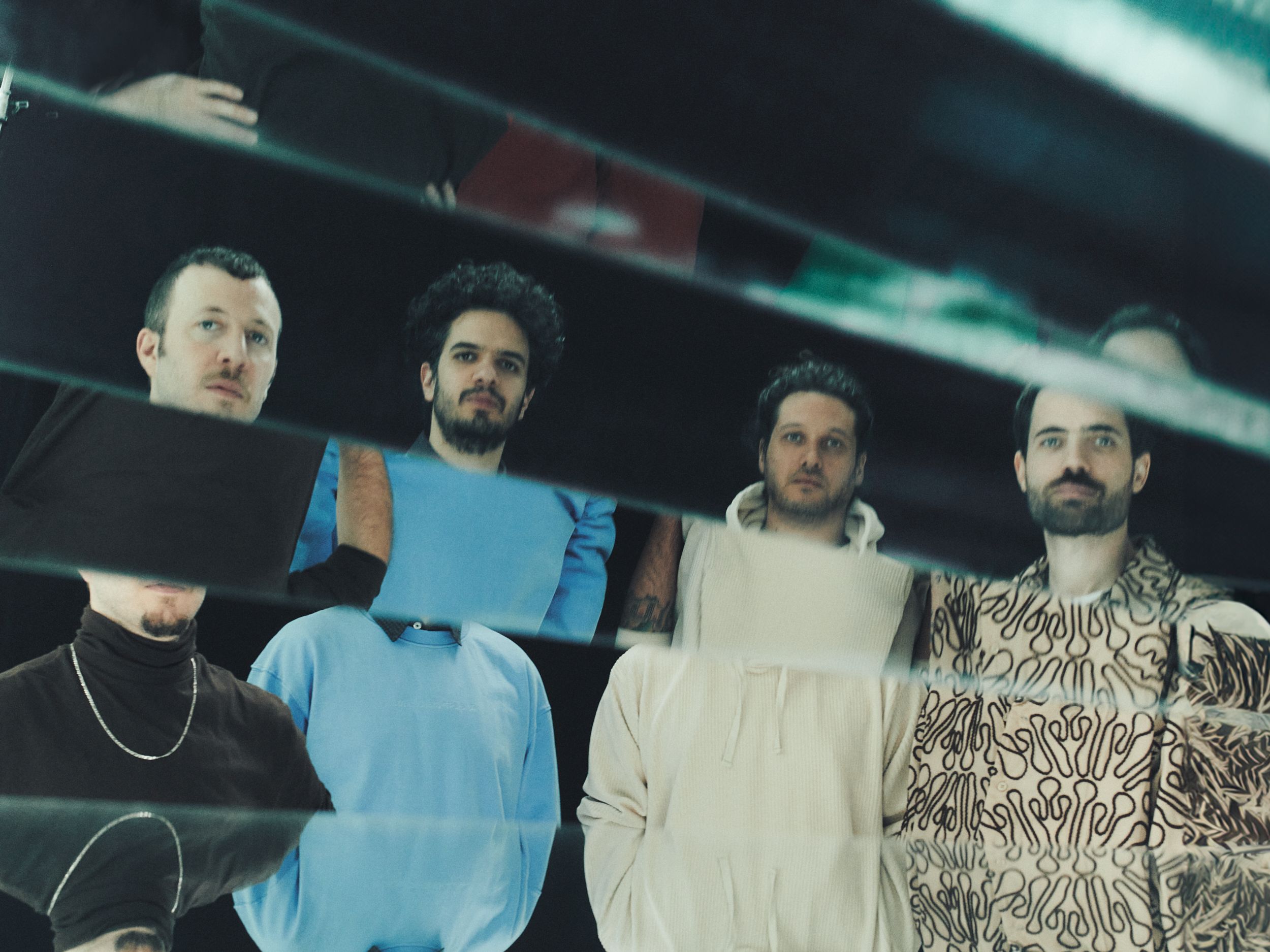
Members: Nitai Hershkovits (keys), Yuval Havkin aka Rejoicer (keys), Amir Bresler (drums) and Yonatan Albalak (bass)
Nationality: Israeli
Occupation: Jazz instrumentalists, improvisers
Current release: Apifera' new single “Bazooka Zoo” is out now via Stones Throw.
Recommendations: Joe Dispenza - Becoming supernatural; Elizabeth Haich - Initiation
If you enjoyed this Apifera interview and would like to know more about the band, visit them on Instagram. They also have a band page on the website of their current label, Stones Throw.
For a while, it seemed as though the model of the bed room producer would replace bands altogether. Why do you like playing in a band rather than making music on your own?
When working alone, the whole process from inception to mix is done by one mind, usually resulting in familiar paths and unconscious tendencies towards old patterns.
Working as a band is more fun because its all about friction, disagreeing until everyone feels it, taking unpredicted turns to places you wouldn’t go to alone, thus compensating for individual members’ blind spots and combining everyone’s taste into a new artistic being.
What, to you, are some of the greatest bands, and what makes them great?
Pink Floyd, Radiohead, Massive Attack, Tame Impala, Air, Hiatus Kayote, Knower, Domi & J.D …
Bands are like a Frankenstein of personalities, and if you look closer you can see certain characteristics from each member of the band standing out, defining the band’s DNA.
In every band the balance is different. Some are equilateral polygons, others a morphing shape, some revolve around charismatic leaders and some aren’t even bands but one guy multitracking himself, and that’s really fun.
[Read our Jean-Benoît Dunckel of Air interview]
Before you started making music together, did you in any form exchange concrete ideas, goals, or strategies? Generally speaking, what are your preferences when it comes to planning vs spontaneity in a collaboration?
Before forming the band we did a bunch of albums in different situations with other cats, each going to slightly different places, always spontaneous. The best material that came out of these projects was our starting point for Apifera, as a general vibe.
Some of those flavours continued into our first album, others were abandoned. The only concrete goal was to move forward, concentrating on the materials we like and finding more of them. It was a pretty quick evolution since it was very clear what worked and what didn’t.
Today when we meet to write together we listen to some references, or talk about “siblings” we want to make for previous songs, and then let inspiration come and lead the way.
There are many potential models for creativity, from live performances and jamming/producing in the same room together up to file sharing. Which of these do you prefer – and why?
We have two main methods of work:
1. Writing with our instruments, playing the song/composition over and over until it’s ready, then recording it live in as less takes as possible to keep it fresh. This works better for instrumental tunes.
2. Finding one or two instruments that carry the groove and form of the piece, recording the general structure and then laying other tracks on top of that, maybe with some form editing. We usually write vocal melodies and lyrics after the playback.
We haven’t shared files or used any kind of sampling so far.
How do your different characters add up to the band's sound and in which way is the end result – including live performances – different from the sum of its pieces?
We have a lot in common but we’re very different. We each have diverse tastes but also clear boundaries and dislikes, so the sweet spot between our personalities is a rare and special place.
We all like jazz (not necessarily mainstream), electronic music and other quality niche stuff.Amir likes African, Middle Eastern music, Yuvi is a hip-hop guy, and also digs dub and African music. Albalak likes IDM, prog-rock and Impressionism, and Nitai likes classical stuff.
It’s great to have all those different styles in a band, more in a subtractive way. We try never go all the way in one genre to avoid being too on the nose and because we’ve heard those genres as themselves before.
Is there a group consciousness, do you feel? How does it express itself?
Like everyone who’s been energetically invested with other souls, we often experience these moments of interlocking frequencies, happy accidents, unplanned unisons or musical serendipity that point to the probability it’s no coincidence but rather a result of a deep mutual focus on a very specific energetic point.
It’s a good feeling and we are grateful to have it.
Tell me about a piece or album which shows the different aspects you each contribute to the process particularly clearly, please.
Here are 4 tracks from our different projects that show each of us individually:
Amir Bresler - "Please Do"
Rejoicer - "Neo Drive Knows You"
Geshem – "Clones"
Nitai Hershkovits - "The Old Wise"
What is your sense of ownership like as part of the collective songwriting process? What is the balance between the lyrics, melodies and harmonies, and the groove in terms of your sound?
The groove, or more accurately - the driving rhythmic element usually comes first. Some shifting harmonies, transitions between parts, etc. Then comes the melody, either by itself or with lyrics. Every element affects the others, so the melody might want a change in harmony, the lyrics could ask for a different melody, etc.
Once these are in place, we colour around all that, which could also lead to changes in earlier phases, like “let’s mute the drums here” or “let’s make this secondary comp track the primary one”, and even sometimes “let’s re-record this part” so everything is constantly changing to obtain the desired balance.
What tend to be the best songs in your opinion – those where you had a lot in common as a band or those where you had more differences? What happens when another musician take you outside of your comfort zone?
We try to get out of our comfort zone as much as possible. Differences are the curves of creation, and that doesn’t contradict having a lot in common.
So the answer is - all of our songs are based on choices we agree on, after we disagree for a while:)
What are your thoughts on the need for compromise vs standing by one's convictions? How did you resolve potential disagreements?
We work hard to find a common ground that feels right for all of us. That could take some time but when we get there it’s very rewarding.
Personally, there’s always a certain degree of letting go, giving in to the collective, that technically is compromise but when the overall result is good, there’s no grudge.
Do any of the band's members also have solo projects? If so, how do these feeds into the band's creative process?
Yes, we all have solo projects, you’re welcome to look them up.
They all feed into the band’s style, defining nuances and colours. And of course we all take part in each other’s projects.
In a live situation, decisions between band members often work without words. From your experience and the performances of your current tour, what does this process feel like and how does it work?
Once we’re on stage the only communication we need is done with our ears, or an occasional signal to move on to the next part. All the talking is done in rehearsals, and lots of it.
When everything’s clear there’s hardly a need to speak, just get in the zone and play.
How has the interaction within the group changed over the years? How do you keep things surprising, playful and inspiring?
We’ve slowed down the writing process from an album in 3 days (3-4 tunes a day) to 1-2 days per song. At first we tried capturing the moment, as abstract as it may be, and moving on.
Nowadays we write vocal melodies and lyrics, which takes a lot longer and requires more focus and an intension to communicate with the listener. It’s hard work, and takes a lot of concentration, but it sounds good to our ears, and hopefully yours too.
Have you worked with outside contributors - from sessions musicians via producers to other songwriters? How did this change, improve or challenge the established dynamic and how do you look back on that?
On our first album we had a brass section for two of the songs. That was awesome because those guys are good friends of ours and they also play together as a section in many situations. They came a day after we recorded the rhythm section for “Notre Damn” and we wrote their parts together. (Later that year we did a vocal version for that tune with Sharada Shashidhar.)
Afterwards we started from scratch and wrote “Overstand” together. We also had producer and keyboard wiz Nomok sit in for a few tunes.
On “Keep the outside open” the only collaboration was with trumpet legend Avishai Cohen, who came to the studio one day and wrote the beautiful “Sara Sam” with us.
All those connections were very organic and merged into our workflow, like a big transformer that’s made out of whoever’s in the room.
Most bands eventually break up. What makes you stay together? What are essentials for a successful band?
Who knows anything … We don’t know if we’ll stay together, we hope we do.
Probably the most essential thing for a band is having the ability to change through the years, because it can get pretty tiresome doing the same thing. Hopefully we can learn new things through the creative process.
Personally we get along fine, so it’s just about keeping the creative flame going.