Published
Name: Astral Cinema
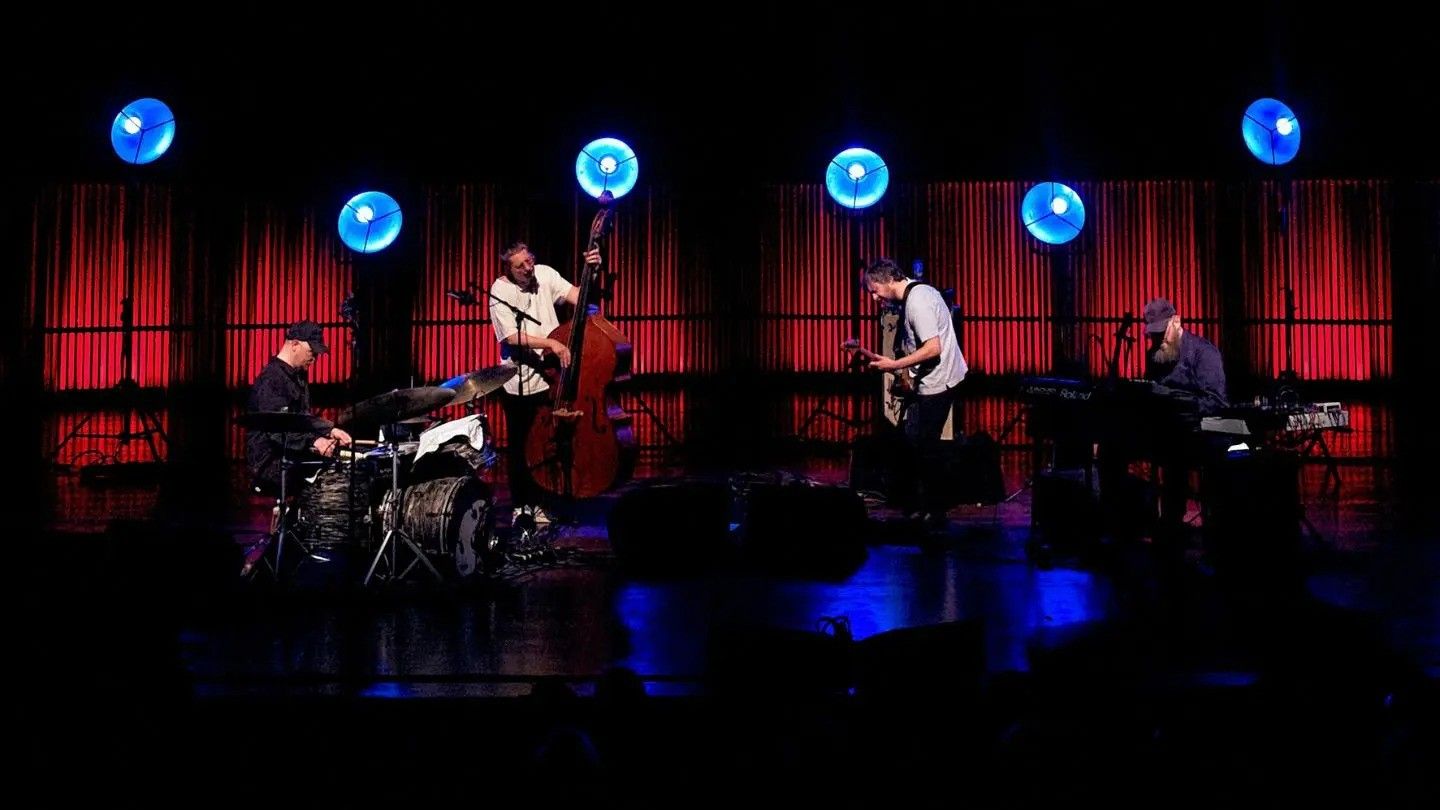
Members: Anders ‘AC’ Christensen (bass), Jonas Struck (guitar), Nikolaj Torp Larsen (keyboards), Sebastian Rochford (drums)
Nationality: British (Sebastian), Danish (rest of the band)
Recent event: Astral Cinema are among the artists featured at Sounds of Denmark, a celebration of Danish jazz that takes place in London and Southampton on September 25th and 26th 2025. For more information and tickets, go here.
Recent release: Astral Cinema's self-titled debut album is out now.
Shoutouts: Jakob Bro (DK), Kresten Osgod (DK) ILK (DK Label) Vortex (UK Venue) Copenhagen Jazz Festival (DK) London Brew (UK).
[Read our Jakob Bro interview]
[Read our Kresten Osgod interview]
[For our conversation with a London Brew member, read our Nubya Garcia interview]
If you enjoyed this Astral Cinema interview and would like to stay up to date with the band and their music, visit them on Instagram, and bandcamp.
What were some of the musical experiences which planted a seed for your interest in jazz?
Jonas: My music teacher gave me 2x Maxell 90mins cassette tapes filled with jazz guitar solos by John McLaughlin, George Benson, Mike Stern, Charlie Christian and of course Wes Montgomery.
The pieces faded in at the beginning of the solo part and faded out at its end.
What does the term jazz mean today, would you say?
Nikolaj : A wide crossover genre which leaves space for spontaneity, improvisation, being present in the music and exploring the unknown.
As of today, what kind of materials, ideas, and technologies are particularly stimulating for you?
Jonas: Nature, visuals, literature and scripts when scoring music for movies.
Where do most of your inspirations to create come from – rather from internal impulses or external ones? Which current social / political / ecological or other developments make you feel like you need to respond as an artist?
Nikolaj/Jonas: Both, as the internal impulses are constantly influenced by the external.
We personally cannot refrain from reacting to the social / political / ecological and other developments in the world we live in.
Tell me a bit about the sounds & creative directions, artists & communities, as well as the colleagues & creative hotspots of your current hometown, please. How do they influence your music?
Jonas: In Denmark, the jazz scene has always been open with no musical borders. Jakob Bro is a good example of mixing genres and also poetry. Collaborations with other artists, various genres, movie directors, editors, sound designers, the teamwork around visualising a movie and its score.
Nikolaj: DUB and the sound system culture of London have been a massive influence on me.
What role do electronic tools and instruments play for your creative process?
Nikolaj: The analogue synths help me visualise the sounds I have in my head and modular synthesisers can also inspire and take me in an unexpected direction. I consider all FX units instruments.
Thanks to technological advances, collaboration has become a lot easier. What have been some of the most fruitful collaborations for you recently and what approaches to and modes of collaboration currently seem best to you?
Nikolaj: We do it all the time. It also means that the creativity does not have to stop when working with artists in different time zones.
But NEVER underestimate the power of being in the same room, letting the energies flow!
Jazz has always had an interesting relationship between honouring its roots and exploring the unknown. What does the balance between these two poles look like in your music?
We strongly believe that we subconsciously mix all the experiences and inspirations, genres and sounds that are stored in our brain from the moment we are born.
How much potential for something “new” is there still in jazz? What could this “new” look like?
There are (almost) unlimited possibilities of mixing genres, textures and sounds.
Could look like a picasso painting ?
For many artists, life-changing musical experiences take place live. How do you see that yourself?
Being in the same creative mind space as an ensemble, “instant composing” rather than individual soloing, never losing narrative of the storytelling of each composition can be pretty mind-blowing.
How, would you say are your live performances and your recording projects connected at the moment? How do they mutually influence and feed off each other?
Equally connected, as composing often happens on stage as well as in the studio.
What, would you say, are the key ideas behind your approach to improvisation?
“Instant composing”, being in the same mind space, completely open, acting/ reacting.
The Montreux Festival intends to preserve its archive of recordings for future generations. Do you personally feels it's important that everything should remain available forever - or is there something to be said for letting beautiful moments pass and linger in the memories of those that experienced them?
Nikolaj: Anything that can inspire future generations should obviously be available, It will never be the same experience watching a recording of a live show as being there anyway.
Not a fan of audience recording live music on their phones though, as it sometimes breaks the energy of being present in the moment.