Published
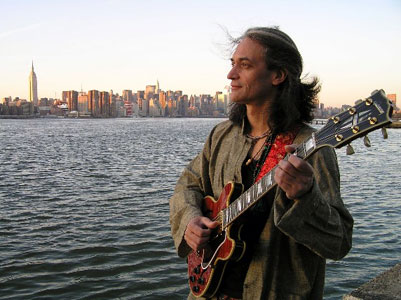
Name: Bele Beledo
Nationality: Uruguyan
Occupation: Guitarist, pianist, composer, improviser
Current release: Bele Beledo's new album Flotando en el vacio, featuring Jorge Pardo (flute, tenor sax), Carles Benavent (bass guitar), Asaf Sirkis (drums) as well as Gary Husband (Fender Rhodes electric piano, Mimi Moog) and Ramon Echegaray (candombe percussion) is out via Moonjune.
If you enjoyed this Bele Beledo interview and would like to know more about his music, visit his official homepage. He is also on Instagram, and Facebook.
What were some of the musical experiences which planted a seed for your interest in jazz?
I grew up studying classical music and after The Beatles I got interested in the blues and Hard Rock, later what is now known as Progressive. During that time I learn about George Benson, John Coltrane, and I continue digging in the past to find Coleman Hawkins and Ben Webster.
But since I was a little kid I always associated jazz with an abstract version of a phrase that resembled the opening riff of "Donna Lee."
One day, I think in 1974 or so, at the hall of the Faculty of Architecture where I was studying, there was a jazz concert by this legendary Uruguayan band called “Tres Para El Jazz” and one of them encouraged me to go to the weekly session at the Hot Club de Montevideo.
I started playing modern jazz tunes by Freddie Hubbard and Herbie Hancock before really digging on old standards.
How do jazz and jazz culture factor into your artistic processes and the music resulting from them?
I am definitely a self taught jazz musician, always finding the materials to study that really interest me, never adjusting to any particular program.
Playing standards to me was always what happens in jams or cocktail types of gigs, because as a composer I was never attracted to make another recorded version of any standard. I always favour using all my knowledge and experience to write new and challenging compositions unless I have a strong passion for a particular piece, like when we recorded “Seriously Deep” by Eberhard Weber.
What does the term jazz mean today, would you say?
It is difficult to say because when I say “jazz” I think of swing, be-bop and blues. But jazz has the license to steal from all of the ethnic musics of the world and incorporate them.
Jazz has a wide spectrum. However the jazz police can be picky and discriminatory in my opinion.
Jazz was about a lot more than just music in the 60s and 70s, from politics to fashion. For you personally, is jazz still a way of life – and if so, in which way?
I do think that jazz is a way of life for those that wish to belong to it.
For me personally is a way of expressing myself and it is firmly stamped in all of the music I’ve made. But I don’t see it from a politics or fashion perspective.
Many people perceive jazz as a genre with high barriers of entrance, both for listeners and musicians. What have your own experiences been in this regard?
I was so naive when I started with jazz that my first self-assignment was transcribing “Giant Steps,” little that I knew that that was more suitable as a graduation piece.
It was a positive experience but the reality is that it takes time and time to listen and really digest intellectually enough to naturally enjoy music of certain complexity or trend.
I remember listening to Stravinsky and hearing something dissonant, but later in life the same piece was completely melodic. It is all subjective.
Derek Bailey defined improvising as the search for material which is endlessly transformable. As of 2024, what kind of materials are particularly stimulating for you?
Listening to good players or just playing the music that I am working on at the time is very stimulating, a constant development.
Melody phrasing and counterpoint are very important focuses for me and I try to practice Slonimski Scales and Yusef Latif melodic patterns here and there for technical inspiration.
It all seems so abstract but it is great when you can apply concepts to play real creative and interesting music.
What, would you say, are the key ideas behind your approach to improvisation?
My original idea of improvisation was definitely the vocabulary of the blues, the minor-major mystery that I now I understand as the ever dominant chord environment. Then I love to add the idiomatic phrasing of the bebop to it as long as it is well hidden with creativity.
Knowledge of scales and arpeggios is a must, but freeing your expression of your heart through the style is what counts, whether it is one note or a lot.
How would you describe your relationship with your instrument – is it an extension of your self/body, a partner and companion, a creative catalyst, a challenge to be overcome, something else entirely?
It is all of the above, though it always challenges you to be better and you never get there.
Some days it feels like you are one with it, but the goddess of music will abandon you the moment you don’t give her the time she needs.
Jazz has always had an interesting relationship between honoring its roots and exploring the unknown. What does the balance between these two poles look like in your music?
My music will definitely tip the scale towards exploring the unknown because I take from jazz what I need to get to where I am going.
If the listener can hear jazz in it, then that is my way to honor those roots.
What are currently direction in jazz or jazz-adjacent communities which you personally find interesting?
I am so lucky to belong to the community of phenomenal artists related to Moonjune Records. I got to play with Soft Machine, Dwiki Dharmawan, Nguyen Le, Dewa Budjana, recorded with Tony Levin, Gary Husband, Carles Benavent, Jorge Pardo, and I got to admire and listen to many alternative European jazz musicians that are not originally American like myself.
Through living in the US I admire composers and arrangers like Vince Mendoza and Billy Childs, those are our contemporary giants of jazz. At the same time, it was awesome to have in New York the sadly closed 55 Bar with Mike Stern and Wayne Krantz. I loved the modern approach of Felix Pastorius.
[Read our Soft Machine interview]
For many artists, life-changing musical experiences take place live. How do you see that yourself?
I agree, I still remember my first professional performance at 14 years old and all of the concerts and festivals that shaped me as an artist through the years.
How, would you say are your live performances and your recording projects connected at the moment? How do they mutually influence and feed off each other?
Whether I am playing my music in the studio or in a live performance it is always my music, even when I play it with different instruments. The difference would be when the timing of the recording is coherent with the tour, then we get to play the same live.
That said, most of the time I play a list of compositions from different albums and am always pushing forward new material, because my generation was one of infinite creativity forward, instead of paying tribute to other musicians from the past.
I got to do a tribute last February 28 2024, presenting the music of my first band Siddhartha with the Montevideo Philharmonic at the Teatro Solís and it was a truly unforgettable experience.
There are various models to support jazz artists, from financial help to mentorships/masterclasses. Which of these feel like the best way forward to you?
My way forward would definitely be masterclasses because my years of experience teaching students and actually doing masterclasses.
Playing music that can be admired by connoisseurs is the wonderful honor that I have and it was my goal from the beginning. However it is hard to survive when it is not commercial enough.
Musicians like me need financial help of any source. I could be good with a fingerboard or a keyboard, but typing the necessary documents is an impossible task for a brain full of musical notes.
Are there approaches, artists, festivals, labels, spaces or anyone/-thing else out there who you feel deserve a shout out for taking jazz into the future?
The inclusion of jazz in the mainstream was happening before, but somehow the promotors are not promoting anything, they are just booking what they know will have the returns they need.
The Montreux Festival intends to preserve its archive of recordings for future generations. Do you personally feels it's important that everything should remain available forever - or is there something to be said for letting beautiful moments pass and linger in the memories of those that experienced them?
It is always good to be able to go back in time and witness something transcendental. A score by Bach, Chopin, it would have been so magical to have been able to get a video of them, but they left papers and a code that could be deciphered.
Maybe those recordings are going to be like that paper compared to the thick holograms and who knows what would be there if there is still life on this beautiful planet.