Published
Name: Ben Stapp
Occupation: Tubist, composer, improviser, educator
Nationality: American
Current release: Ben Stapp's new album Uzmic Ro’Samg (Live Solo Tuba) is out October 24th 2025 via 577.
Hometown Recommendations: Food in Queens, NY (where I live) is spectacular. My hometown is Sacramento and I recommend the Train Museum, not just for the kids; it’s a beautiful museum.
If you enjoyed this Ben Stapp interview and would like to know more about his music and upcoming live dates, visit his official homepage. He is also on Instagram, and bandcamp.
Where does the impulse to create something come from for you?
Until I can accurately articulate and express my phenomenological experiences in a clear and magical way, I feel I still have work to do as a composer and performer.
This is the impulse that drives me to create.
What role do often-quoted sources of inspiration like dreams, other forms of art, personal relationships, politics etc play?
For political reasons, since I am a pluralist, I feel empowered to artistically pursue anything that is authentically me.
As far as text is concerned, science fiction entertains my desire to ‘get off the beaten path’ as Octavia Butler says, and Tibetan Buddhism provides a refuge. My reading is focused on those two subjects.
For you to get started, do there need to be concrete ideas – or what some have called a 'visualisation' of the finished work? What does the balance between planning and chance look like for you?
For my larger projects like my opera and my current textual and music work in the Eono universe, I had inspiring, daydream-like images flash before my eyes. They were like memories from a performance from a future-me.
I spend my time now trying to realize the entire work that the memories came from. I think it is similar to how August Wilson crafts his plays from a single line, but this is more visual. From the visual comes the structure and the sound.
When I am in the zone of composing and making music I am just thinking in terms of music, working on accurately expressing what I am hearing.
Is there a preparation phase for your process? Do you require your tools to be laid out in a particular way, for example, do you need to do 'research' or create 'early versions'?
I usually create a series of obstacles for myself, consciously and unconsciously before I am ready to start putting notes to paper.
For all the recent music related to the world of Eono, I have spent many years creating a set of music laws that puts many restrictions on my process. There is an intuitive aspect to the process that remains but it is within the jail cell of this set of rules.
Do you have certain rituals to get you into the right mindset for creating? What role do certain foods or stimulants like coffee, lighting, scents, exercise or reading poetry play?
As a father and a public school teacher, I have to make sure all of my work and family duties are in order before I feel like I can get in the creative zone.
I only have so much energy in the day, but if I feel especially inspired, due to some creative vision, I am able to do much more with less sleep.
For Uzmic Ro’Samg, what did you start with? If there were conceptual considerations, what were they?
I started with creating a set of rules in music. This took several years to develop but what I was left with was over 100 scales and specific ways one set of pitches modulated to another. I called it Theta Harmony.
Once the new harmony was crafted I decided it needed a home. I decided to map out a universe in which Theta Harmony was an ontological building block. In this science fiction world I call Eono, individuals could travel through space-time by entering and leaving the energy channels of a multi-dimensional being called a Keeper. Each location in space-time could be described as a resonance or scale. Travelers had to learn how to modulate between these scales in order to get from one to another.
Once this ontological system was set, a narrative began to unfold and I ended up with a novel that is now in its second draft, a painful process, especially as an amateur writer.
In the process of finishing the novel, I learned more about this world as it started to talk back to me. Aspects of rhythm became defined, which I hadn’t considered before. I also started to learn about the other creatures that lived on the planet and how they interacted with colonists or Moonshipers as I call them.
It became clear to me that the themes and characters in the book had musical qualities to them, further elaborating the Theta systems in more nuanced ways; ways that I couldn’t have seen before just looking at the music theory. From these more abstract and figurative qualities I was able to create improvising structures that paved the way for the album Uzmic Ro’Samg.
Tell me a bit about the way the new material developed and gradually took its final form, please.
The Uzmic Ro’Samg is not unlike the Dharmakaya in Tibetan Buddhism. It is a pervasive force in the universe where everything goes back into. It is something hard to define and because it escapes convention, it is closer to reality without conceptualization.
There are a set of tracks on the album where I use only extended techniques and hearing the natural sound of the tuba is intentionally subverted, although it is because of the tuba that the sound is created.
There are another set of tracks that use some alteration of the natural tuba sound. These tracks also feature some rhythmic and melodic conventions but also find ways to blur the line. “Oss” and “Sciastica Neon,” are examples of this, both literary themes in the book that traverse the conventional and abstract.
The other set of pieces like “Errathemuel” and “Egdon” are musical pieces where the natural sound of the tuba is featured as well as conventional jazz language. These characters in the story, like the music, are very accessible.
Many writers have claimed that as soon as they enter into the process, certain aspects of the narrative are out of their hands. Do you like to keep strict control or is there a sense of following things where they lead you?
Yes. I find this to be true with melody and rhythm as well.
Once you start writing something, it is beneficial to stop, wait and try to listen to what it wants to do without your input.
There are many descriptions of the creative state. How would you describe it for you personally? Is there an element of spirituality to what you do?
For me, being in the creative state is a sign that I am in a good place mentally.
I’m still trying to understand this myself.
Once a piece is finished, how important is it for you to let it lie and evaluate it later on? How much improvement and refinement do you personally allow until you're satisfied with a piece? What does this process look like in practise?
I’m not big into revising. I usually throw things away that require me to endlessly revise.
My ideal creative objects, that I successfully see through to the end, carry with them a seed that sees its own natural completion. I find myself just taking notes and following it where it goes.
How do you think the meaning, or effect of an individual piece is enhanced, clarified or possibly contrasted by the EPs, or albums it is part of? Does each piece, for example, need to be consistent with the larger whole?
As a listener, if I like several selections from an album, I come to find meaning between the different tracks myself and then check in with the intentions of the author to see if I can relate.
As a composer and someone who makes projects and albums, I think of the whole and how the tracks fit with the overarching concept.
As a listener it doesn’t matter as much but as a creator, I start from the larger concept.
What's your take on the role and importance of production, including mixing and mastering for you personally? In terms of what they contribute to a song, what is the balance between the composition and the arrangement (performance)?
If you can find people who share your vision in these aspects, it will enhance of course.
Music and the accompanying artwork are often closely related. Can you talk about this a little bit for your current project and the relationship that images and sounds have for you in general?
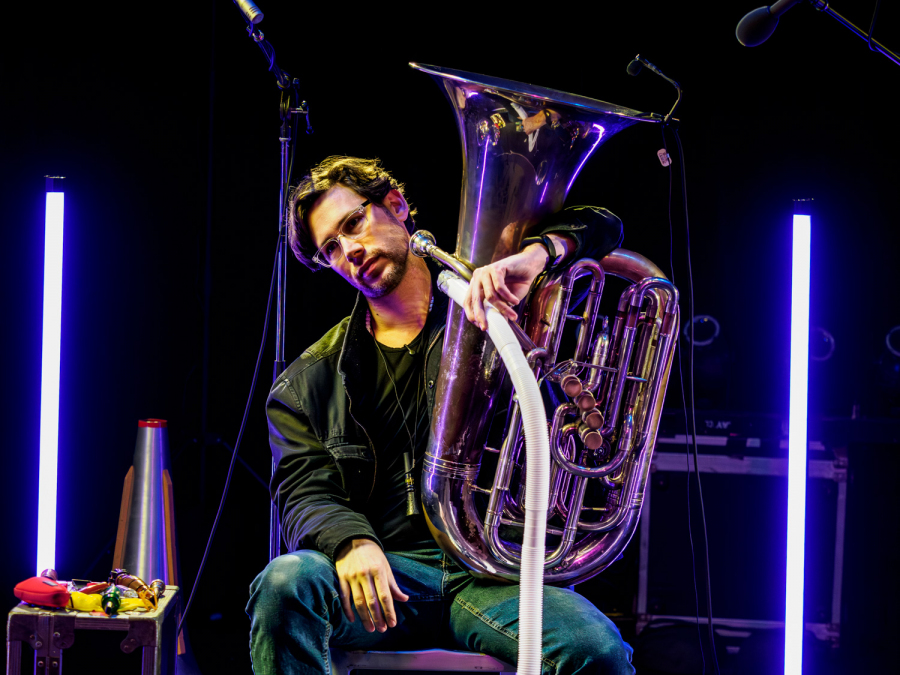
I want people to know what they are buying so that’s why I chose the album picture to be of me and my setup.
After finishing a piece or album and releasing something into the world, there can be a sense of emptiness. Can you relate to this – and how do you return to the state of creativity after experiencing it?
It’s not a good place to be constantly thinking about what other people think of you. That is the only downside of finishing a project. It is much healthier to get back into the creative space and concern yourself with expressing your visions.
I’m very bad at self promoting and the ‘what-to-do’ once something is finished. This has not always worked in my favor. I usually prefer to just start a new project and don’t bother with the promotion part.
For this album, since it is featuring my instrument in the forefront, I think it was important for me to consider how it was being presented. This was why I wanted to get videos of the recording.
Creativity can reach many different corners of our lives. Do you personally feel as though writing a piece of music is inherently different from something like making a great cup of coffee? What do you express through music that you couldn't or wouldn't in more 'mundane' tasks?
People have been very positive with this album.
I wanted it to transcend the instrument and the music and to conjure ‘something-else’ for people and I feel the responses have alluded to this.