Published
Name: Berenice Llorens
Nationality: Argentine
Occupation: Producer, composer, guitarist, sound artist, improviser
Current release: Berenice Llorens is one of the artists contributing to the new compilation Atmosphères Vol. 1, curated by Emme Moises and released via Atmosphères Records.
If you enjoyed this Berenice Llorens interview and would like to know more about her music and upcoming performances, visit her official website. She is also on Instagram, Soundcloud, and bandcamp.
How did you get in touch with Emme and Atmosphères (or how did Emme get in touch with you)?
I’ve known Emme for more than fifteen years. We met when we started studying composition at the University of Córdoba in Argentina and were part of the same group back then. I remember her house was also a regular meeting point for gatherings and small parties.
Then, we each followed different paths, but reconnected when I arrived in 2022. She immediately invited me to perform at her album release, and since then we’ve stayed connected both as friends and collaborators.
She later invited me to join Atmosphères, around its second or third edition, and since then we’ve also shared improvisations, radio shows, and other projects.
When you look at the artists who have been part of Atmosphères – do you think that despite all of you having very distinct personalities, there are musical/creative aspects that most of you share?
I think what brings the artists together in Atmosphères is a shared desire to expand beyond where each of us is musically. While there may be some overlaps in tastes, textures, or sonic choices, what connects us more is the intention to move beyond the boundaries of genre and to engage in sonic exploration.
There is also a common interest in attentive listening, both from the artist’s perspective and as something we invite from the audience.
Describe the creative process for your contribution to the sampler VA, please.
“Vibration” was made in my first studio in Berlin. At the time, I was sharing the space with several artists who had a variety of synthesizers, like the Jupiter, SH-101, and Hydra—which I explored one by one, recording improvisations and finding sounds. Some of the textures in the final track emerged from those sessions.
In this piece I move from electroacoustics to ambient, electronic, and sci-fi music influence. My search is always guided by what resonates with and by images that I bring from different environments. I didn’t start from a fixed concept, I let it grow. In this case, I imagined a mountain vibrating from within. I think about the pulse of that vibration and how it interacts with my own human pulse, when they align and when they challenge each other.
From there, I began finding elements, nuances, and textures, also reinterpreting what comes from outside. Then I put everything together, the thoughts, the wind, birds, or the noise of a distant machine, building a sonic territory from that inner image that was once outer.
The press release to Atmosphères Vol. 1 emphasises the importance of active listening. What does active listening mean to you and how do you practise it?
For me, active listening is not only an artistic practice but a way of being in the world. It is something that has been present in me since childhood, a way of inhabiting spaces, relationships, and even my own body.
I feel I am part of something bigger, and I inhabit that whole in multiple ways, but my preferred way is through observing and listening. This also comes from a more introverted or quiet way of being, where I tend to engage from calmness and stillness, which allows me to perceive everything around me more deeply.
In my practice, I work with field recordings, mainly from natural environments in the Argentine native forest. Of course, in our current times there is a very thin line between what is considered “natural” and what is not. Still, the Córdoba native forest, in my perception, preserves a certain state of austerity or something more unaltered, where the space itself becomes sonorous, whether through the beings that inhabit it, through thoughts, or simply through the act of being there with the landscape and yourself.
From these spaces I propose or construct atmospheres that invite an attentive and immersive form of listening. I weave sonic materials from different environments, from the forest, industrial places or my own instrument and I put them into new sonic territories that the listener completes through their own perception, memory, and imagination. What I try to reconstruct is not the landscape itself, but the state of listening that these environments provoke, and to bring it into other contexts and places.
Through these sonic layers and constructed territories, I aim to activate a sense of deep observation and active listening, an invitation to slow down and inhabit sound differently.
Do you think that as an artist it is possible to create music that actively encourages active listening – or is a quality that the audience has to contribute?
As an artist, and also through curatorial work, it’s possible to propose contexts that open up this way of listening or inhabiting a concert. But in the end, it is the audience who completes that intention. Not all music is meant for active listening, and not all audiences are able to enter that state.
I think it is a relationship: from the artist or curator, one can try to activate other modes of listening or propose experiences that go beyond the audience’s usual habits. Sometimes the audience connects and stays; other times they simply don’t connect, get distracted, bored, or start talking.
Personally, I’m interested in the idea that, beyond genre or context, this way of inhabiting can be invited and even cultivated, not only in listening, but in our environment more generally, whether in music or in everyday life. Even at home, the number of machines we constantly hear like dishwashers, washing machines, etc, produce a kind of sound pollution that often affects the way we live. I feel that the immediacy in which we live today, and the way we consume, directly impacts how we listen.
Musical platforms often encourage an automated form of listening, where the listener doesn’t always know what they are hearing, or simply doesn’t care. In that sense, projects like Atmosphères, which began within a club context oriented towards electronic music, function almost as an intervention or a rupture that opens up other possibilities: a proposal that shifts listening towards another place.
This not only enriches the space, but also allows audiences who may not be familiar with these practices to at least come into contact with them.
What role does community play for your interest in production and getting better as a producer – such as the one around Atmosphères?
In terms of the technical side and sound engineering, I think it’s important to keep growing, studying, and improving in order to offer the best possible version of what you have to share, especially in a context like Berlin, where the scene and its standards are very high. In that sense, having colleagues and a community where you can grow alongside others, learn from them, and share your own knowledge is very enriching.
On a compositional level, I see production as closely connected to what each artist needs to express, explore, or share. I believe in the singularity of each artist and in what each person brings from their own experience. Nurturing those differences is essential.
Of course, there are influences and moments when many artists seem to move in similar directions. While that can create a sense of belonging, I’ve always tried to maintain some distance, in order to preserve my own voice. When the focus shifts too much to the outside—whether to fit in or meet expectations—it becomes easy to lose intuition in the creative process.
Since I started making music almost 20 years ago, I’ve followed a path of constant transformation, moving through different bands, scenes, and musical languages. Each community I’ve been part of has taught me something, and over time these experiences have helped me grow while also reinforcing a personal voice.
What kind of musical/sonic materials, and ideas are particularly stimulating for your own work right now?
Mm, I think I’m going through a kind of return at the moment. For quite a while now, I’ve been working with a similar set of materials: pedals, field recordings, objects, acoustic and electronic instruments, spoken word, guitar with extended techniques, digital processing, samplers and computer music. Over time, my sound has become more abstract, especially in terms of harmony and melody, compared to 4-5 years ago.
Although I enjoy it and feel I’ve reached a very interesting and a nice place, I’ve started to miss more lightly processed sounds: a classical guitar, a bass, a piano, harmonies based on fourths and fifths, and even lyrics or certain forms of classical music. Modular synthesizers are something I still find very interesting and full of potential, and I continue to be drawn to them, maybe at some point I’ll start incorporating them gradually.
I perceive my work as cyclical. So this return could be understood as a cycle, where ideas and musical materials return in different forms. This movement keeps transforming my practice, feeding my personal search, and keeping it alive.
Tell me a bit about the sounds & creative directions, artists & communities, as well as the colleagues & creative hotspots of your current hometown, please. How do they influence your music?
At the moment, I’m moving through two main scenes.
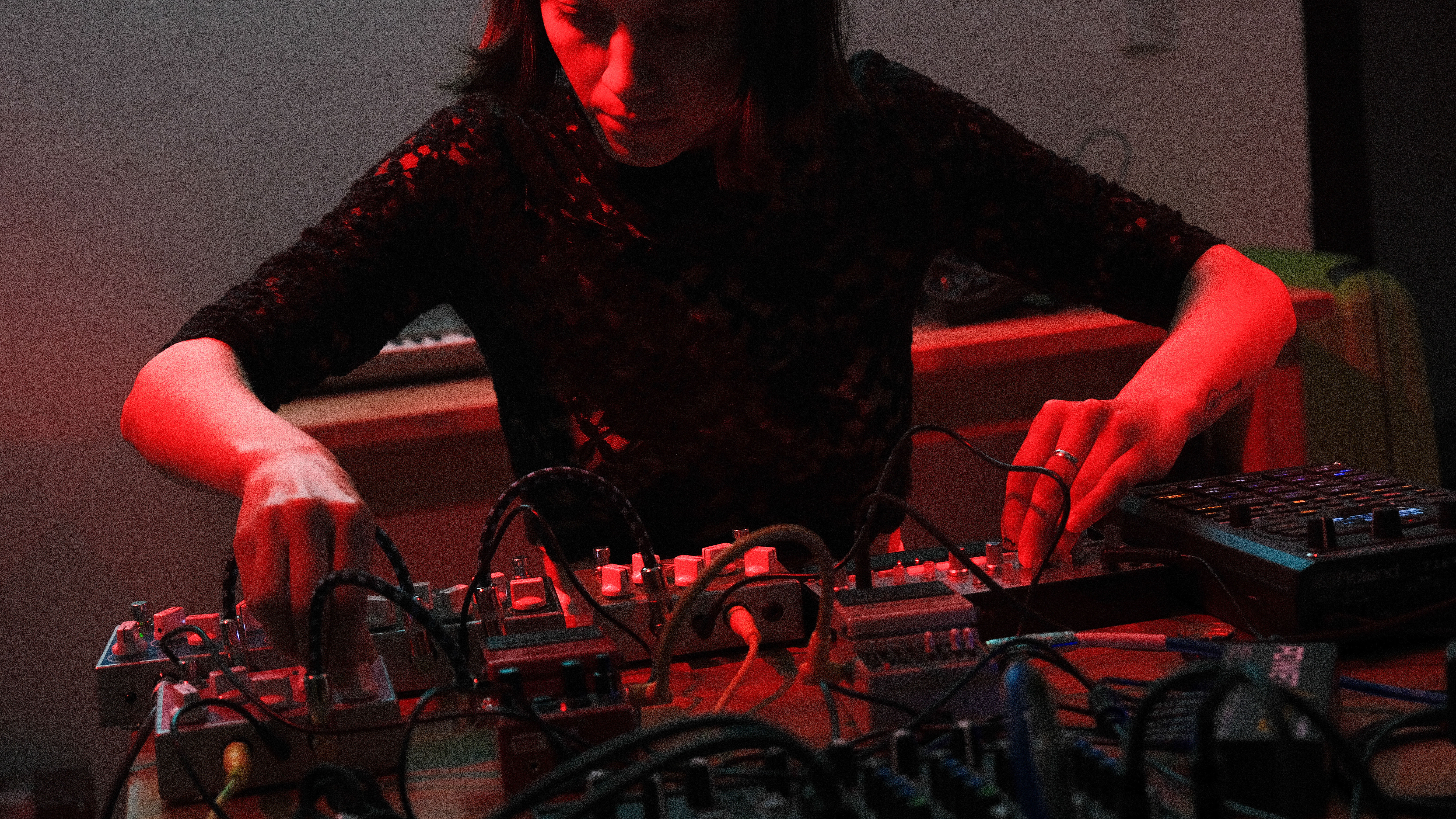
One is the noise and free improvisation scene, where I usually perform just with guitar and pedals. The other is the experimental music and sound art scene, where I present my compositional and electronic project with a full setup. I also still inhabit, although less consistently now, the electronic music and club scene, where I continue to play DJ sets of techno and experimental music a few times a year.
One of the key aspects of my practice across all these contexts is collaboration. In recent years, I’ve met and worked with many artists from different parts of the world, and these exchanges constantly feed back into my personal work. I see collaboration not only as a way of sharing music, but also as a way of learning and exchanging knowledge, experiences, and ways of being. It really contributes to how I grow both as an artist and as a person.
Spaces such as Neue Zukunft, Richten 25, PAS, Dim Thing, Panke Culture, ACUD Macht Neu, SOWIESO, Refuge Worldwide, Morphine Raum, TRXXTR, OHM, Madame Claude, Hosek Contemporary, 90mil, Villa Kuriosum, and many others have been important places where I’ve shared work across different collectives, scenes, and contexts.
Taking your track for the compilation and your live performance for Atmosphères as an example, how, would you say, are your live performances and your recording projects connected at the moment? How do they mutually influence and feed off each other?
In the studio, or when I set myself to compose and produce, the process usually begins with improvisation. My entire setup is connected and I record continuously without thinking too much in advance, although I am in a receptive or meditative state, open to something emerging. I am not thinking in fixed structures or predefined ideas.
Later, I listen back to the material and, if something stands out, I take it and that becomes the starting point for a more focused compositional process. From there, I develop the material in depth, sometimes using sketches, drawings, or visual notes as a kind of score. I expand it until I often realize there are too many layers, and then I enter a process of reduction, cleaning, mixing, organizing, and repositioning elements. It becomes quite an obsessive process.
I would say that around 30% comes from improvisation and 70% from compositional work. That initial 30% is essential, I often prioritize the first take over technical perfection because it contains something unrepeatable. That is how my recorded pieces are built.
In my live sets, the balance shifts. It is often around 50/50 or even 40% composition and 60% improvisation. I work with a catalogue of materials, samples, sounds, and textures that I can access easily, but what happens in performance is also shaped by the space, my emotional state, the audience, the sound system, and how I hear myself. Everything influences the outcome.
I see a clear connection between both processes, but also subtle differences. In the end, I am one person working across different situations, and I try to keep both practices close enough so that someone listening to an album or a performance can recognize my language, while still allowing each format its own identity.
In that sense, the live set functions as a living expansion of my compositions.