Published
Name: Bikini Beach
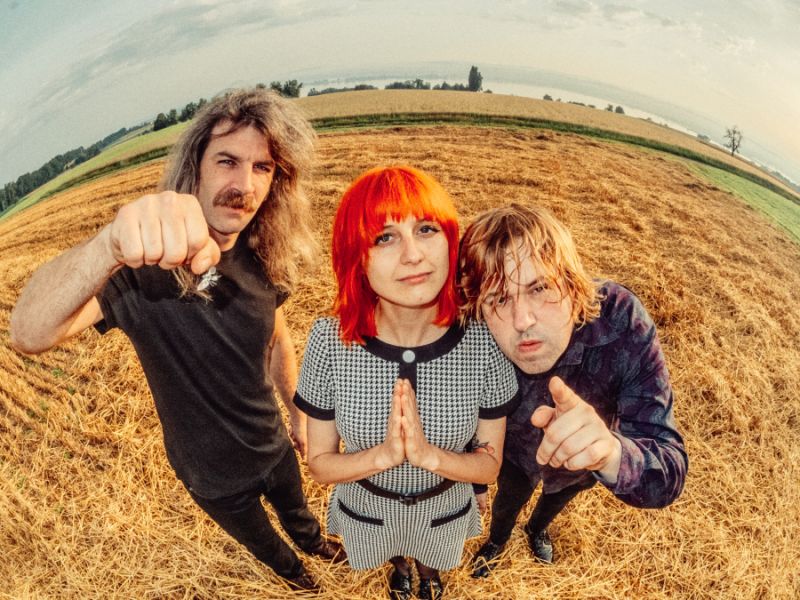
Members: Nils Hagstrom (vocals, guitar), Charlotte Love (bass), Manuel "Flip" Oetlli (drums)
Nationality: German (Nils, Charlotte), Swiss (Manuel)
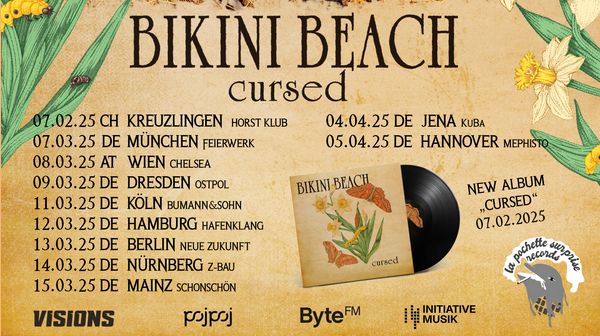
Current release: Bikini Beach's new single “Family” is out via La Pochette Surprise. Their new full-length album cursed will follow February 7th 2025. Pre-order it here.
The band are also about to embark on an extensive tour: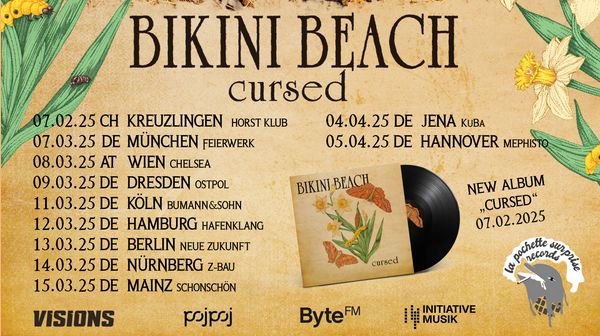
Recommendation for their current hometown: Lotti: I live in "Konstanz" (Lake Constance), the area is very beautiful. And you can always go swimming. Also, we all love the Horst Klub in Kreuzlingen, great bands play there.
If you enjoyed this Bikini Beach interview and would like to find out more about their music and upcoming live dates his music, visit their official homepage. They are also on Instagram, Facebook, and bandcamp.
Are there examples of minimalism in music – and outside of music - that impressed you early on?
Flip: My neighbors were addicted to drugs. They were always nice and had almost no material things. Sometimes not even food.
I was really impressed that they actually only did one thing to make them happy.
Were you ever interested in minimalism as a style – from the Philip-Glass-variety to solo instrumental work to minimal techno? If so, tell me a bit about your interest in this.
Flip: No I don’t like this music style to much …. am just a fan of DJ Bobo. Eurodance was hitting me more than techno as a child.
Do you tend to find that, as many claim, “less is more?” Are the notes you don't play really as important as the ones you do play?
Flip: I think this is a big challenge and I try to to that in some songs. In “King Ueli”, the drumming is very easy and kind of always the same … just very small things are different.
Lotti: I love music that gets by with little and deliberately sets its accents. Subtle differences that have a big effect. Deliberate pauses, deliberate accents.
I tend to get bored with big digressions in songs, although I know that can be an art in itself.
Do you feel as that making music is a process of adding elements until it is done – or one where you chisel away pieces from something that is already there?
Flip: The former.
Lotti: Both. In the beginning you have to add something in order to create something. And sometimes you cut too much, so you have to add something again.
Making music is always a process that I don't think you can always influence so much. Sometimes something just comes out of playing together that you can pick up later and shape, and sometimes you ruin a song by tweaking it too much.
Many artists are becoming more minimalist in their music as the years go on, focusing on the “essence.” How is that for yourself and how would you describe your development in this regard?
Lotti: I don't know if you can define it so clearly.
On the one hand not really, because when I started with music I knew almost nothing, because I taught myself everything. As a result, the music was very minimal and simple, but also not very well thought out and mature. We also like to try out new instruments in the band and like to add little, subtle background noises that you might not even notice the first time you hear them and that fade into the background.
On the other hand, we have become much more focused when it comes to writing songs. At some point you just know what works well and what is more difficult. It's often a case of less is more.
Flip: As older I get, there are more things am getting in touch with. I love trying new things and bring them in too music. Sometimes maybe a bit to much …
What were some of the starting points for your most recent release?
Lotti: Our new album is called 'cursed' and that describes it quite well. It's a bit darker, especially the lyrics, and very personal. Private crises, but also the general mood in the world played a big role in the lyrics, the music is powerful and pushing forward.
Rod from 'Die Ärzte' emphasised completely new aspects during the mixing process and overall I think it's our best album so far.
How did a minimalist mindset possibly inform the creative process?
Lotti: In my head I'm anything but minimalist, the ideas just sparkle.
It helps me to write down the most important points and I like to work in a tidy environment so that I can concentrate on the essentials.
Do you like to set yourself limitations? If so, which were some of those limitations for the new pieces?
Lotti: The biggest and most important limitation is time. I used to get upset when I started too late because I felt I could have done so much more. Now I like it because I often get lost. Nils is much better than me, he can finish songs faster.
I would say that both Flip and I are more the dreamers, it's harder for us to stop and say: That's enough. And then it often happens that you get completely lost and ruin things.
Thanks to sampling and digital synthesis, there are endless possibilities for sculpting the sounds and overall sound design of a piece or album. What are your considerations in this regard?
Flip: It's nice for some things but for me it's too many possibilities.
I think the challenge is too bring everything out of the things you have, and not to choose from everything. I like real instruments.
Would you say that you approach your creative tools with a minimalist mindset? Or do you need a wide choice of instruments and tools to make music?
Lotti: We have a pretty simple basic structure, drums, guitar, bass. And two voices. At concerts it's the best thing ever, because you can throw the energy forward in a raw and wild way, the audience picks it up and gives it back. It doesn't take long for anyone to listen too closely, they're just enjoying the evening.
On the record I really appreciate having different instruments to choose from and taking the time to work out different guitar tracks or record something completely new. We have a pretty good collection of different instruments now and we're not above looking for squeaky toys in dollar stores and incorporating them in different ways. It's just fun.
What were some of the most important pieces of gear or instruments for this release?
Flip: There is the 22 Ride Cymbal with a very deep sound I really like, and used a lot for drone sounds.
Reducing one's options and techniques often implies a different way of working with the materials. Tell me about yours, please.
Lotti: Well, well ... I can only play bass as well as I can play bass. And since I taught myself everything ... Well.
French producer Guillaume Duchastel told me: “Minimalism is about more than owning fewer things. It’s about focusing on what truly matters.“ What are some of your strategies for separating what matters from that which doesn't?
Lotti: If you look at my apartment: Obviously one that doesn't work so well. It's not really minimalist, it's full of a lot of things. But in my everyday life I have to focus on what's important because I'm doing too many things at the same time. As well as music, I'm currently studying for a Master's degree, have a time-consuming hobby and work in a design agency. I live by making lists, otherwise I get lost.
When it comes to music, we always concentrate on the fact that the song can work just as well live in a stripped-down version with guitar, drums and bass.
With so much incredible music instantly available, are you finding that you want to take it all in – or that you need to be more selective? How do you pick the music you really want to invest in?
Lotti: I'm often completely overwhelmed online because there's so much music, so much to discover, so many great artists. So many talented people.
I have a lot of playlists where I can just collect music. But I'm still most impressed by live music. If I've seen a band that blows everything away live, I'll buy something right away.
Flip: I just try and when its fun and hits me am sticking and listen to it all the time.
Would you say that minimalism extends into other parts of your life as well?
Lotti: Like I said - definitely not in my home. But in many other areas, be it work or study, it definitely does.
In design anyway, it is more durable to create minimalist designs that can be used flexibly. But it's also a long process and the most difficult, which clients often don't understand. They see a simple logo and think to themselves: Simple, I can do that.
But the amount of time, thought and variation that goes into it is often not apparent to people.