Published
Name: Biomania
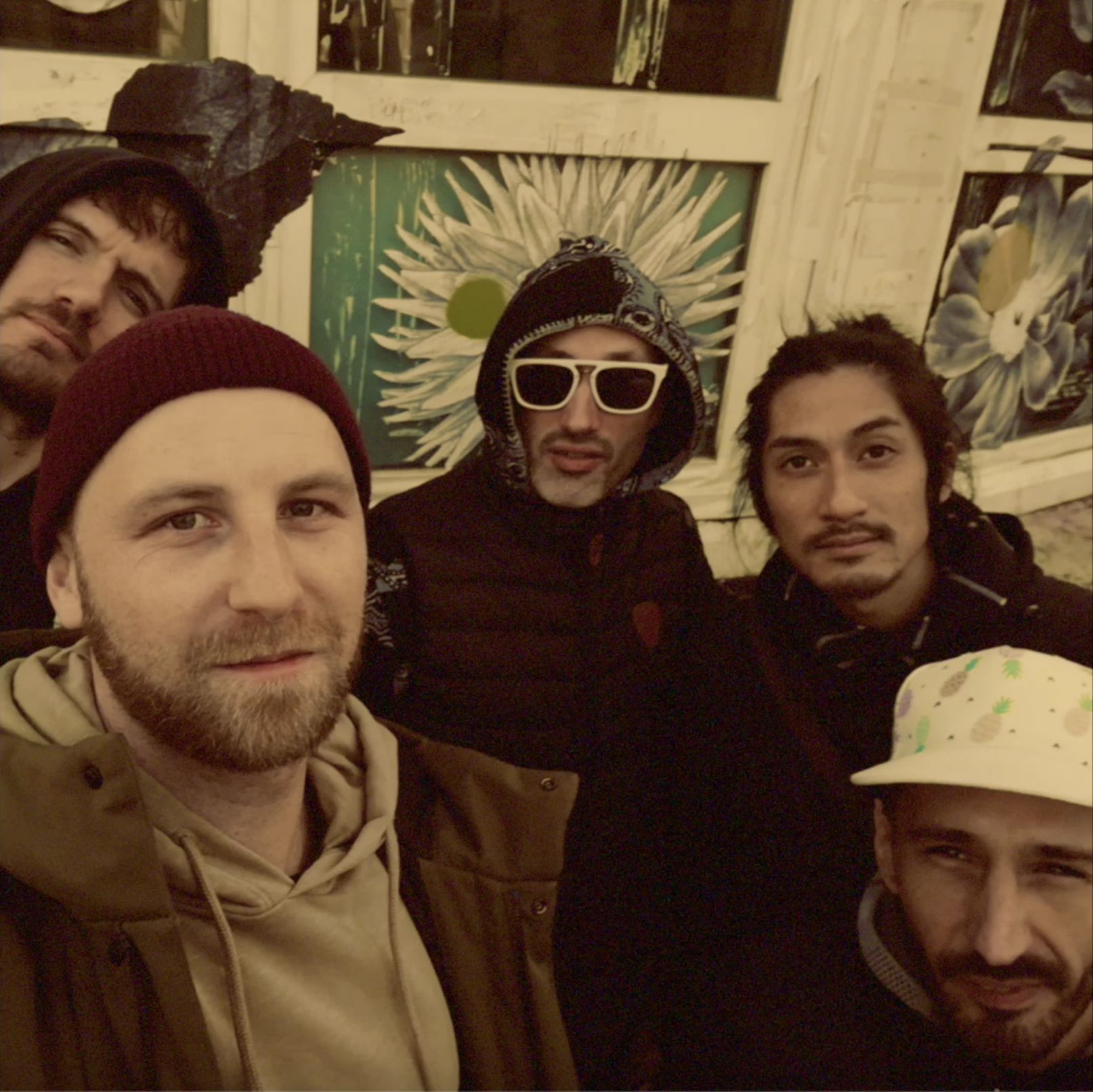
Members: Thierry Lemaitre (saxophone), Công Minh Pham (keyboards), Arthur Links (guitar), Nicolas Bauer (bass), Benjamin Pellet (drums)
Interviewee: Thierry Lemaitre
Nationality: French
Current release: Biomania's new single “Devils” is out via Most Least.
Recommendation for Paris, France:
I’d recommend La Coulée Verte, a beautiful walking path in Paris that runs through nature and urban spaces. It’s a perfect analogy for Biomania’s essence—finding harmony between contrasting elements.
Topic I rarely get to talk about:
I’m actually a big fan of contemporary classical music, particularly spectral music by Gérard Grisey and many of Ligeti’s pieces. There’s something incredibly inspiring about their work—the way they explore the raw concepts of sound and vibration feels so elemental and pure. It’s almost like my guilty pleasure to immerse myself in that world.
Even though it’s obviously far from Biomania’s music, some of those concepts and textures have definitely influenced me and will surely find their way into the next record.
If you enjoyed this Biomania interview and would like to know more about the band and their music, visit them on Instagram, Facebook, and bandcamp.
What were some of the musical experiences which planted a seed for your interest in jazz?
My first saxophone teacher, Federico Benedetti, asked me during my very first lesson if I wanted to learn classical music or jazz. I had no idea what jazz even was at the time, but I instinctively answered, “jazz.”
To show me what it meant, he played Blues & Roots by Charles Mingus (“Moanin’”) on these huge speakers in a beautiful, moquette-lined basement. I remember the sheer power of the music—the raw, messy, and beautiful sound. It was like discovering an entirely new planet of sound. I fell in love with it instantly.
That moment remains one of my most cherished memories, as it sparked my lifelong passion for jazz.
What does the term jazz mean today, would you say?
To me, jazz is no longer just a genre or style—it’s a way of creating music. It’s about minimal written instruction and skilled musicians using a broad musical vocabulary to improvise and collaborate. This vocabulary isn’t exclusive to jazz; it draws from all kinds of music.
In Biomania, I provide only basic ideas, trusting the musicians to transform them into something alive and evolving. That’s the essence of the name Biomania: “bio” reflects the organic, ever-growing nature of the music.
Today, jazz blends with so many styles that it defies categorization. Biomania, for instance, cannot be defined as a pure jazz project, since it heavily draws from hip-hop and soul.
As of today, what kind of materials, ideas, and technologies are particularly stimulating for you?
Home studio technology has been a huge opportunity for me to create music and refine my writing and ideas. It’s incredible to be able to record, produce, and explore concepts at home, almost for free. In fact, I started composing Biomania on Ableton (a digital audio workstation) during the pandemic, working on my own before adapting the pieces with the full band.
That said, the home studio comes with a danger: it’s easy to lose the freshness and organic quality of music when everything is done in isolation. That’s why I made the decision to bring together a band—to breathe life into the music and let it evolve naturally.
Where do most of your inspirations to create come from – rather from internal impulses or external ones? Which current social/political/ecological or other developments make you feel like you need to respond as an artist?
Music is a vibration that evokes feelings and moods, and that’s what I strive for—both as a writer and performer. Conveying profound emotions is a challenging but rewarding exercise.
In Biomania, larger concepts often surface in the titles—whether as figuralism or simply a feeling.
For example, it could be either an action like “DARE”, a vanished species like “DINOSAUR” or an object “DIVANO” (sofa, in Italian). I keep these ideas intentionally vague, leaving space for listeners to interpret them in their own way.
I often begin concerts with the phrase “Welcome to the biosphere,” reflecting both the chaos and beauty of life on Earth. Ultimately, it’s all about abstraction, absurdity, and inviting personal meaning.
Do you still think there are city scenes with a distinct, unique sound? How does your local scene influence your work?
Globalization is definitely having an impact on art.
Some might argue that it’s making music more uniform, but I believe that if this is happening, it’s for one of the best reasons imaginable: the ability to listen to, learn from, and collaborate with musicians from all over the world. That kind of exchange is an incredible richness, not an issue.
In my opinion, there are as many cultures and personalities in music as there are people. While every city’s music scene has its unique character, they are now more connected than ever—and I think that’s a beautiful thing.
What role do electronic tools and instruments play in your creative process?
If we’re talking about home studio tools, I think I’ve already touched on that. But when it comes to synthesizers and beat machines, I don’t see a huge difference between them and acoustic instruments—they’re just another way to shape sound and rhythm.
That said, certain electronic instruments can strongly define a style or carry specific connotations. While that can be great for adding character, it can also be risky when it comes to maintaining the overall taste and identity of your music. That’s why I’m always careful when working with synths.
Thanks to technological advances, collaboration has become a lot easier. What have been some of the most fruitful collaborations for you recently, and what approaches to collaboration currently seem best to you?
I’ve recently collaborated with people remotely on projects across countries, even continents, and it’s been absolutely amazing.
However, there’s always something extra—something magical—that happens when you’re physically in the same room, meeting and playing with the people you’re working with. That connection is hard to replicate remotely.
Jazz has always had an interesting relationship between honouring its roots and exploring the unknown. What does the balance between these two poles look like in your music?
For me, Biomania definitely honours its roots—but not just the traditional jazz roots. It also incorporates more contemporary influences, like hip-hop, neo-soul, and soul music—genres that share a deep connection with jazz in both their origins and spirit.
As for the unknown, every artist is inevitably shaped by their influences, whether they’re old or new, but what truly sets an artist apart is their unique personality and voice. That’s where the unknown comes into play: every new tune or performance is a step into uncharted territory.
As a band, we’re not really drawn to complexity for complexity’s sake. What excites us is finding that beautiful balance where the music feels and appears simple but reveals its subtleties to those who listen closely.
I love the idea of creating music that appeals to a wide range of listeners while also surprising them with little details or clever tricks—keeping it simple yet eloquent. In that way, Biomania is an honest blend of mainstream accessibility and underlying complexity.
How much potential for something “new” is there still in jazz? What could this “new” look like?
I think I’ve already touched on this a bit. As long as there are new people coming into the world, there will be new music.
The future is unpredictable, but I’m sure that new and revolutionary ideas will continue to emerge, as they always have. Since humans first started playing with sounds, we’ve been evolving creatively. I see no reason for that to stop—unless, of course, we go extinct! Haha.
Actually, we have a tune titled “Dear Humanity”—it’s not recorded yet, unfortunately, but we play it live. That one really captures the vibe of this idea perfectly!
For many artists, life-changing musical experiences take place live. How do you see that yourself?
Live performances are magical because they transcend the individual. It’s not just you, or the band, or the music—it’s a collective experience, where vibrations and emotions shape the performance. The most fulfilling part is expressing your deepest feelings and having the audience respond. That’s when the magic really happens.
I do sometimes wish that jazz audiences and venues were a little less conventional—perhaps more relaxed, or even standing up. I believe it would amplify the experience. Bodies need to be involved, not just the mind. That physical engagement can bring a new dimension to the music.
How would you say your live performances and recording projects are connected at the moment? How do they mutually influence and feed off each other?
For me, writing and performing are two very different processes. I don’t write with live performances in mind; it’s not a direct link for me.
But when it comes to recording, especially in Biomania, which involves a lot of improvisation, the process does feel live. Every take is unique, just like a live performance. It’s as though you’re capturing something fleeting, in real time.
So, in that sense, the energy of live performance does bleed into the recordings.
Improvisation is obviously an essential element of jazz, but I would assume that just like composition, it is transforming. How do you feel the role of improvisation has changed in jazz?
Improvisation, like any language, evolves. The way expressions, words, and concepts are used changes over time, and music follows that same natural progression. It’s a good thing that jazz musicians aren’t playing the same things they were 50 years ago.
However, if you look closely, some of the greats from the past were so ahead of their time that the evolution isn’t always linear; it’s often cyclical. Some older pieces by Duke Ellington or Art Blakey have grooves so deep they could easily fit into modern hip-hop jazz.
There’s a beautiful anachronism in music where the past and present converge.
What would you say are the key ideas behind your approach to improvisation?
Without a doubt: play as if you were singing. Biomania is heavily influenced by soul and gospel vocal intonations, and I find it fascinating to channel that power through an instrument. The goal is to replicate the expressiveness of the human voice while still using jazz vocabulary.
Improvisation, to me, also means being true to the sound—no meaningless technical phrases. It’s about playing real phrases, words you genuinely hear and feel, not just filler. It’s a challenging goal, but it’s essential to what we strive for in our improvisation.
Are there approaches, artists, festivals, labels, spaces, or anything else that you feel deserve a shout-out for taking jazz into the future?
We really admire the approach of Butcher Brown. Their ability to seamlessly blend modern and old-school elements with incredible taste is truly inspiring. Their sound feels both contemporary and rooted in tradition, which makes their take on jazz feel fresh and forward-thinking.
[Read our Butcher Brown interview]
Similarly, Makaya McCraven is crafting a beautiful new texture of jazz—his work is innovative and captivating. There are so many other artists pushing boundaries too.
That said, I tend to focus more on the present than the future. What’s happening now excites me the most. Especially when it comes to improvisation, it’s about being completely in the moment. You’re not thinking about what’s coming next, but instead responding naturally to what’s happening right now.
It’s like having a conversation—I don’t know what I’ll say in a minute, but I’m here, reacting to what was just said. Improvisation and art should always feel fresh, natural, and instinctive. Progress happens organically; artists don’t need to overthink or force it. The future will unfold on its own.
As a producer and composer, I’m also deeply inspired by the work of Leon Michels, particularly on albums like Adult Themes or Glorious Game. His blend of soul, hip-hop, and jazz has been a major influence.
While his style is distinct from what Biomania does, his ability to fuse genres with such elegance has been a guiding light for me.
I also think Big Crown Records is housing some incredibly cool music right now. They’re moving outside the traditional jazz realm while still keeping it as a huge influence, which is something I find very exciting.
The Montreux Festival intends to preserve its archive of recordings for future generations. Do you personally feel it’s important that everything should remain available forever, or is there something to be said for letting beautiful moments pass and linger in the memories of those who experienced them?
I think it’s fantastic. I would have loved the opportunity to witness live performances by figures like J.S. Bach or Debussy.
There’s something valuable in preserving these moments for future generations, but I also appreciate the ephemeral nature of live music—the magic is often in the moment, and some things are best left to be remembered by those who were there.