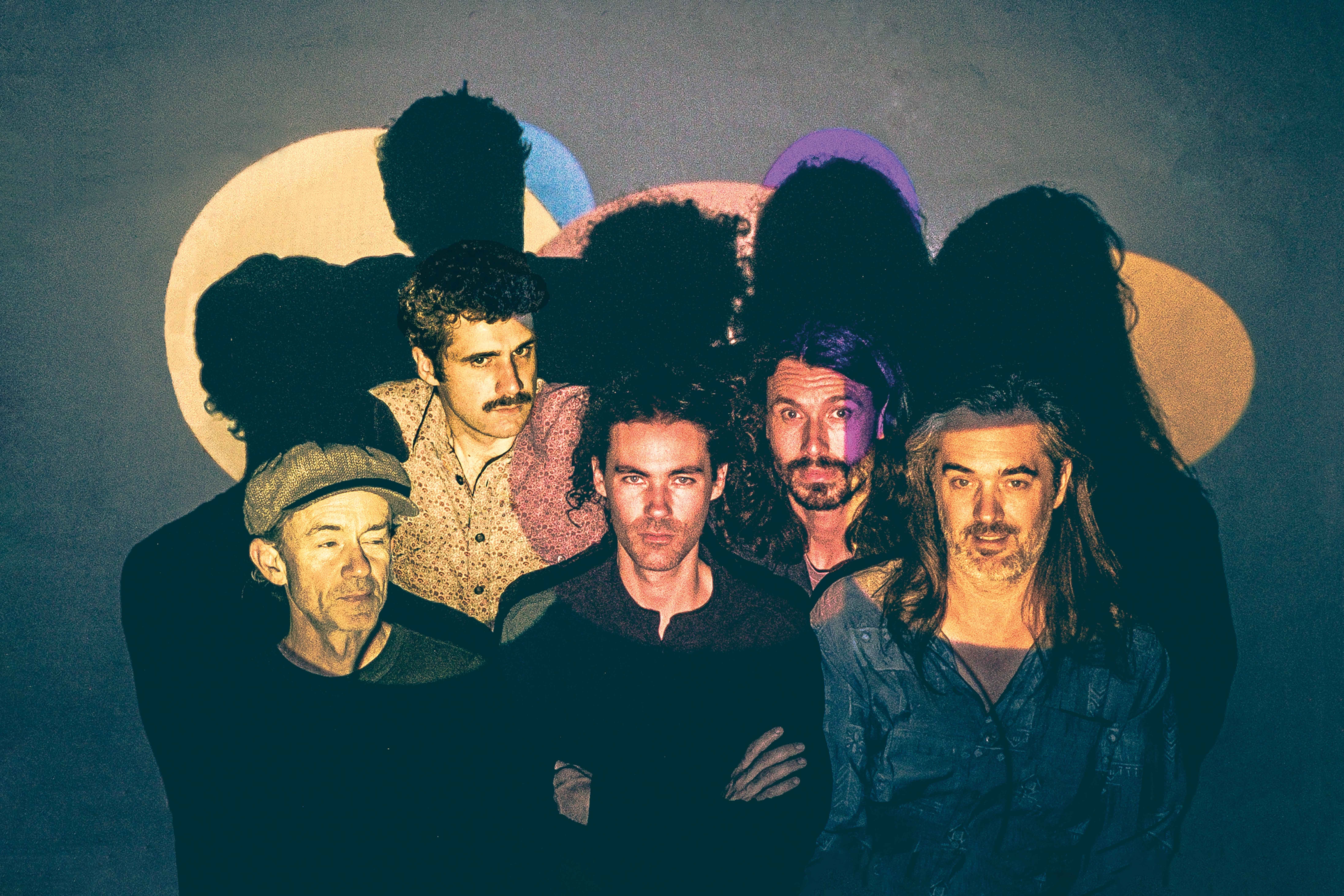
Published
Name: Black Flower
Members: Nathan Daems, Jon Birdsong, Simon Segers, Filip Vandebril, Karel Cuelenaere
Interviewee: Nathan Daems
Nationality: American (Jon), Belgian (rest of the band)
Current release: Black Flower's new album Kinetic is out via Sdban. You can catch them live on their European tour at one of the following dates:
15/02 Bimhuis, Amsterdam (NL)
22/02 Ancienne Belgique, Brussels
27/02 Privatclub, Berlin (DE)
10/04 Banlieues Bleues, Paris (FR)
Recommendations for their current hometown: The countless record shops all over Brussels!
Topic I rarely get to talk about: I used to think that humans are deeply concerned about aesthetics. Now that I have a kid it’s even more clear to me, it’s really in our DNA or even deeper. Beauty or the attempts to create it are such powerful drivers, it’s so incredibly important on many levels.
If you enjoyed this Black Flower interview and would like to know more about the band and their music, visit their official homepage. They are also on Instagram, Facebook, and bandcamp.
What were some of the musical experiences which planted a seed for your interest in jazz?
Attending live concerts, borrowing CDs from the library, sharing CDs with music loving friends all the time ,…
What does the term jazz mean today, would you say?
It used to be a result, a style of music, a new style with specific characteristics like for example a swinging groove played by drums and double bass, etc …
Nowadays it’s more like a certain mindset, a creative philosophy, but in terms of sound it can be something totally different.
It’s not just about the result anymore, it tells us more about what came before, about the process.
As of today, what kind of materials, ideas, and technologies are particularly stimulating for you?
With my saxes and neys and kavals (flutes) I dove into effect pedals a few years ago. Especially the Chass Bliss pedals are very inspiring for me, especially for my duo project.
There is something about the sound quality and about the unpredictability / randomness of these pedals that make them very attractive and stimulating.
Where do most of your inspirations to create come from – rather from internal impulses or external ones? Which current social / political / ecological or other developments make you feel like you need to respond as an artist?
Rather internal. Instrumental music can sometimes feel like a parallel universe, not necessarily with connections to this one. I tend to see that world as abstract, not explicit, without words or meanings that are forced upon you.
I do feel like responding to several developments at a time but not in very explicit ways. It’s more like empowering people by making them feel connected with their own beliefs, concerns, things they care about.
I’m not telling them what they should care about - I hope my music makes them feel connected.
Music has become a lot more global, and incorporating elements from other parts of the world or the musical spectrum is commonplace. Do you still think there are city scenes with a distinct, unique sound? How does your local scene influence your work?
I couldn’t say this is how Belgium or Brussels/Gent sounds, but I do see an adventurous mindset, a thirst for pushing musical borders and taking musical risks in this territory.
That’s super nice about the Belgian jazz scene I would say.
What role do electronic tools and instruments play for your creative process?
In Black Flower hardly any, apart from a few effect pedals for the bass and the keys. Most of it is organic, homegrown, artisinal stuff.
Thanks to technological advances, collaboration has become a lot easier. What have been some of the most fruitful collaborations for you recently and what approaches to and modes of collaboration currently seem best to you?
We collaborated with The Gaslamp Killer, a producer/DJ from L.A. whose sound we adore. It was a very nice collab and the track (“Blind Dog”) ended up on his album (Heart Math) and we’re planning do repeat this in the future.
We don’t do collaborations often, it’s really an exception for us, apart from two tracks that we recorded with an amazing guest singer from Belgium: Meskerem Mees.
Jazz has always had an interesting relationship between honouring its roots and exploring the unknown. What does the balance between these two poles look like in your music?
We all listen to very old stuff, old stuff, vintage stuff, more recent stuff, stuff from last year and stuff from now. I personally listen more to traditional styles from the East and study this genres (Balkan music, middle-eastern and Indian music).
Being immersed in these styles, they naturally come out in our “modern” jazz project although they are centuries old if not millennia, way older than jazz in fact. For me these are also the roots.
How much potential for something “new” is there still in jazz? What could this “new” look like?
The possibilities are endless, we don’t worry about that. It could look like anything you cannot imagine (yet).
How much is there that we cannot imagine yet and one day can, well, almost an infinite amount of things.
For many artists, life-changing musical experiences take place live. How do you see that yourself?
I wouldn’t necessarily say that live experiences are life-changing but more life-affirming and encouraging. That’s pretty different then realising something you never realised before and therefore choosing a different path in life.
Every concert has its unique intensity and worth, regardless of the size of the audience. Live shows can resonate long afterwards and continue to inspire.
How, would you say are your live performances and your recording projects connected at the moment? How do they mutually influence and feed off each other?
Yes, totally. I also try to avoid making tracks in the studio that are impossible to bring to the live stage. For example, adding too much instruments and layers. Because I want to have a satisfying result, a track that sounds full and intense enough, without too much “cheating”. Otherwise it will sound boring and disappointing live.
When we achieve the same result just with the 5 of us playing together, then I know we can pull it off in a live situation as well.
Improvisation is obviously an essential element of jazz, but I would assume that just like composition, it is transforming. How do you feel has the role of improvisation changed in jazz?
I think jazz has lost its meaning as a specific style of music. It’s a way of making music, of composing music with a lot of room for improvisation, regardless the fact that it’s on top of an oldschool swing groove or a rock beat or an afro groove …
The role of improvisation kind of differs from band to band, from project to project.
What, would you say, are the key ideas behind your approach to improvisation?
I use a lot of Turkish makams and derived modes from the balkans as well as Indian ragas. These are all scales + a vocabulary of many many typical phrases and melodic outlines.
I integrate them in a spirit of free impro in order to blend these ingredients in a way that doesn’t feel forced or unnatural.
Are there approaches, artists, festivals, labels, spaces or anyone/-thing else out there who you feel deserve a shout out for taking jazz into the future?
I especially love the Belgian and the UK jazz scene. Our own label Sdban of course and also W.E.R.F. Records.
The Montreux Festival intends to preserve its archive of recordings for future generations. Do you personally feels it's important that everything should remain available forever - or is there something to be said for letting beautiful moments pass and linger in the memories of those that experienced them?
If the technology exists, then it’s much more important to keep those memories for future generations!