Published
Part 1
Name: Riccardo Paffetti aka Black Loops
Nationality: Italian, Germany-based
Occupation: Composer, producer, DJ
Current release: Black Loops' new album Always Moving is out May 9th 2025 via Freerange.
If you enjoyed this Black Loops interview and would like to know more about his music and upcoming releases and live dates, visit him on Instagram, Facebook, Soundcloud, and bandcamp.
Production is a discipline bordering technology, art, and creativity. How do you see the relationship between these and what is their balance for your own music, do you feel?
I see the relationship between technology, art, and creativity as a kind of synergy. For me, the problem starts when technology begins to overpower creativity — especially now with the rise of AI, where things can start to feel a bit soulless. There’s a risk of losing that human touch, that emotional nuance that’s always been at the core of creativity.
In my own music, I try to keep that balance by using the tools available to me without letting them dictate the outcome. For example, I rarely quantize my beats. I come from a drumming background, so timing and feel are really important to me. If something I’ve played feels tight and has that natural groove, I prefer to leave it as is — even if it’s not perfectly locked in.
That slight imperfection adds personality, and it’s a way of preserving the human side of things, even when I’m working with machines.
Which part of the production process do you draw the greatest fulfilment from?
Being a drummer, rhythm is naturally where I feel most at home — it’s usually the easiest entry point for me when starting a track. I wouldn’t say I’m the best at it, but it’s instinctive. Laying down a groove or sketching out the rhythmic foundation tends to come pretty quickly.
But the part of the process that gives me the most fulfilment is when I find the right melody — especially when it locks in with the rhythm. I’m not a trained keyboard player, but I’ve found my way into the world of chords, scales, and progressions over time.
There’s a moment when the rhythm and melody click together, and something just feels right. It’s not always easy to explain, but it gives me a sense of direction — like the track finally has a pulse, and I know where it wants to go.
For you personally, where does composition end and production start (or vice versa)?
For me, it’s actually pretty clear. Composition starts when I’m just jamming — laying down ideas, experimenting, trying things without thinking too much about structure. It’s a more instinctive, free-flowing phase where I’m not worried about arrangement or whether things make sense yet.
Production begins when I shift into making sense of all that — organizing the ideas, shaping the arrangement, and giving the track a clear direction. That’s the point where I start connecting the dots and shaping the track into something more solid
Is technology something that you would like to have disappear behind your music – or is it a musical element that you want to bring to the fore and play with?
I make electronic music, so technology is naturally a big part of what I do — I definitely see it as something I play with, not just a background tool.
At the same time, I’m still a firm believer that it shouldn’t overpower the human feel. The emotional side, the imperfections, the personality — those things still need to come through.
So while I embrace technology, I always try to keep things feeling natural and not too cold or mechanical.
Could you describe how your relationship with your studio/set-up feels like - is it an extension of your self/body, a partner and companion, a creative catalyst, a challenge to be overcome, something else entirely?
I’d describe my relationship with my studio setup as pretty fluid and dynamic. There are days when I love it and everything just clicks — and then there are days when I can’t stand what I have and feel like I need something new to shake things up. It doesn’t have to be some expensive piece of gear — just something I’ve never used before that brings a different energy.
The way I route things, the way my machines are connected — it’s always changing. I’m constantly tweaking things. Sometimes it feels like I’m chasing this ideal setup where everything flows in sync with me.
And yeah, there are definitely moments where it feels like a bit of a puzzle to solve, but that’s also part of what keeps it exciting.
How and for what reasons has your music set-up evolved over the years and what are currently some of the most important pieces of gear and software for you?
In the beginning, my setup was pretty minimal — mostly because I couldn’t afford much. Everything was done in the box.
But once I started getting gigs and earning a bit from music, I began investing in gear and slowly moved into working with outboard equipment. That shift started around ten years ago, and it really opened up a new way of working for me.
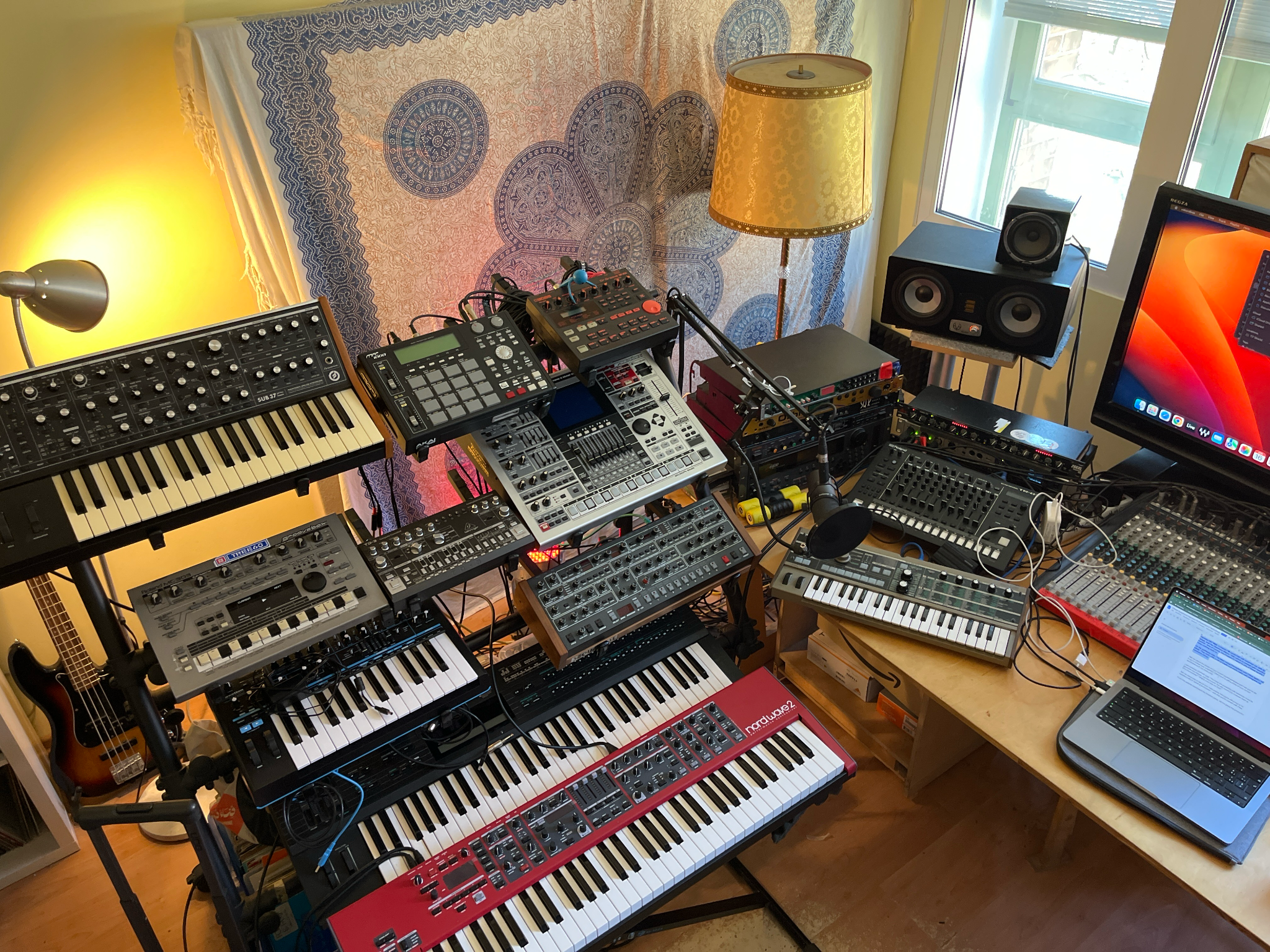
One of the key pieces in my setup is the Boss DR. Groove DR-202, a drum machine from the late ’90s. It’s super affordable — at least it was when I picked it up for around $80 — but the sound is incredible. It’s got this gritty, digital character that I really love, and I’ve made a lot of my drum parts with it over the years.
Another big one for me is the Roland MC-909 Groovebox. It’s a wild machine — you could honestly produce an entire track on it without even touching a DAW. I’ve been using it a lot lately.
Then there’s the Yamaha DX7 MkII, a classic FM synth that still surprises me with its range, and the Oberheim Matrix 1000, which is packed with beautiful sounds. And of course, the Prophet 6, which is one of those synths I keep coming back to.
On the software side, I’ve been using Omnisphere and Trilian quite a bit lately. They both offer a lot of depth and work really well alongside my hardware setup.
Tell me about the space of your current studio/workplace and how you've set it up to further your creativity?
My studio is in Berlin — over the past 13 years I’ve moved around quite a bit, but this current space has been the most stable. I’ve been here since 2018, and it really feels like the right spot for what I do.
I share the space with Carlo from Aterral Records, who I’ve known since the early days. We’ve worked together on releases, and we also play together from time to time. It’s a space that feels relaxed and familiar, but also full of potential — the kind of place that invites you to get lost in the process.
Late producer SOPHIE said: “You have the possibility with electronic music to generate any texture, and any sound. So why would any musician want to limit themselves?” What's your take on that?
My take is pretty simple, and it ties back to what I mentioned earlier. When technology and human creativity work in synergy, the possibilities are endless.
But it’s important that one doesn’t overpower the other. The balance is everything — the magic happens when those two forces support each other and create something unique together.
Tell me about one or two of your early pieces that you're still proud of (or satisfied with) in terms of production – and why you're content with them.
The first piece I’d mention is actually my upcoming album Always Moving, which will be out on May 9 via Freerange. It’s my debut album as Black Loops — up until now, I’ve only released EPs, remixes, and singles, so this feels like a really important step for me.
The process has been a real emotional roller coaster, but what makes this project special is that it’s the first time I’ve recorded live drums myself. Coming from a drumming background, that added a whole new layer of expression to the music.
It’s also the first time I’ve collaborated with other musicians in this way — people I’ve admired for years, like Harvey Sutherland and Byron the Aquarius. That made the whole experience feel even more meaningful. So yeah, I’d say this is definitely the project I’m most proud of so far.
Another track I’m really happy with is “Proto/Emotions,” which came out a couple of years ago on Aterral. It’s got this analog ’80s vibe with uplifting melodies and a kind of emotional warmth that I still connect with.
It’s always a good feeling when people tell me how much they vibe with it too — that it gives them a good energy. That’s the kind of feedback that stays with you.