Published
Name: Bon Entendeur
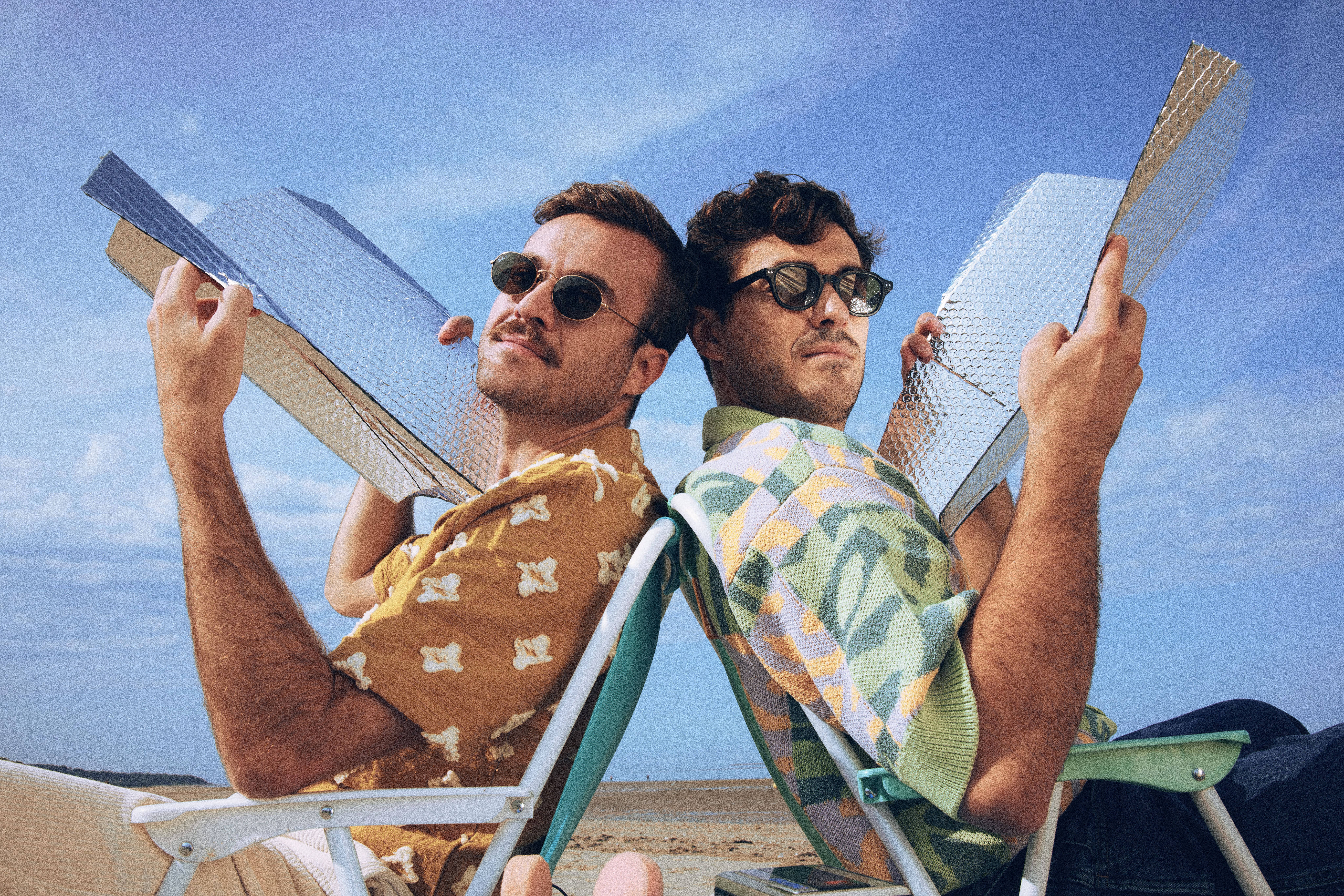
Members: Arnaud Bonet, Pierre Della Monica
Interviewee: Pierre Della Monica
Nationality: French
Occupation: DJs, producers
Current release: Bon Entendeur's latest album Rivages is out now.
Current Event: In support of the album, Bon Entendeur are about to embark on an expansive 2025 US tour. Catch them live at one of the following dates:
February 21 – Outset – Chicago, IL
February 22 – 9:30 Club – Washington, DC
February 23 – Zey Zey – Miami, FL
February 26 – The Fonda Theatre – Los Angeles, CA
February 27 – August Hall – San Francisco, CA
February 28 – Reelworks – Denver, CO
March 1 – CRSSD Festival – San Diego, CA
Recommendation: I took advantage of this tour in the United States and the fact that we were starting in New York to arrive a few days early, walk around the city, and visit some museums. I went to the Metropolitan Museum of Art, the MET, and I randomly came across a painting that really moved me—a painting of Joan of Arc by Jules Bastien-Lepage.
She’s simply standing in a garden, seemingly having a revelation as she gazes into the distance. It’s a mix of softness and strength, and the painting really struck me. I was walking past the artworks rather quickly, but this one caught my attention. I stopped and ended up staring at it for about ten minutes, trying to understand what the painter was conveying and taking in the details. Joan of Arc herself is incredibly realistic, while the background is blurred and abstract. There’s so much to observe and interpret in this painting.
In short, it definitely touched me.
If you enjoyed this Bon Entendeur interview and would like to stay up to date with the duo, their music and current live dates, visit their official homepage. They are also on Instagram, Facebook, and Soundcloud.
Do you think that some of your earliest musical experiences planted a seed for your interest in DJing? How and when did you start DJing?
Our first experience with DJing was quite special. In fact, we had already started making mixtapes using Ableton, but we had never really mixed properly.
What happened was that we received our first request in 2014, and we had to train ourselves at full speed on a small “hercule” controller. It was an incredible memory.
Today, DJs are rarely just DJs. Very often, they can be producers who are also DJs or DJs who are also producers. Where do you see yourself on this spectrum and what kind of potential issues and cross-pollinations does this create?
Yes, you're absolutely right—not all DJs are producers, and not all producers enjoy playing music. In fact, we have some very talented producer friends who don’t particularly like performing at festivals or in clubs with sold-out crowds.
Historically, we come from DJing, and we started producing our own tracks—more specifically, our remixes—a bit later. Our first track was a remix of “Le Temps est bon” by Isabelle Pierre. It was through this remix that the idea of creating albums and original productions came to us.
So yes, to sum up, I’d say we come from the world of DJing and gradually transitioned into music production.
For you, is there still listening outside of looking for music for your next sets? If so, what do you prefer to listen to and how does it possibly nonetheless have an influence on your performances?
Yes, of course. In the end, we spend our entire days listening to music. It's almost a compulsive way of consuming it. From morning to night, we love discovering new artists and new songs. In fact, in our minds now, when we listen to a song, we subconsciously categorize it with a specific purpose.
Let me explain—if the music is from the '60s or '70s, for example, we might think, “This could be interesting to remix.” There might be something to do with it. So, we add it to a special playlist to see if it could inspire us later for an original production, a remix, or even sampling.
Another possibility is stumbling upon a small pop band we love or discovering one we will eventually adore. I’m thinking of Midnight Generation or even Zimmer 90.
In that case, we know we won’t necessarily remix them, but it’s just a pleasure to listen to them—whether on tour, in our headphones, or while commuting.
And finally, there are the tracks we discover through DJ sets. Often, in our own DJ sets, we play tracks that aren’t ours. Many times, we come across electronic tracks we love, buy them, load them onto our USB keys, and enjoy playing them for our audience.
On the basis of one of your most recent gigs, tell me about how the preparation- and decision making process works during a gig with regards to the inclusion of key records, the next transition and where you want the set to go?
Now, it’s been almost 10 years that we’ve been DJing together, so the process is well established. You should know that 9 times out of 10, it’s always pure improvisation.
The only things we know before going on stage is which of our own tracks we have to play—the ones people come to hear. I’m thinking, for example, of “Le Temps est bon” or our latest track, our remix of Nicoletta’s “Fio Maravilla.”
Beyond that, it’s just a USB key we know inside out, filled with dozens, even hundreds, of folders and subfolders. We simply pick tracks somewhat at random based on the crowd’s vibe.
You really have to see it as a back-to-back with Arnaud—I do a transition, then he does one, then I do one. I never really know what he’s going to play, but over time, we’ve gotten used to each other and know each other by heart. I adapt to what Arnaud plays, and also to how the audience reacts.
There must be endless ways of “matching” two or more tracks. How do you prefer to do it? What makes two tracks inherently “matchable” and what constitutes a great transition?
There are several questions within your question.
The first one I’ll answer is about “how to make a good transition”. I would simply say: for me, a good transition is one that is either completely undetectable because the two tracks blend so well together, matching perfectly, or one where you’ve fully understood the essence of the first track and introduce a second one that complements it seamlessly. This results in an incredibly smooth transition, allowing the audience to stay immersed as they move from track A to track B.
As for what intrinsically makes two tracks match well, I’d say it’s when you put them together and it feels like they were always meant to be combined—creating a third, harmonious, and cohesive sound.
How would you describe the experience of DJing, physically and mentally? Do you listen – and deejay - with your eyes open or closed?
It's an incredible experience and very difficult to describe or explain. Of course, it varies a lot depending on whether you're playing in front of 200 people, 2,000, or 20,000, or whether you're playing from 6 PM to 8 PM or from 1 AM to 3 AM—it’s completely different each time.
But there’s one common element in all these nights: the feeling that time flies at an insane speed. With Arnaud, we step on stage, launch the intro, and it feels like we barely have time to blink before someone taps us on the shoulder, saying, Guys, you’ve got 10 minutes left. It’s absolutely surreal.
Again, it's really hard to put this feeling into words. It’s a mix of stress, an intense and incomparable joy, and simply unique moments.
Do you engage with audiences/dancers - and how? Taking one of your online DJ mixes as an example, how does the experience and the way you deejay change when you subtract the audience?
Yes, absolutely: we try to engage the crowd, communicate with them, and share the joy we feel about being with them
However, we don’t grab the mic every three transitions either. We try to focus as much as possible on the music, only taking the mic occasionally to thank the people who took the time to come, but that’s it.
We’re not the kind of DJs who speak after every other track, asking how they’re doing, if they’re still with us, etc. We tend to be rather shy about it.
Collaboration is a key part of almost every aspect of music making, but it is stil rare in DJing. Tell me about your own views on back-to-back DJing, interactions with live musicians or other forms of turning DJing into a more collective process.
Back-to-back DJing is at the heart of what we do. Since we’ve always played as a duo, we’re constantly in conversation through music. It’s a really interesting way of DJing because it forces you to be reactive, to listen to what the other is playing, and to respond in a way that makes sense. It’s like a dialogue without words, where each track is an answer to the previous one.
Beyond back-to-back sets, we also love the idea of bringing live musicians into a DJ set. There’s something special about blending the structure and energy of a DJ performance with the spontaneity of live instruments. It brings a whole new dimension to the set, making it even more immersive and unpredictable.
We’ve done it a few times with percussionists or guitarist / bassists, and each time, it’s been an incredible experience.
How important is dancing for our wellbeing on a personal and even on a societal level?
Dance and music are completely intertwined; both are expressed unconditionally in the same way.
Just as we can hear music and create it anytime, anywhere, regardless of our mental state at the moment, the same goes for dance. We dance without even realizing it, moving with the rhythm. I don’t think we can say that Arnaud and I are great dancers, haha.
Plus, it could be game changing given the known benefits for physical and mental health obviously, also because it’s one of the best self-empowerment and breaking barriers of race, age, background. Simply, it brings us together.
Especially in the light of advances in AI, where do you see the role of humans in DJing versus that of technology? Can AI act as a collaborator or creative stimulus?
When it comes to AI, I believe we are driving a major revolution across all fields. Just as the invention of the printing press sparked great debates in its time, I think something similar is happening with AI today.
In any case, AI will be omnipresent in the coming years, and it’s up to us to decide whether or not to jump on board. I don’t believe AI will ever replace humans or their sensitivity, no matter the art form. It may try, but it will struggle.
However, we shouldn’t fear it; instead, we should see it as a tool that allows us to push the creative process even further.
Tinnitus and developing hyperacusis are very real risks for anyone working with sound. Do you take precautions in this regard and if you're suffering from these or similar issues – how do you cope with them?
Yes, it’s something we take very seriously. When you spend years playing in clubs and festivals at high volume, you inevitably start thinking about the long-term impact on your hearing.
We always wear custom-made earplugs during our sets—they reduce the volume significantly while keeping the sound quality intact, which is essential for us. We also try to be mindful of volume levels, both on stage and in our daily lives.
After a long weekend of gigs, we make sure to give our ears some rest—avoiding headphones, loud music, or noisy environments. It’s a small adjustment, but it makes a big difference.
Do you feel as though DJing is inherently different from something like making a great cup of coffee? What do you express through music that you couldn't or wouldn't in more 'mundane' tasks?
At first glance, DJing and making coffee might seem worlds apart, but they do share something in common: both involve precision, timing, and a certain intuition.
That said, DJing is much more than just a technical process—it’s about storytelling, emotion, and connection. Through music, we express things that words often can’t. A set can tell a story, evoke nostalgia, create euphoria, or bring people together in a way that feels almost transcendental. There’s an emotional depth to it that goes far beyond the mechanics of mixing two tracks.
A great cup of coffee might bring comfort, but a great DJ set can make someone’s night unforgettable. That’s the difference.
Let's imagine you lost all your music for one night and all there is left at the venue is a crate of records containing a random selection of music. How would you approach this set?
When you say "I lose all my music for a night," do you mean that I’m going to lose my music right before going on stage, so I have no reference points at all? (If that’s what you mean, that’s never happened to us, but it’s actually a pretty frequent nightmare —it must be an artist’s nightmare, haha.)
Or do you mean, for one night, I literally have no reference points, I lose my music and randomly come across records?
I’d see it as an amazing opportunity to discover new tracks. And if it’s a crate full of vinyl records that I don’t know at all, then what usually plays a big role at first is the cover itself—the colors, the style, the mood—those elements make me want to open it, put it on a turntable, and find out what it sounds like.