Published
Name: SML
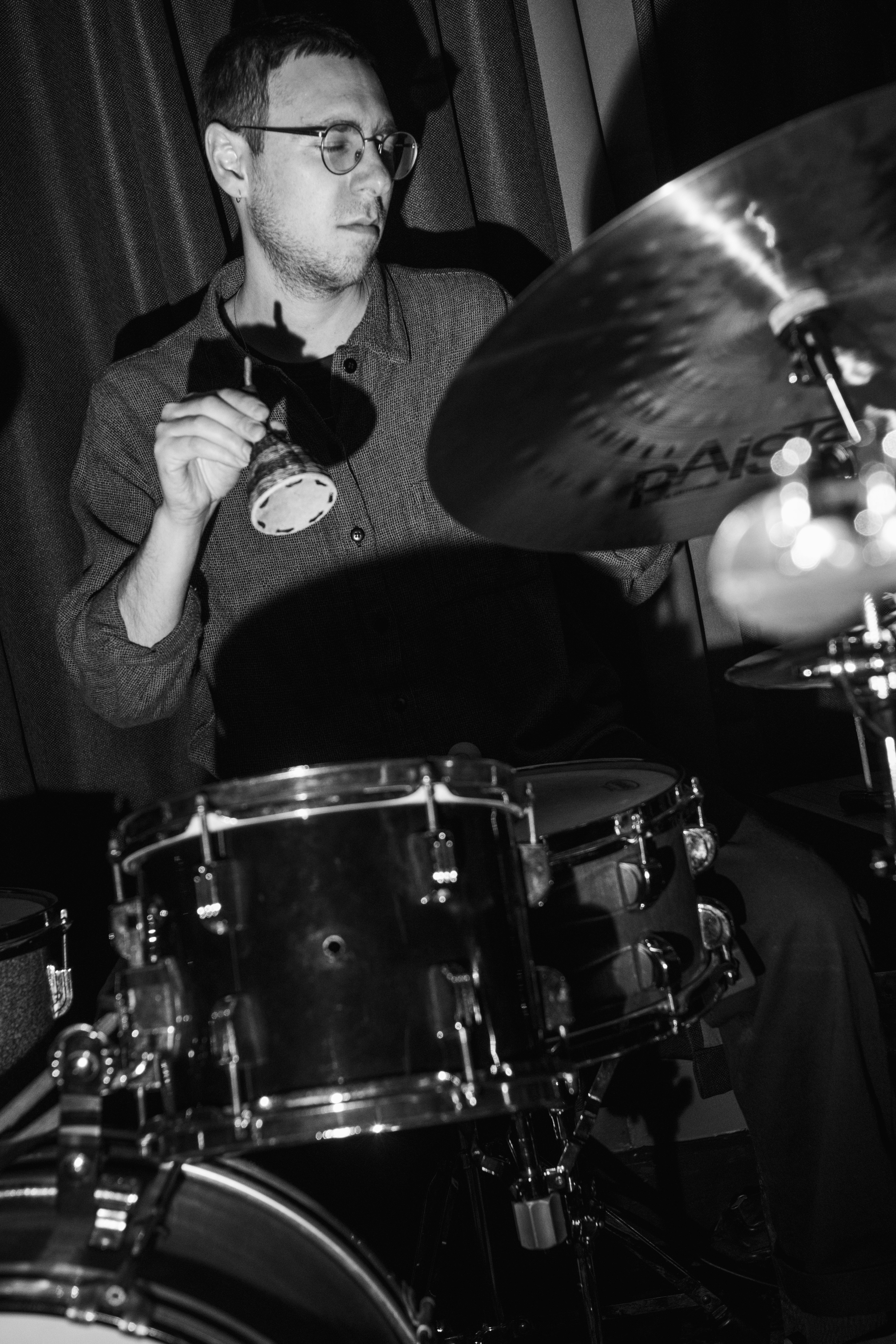
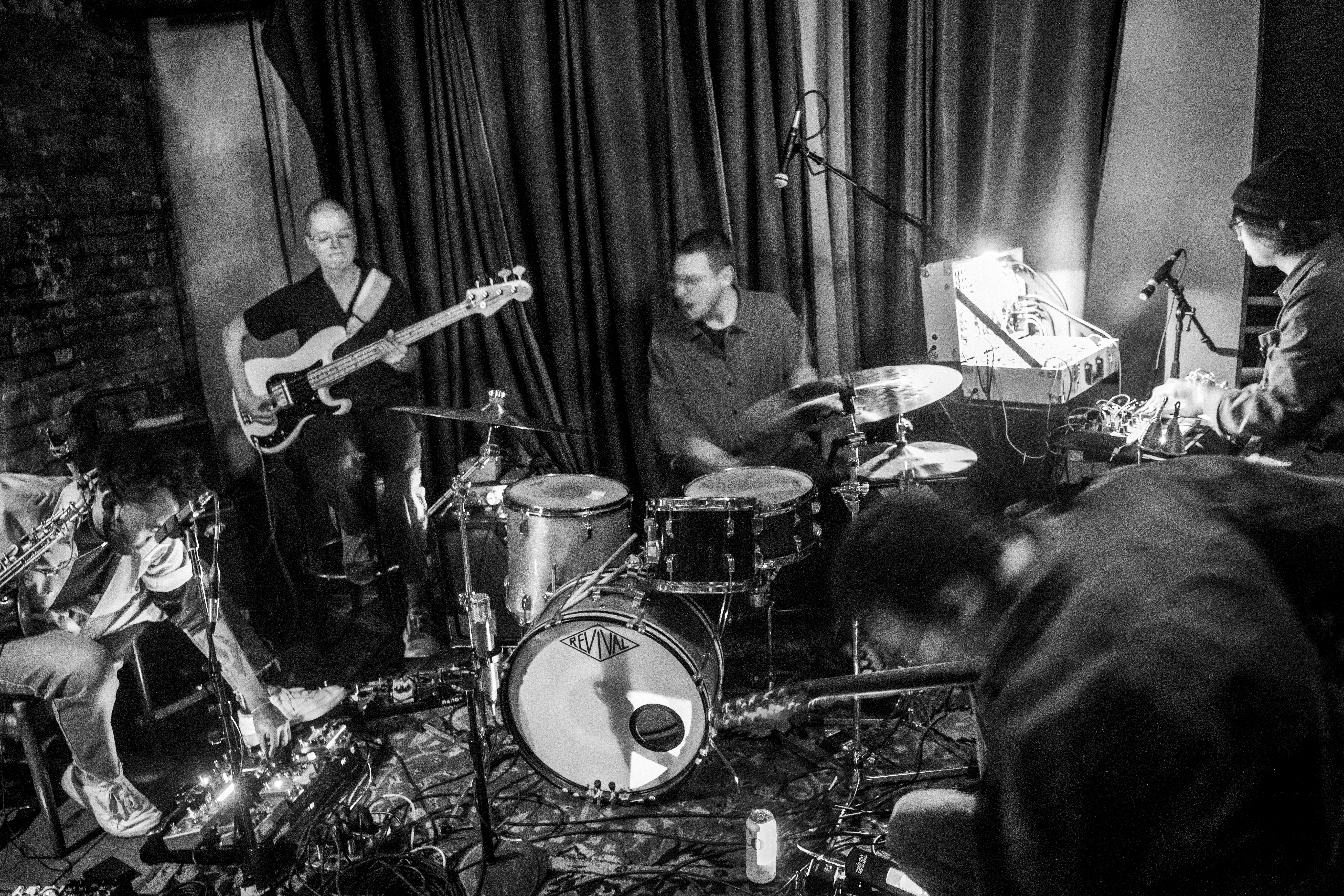
Members: Anna Butterss (bass), Jeremiah Chiu (synthesizers, electronics), Josh Johnson (saxophone), Booker Stardrum (drums, percussion), Gregory Uhlmann (guitar)
Interviewee: Booker Stardrum
Nationality: American
Current event: SML's Small Medium Large is out via International Anthem.
[Read our Anna Butterss interview]
[Read our Jeremiah Chiu interview]
If you enjoyed this Booker Stardrum interview and would like to know more about his work, visit his official homepage. He is also on Instagram.
Over the course of his career, Booker Stardrum has worked with a wide range of artists, including Jaimie Branch, Patrick Shiroishi, Wendy Eisenberg, Amirtha Kidambi, and Carl Stone.
[Read our Jaimie Branch interview]
[Read our Patrick Shiroishi interview about improvisation]
[Read our Patrick Shiroishi interview about collaboration]
[Read our Wendy Eisenberg interview]
[Read our Amirtha Kidambi interview]
[Read our Carl Stone interview]
[Read our Carl Stone interview about Production and Technology]
What was your first drum set like and what are you using today? What, to you personally, are factors in terms of build and design that you appreciate in drums and percussion instruments?
My first drum set was a frankenstein kit made up of several random pieces. I still have the blue sparkle Gretsch floor tom and kick drum from that original kit and still play them. I have been playing the same mid-1960s gold sparkle Rogers Holiday drum set for 20 years.
There are certainly drums that sound better to my ears than others, and I appreciate a well made and maintained instrument, but I’m not really a gear head. The way a drum sounds has so much to do with how it’s tuned/prepared, where it’s being played, and mostly importantly, how it’s being played.
Late Rush-drummer Neil Peart said: “The equipment is not an influence. It doesn't affect the way I play. It's an expression of the way I play.” What's your take on that?
Peart was used to playing on the same perfectly tuned, perfectly cared for drum set every night. So, his drums were probably a very considered and customized expression of what he wanted to hear.
On tour, I may be playing on a different backlined drum set every night. I like to imagine that my musical ‘voice’ - touch, intention, vocabulary - comes across on various instruments, but it would be impossible not to be affected by the equipment I am playing on. I know that I play differently on different drums, just like I play differently in different rooms.
I don’t just sit down in any space and bang on the drums like nothing has changed. I’m always trying to play to an environment and be in conversation with the energy of that space, audience, music, etc.
Drumming is an integral part of many cultures, and traditions. Which of these do you draw from in your playing – and why?
I love a lot of music from a lot of places including Indonesia, West Africa, Zimbabwe, Morroco, Japan, Columbia, Haiti, and many more. I couldn’t really tell you why I like anything; it’s not an intellectual decision. How does something hit me? Does it make me move? Does it make me laugh? Does it make me cry?
Sometimes I see myself and my own musical intuition in music from somewhere across the world and that draws me in. The only music I’ve studied on a scholarly level is jazz music, but many other traditions have seeped their way in through listening and playing, and have influenced my music in major ways!
How do you experience the concepts of "groove," "swing," and "rhythmic feel" in music?
A lot of choices I make as a drummer are based in intuition. Especially when improvising, I am not making a whole lot of thought-out, intellectualized decisions.
For me, I’m feeling groove in my body in relationship to whatever is happening in the music. I know some other drummers may work this way, but I’m rarely thinking “okay, here’s the section where I’m going to play behind the beat.” I may very well be pushing between different feels though, depending on where my body thinks the music needs to go.
I also sometimes drag or rush! I am an imperfect being : ). 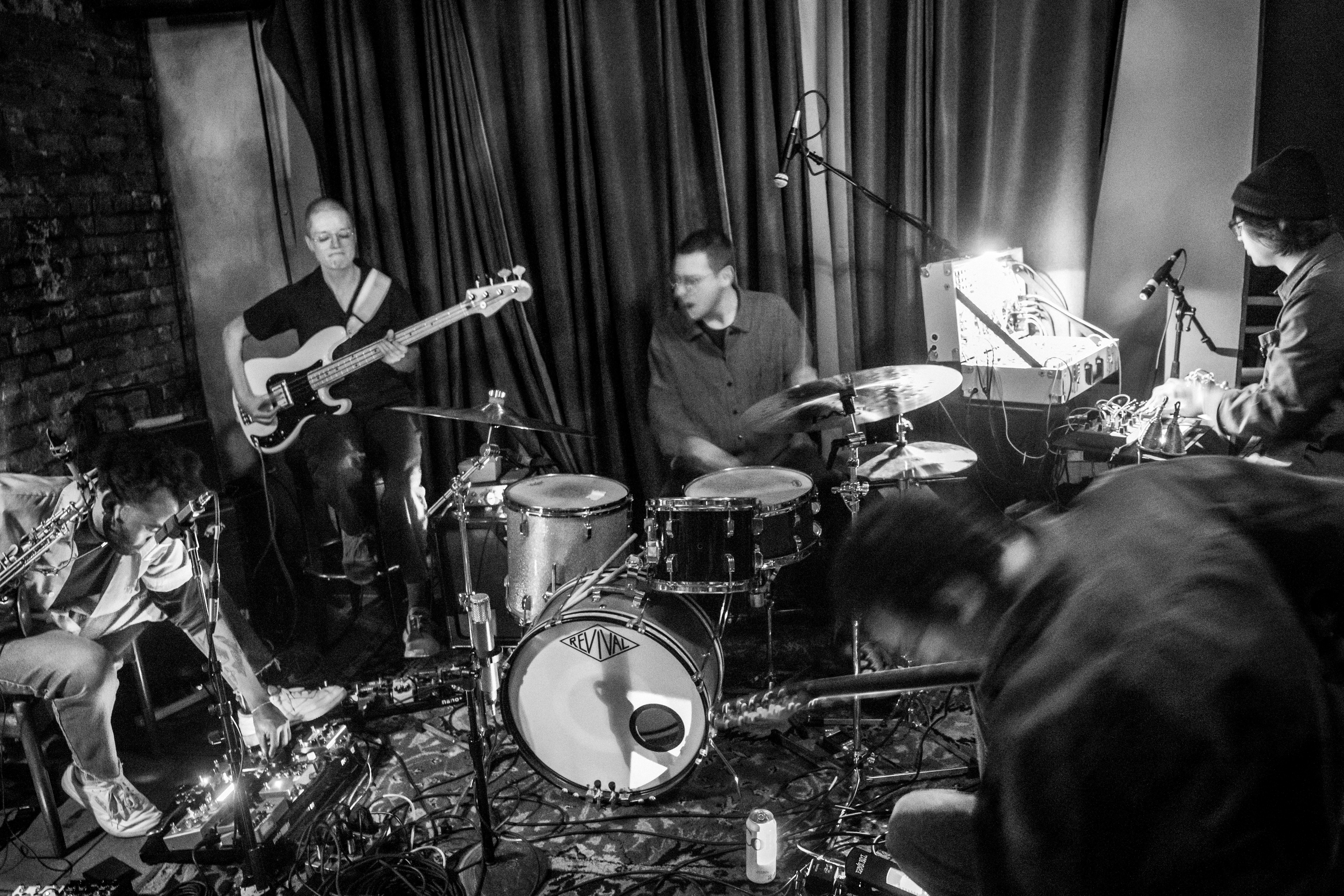
SML Interview Image by Brian Guido
How do time signatures and tempo affect our perception of rhythm?
There are so many factors contributing to the many ways we perceive and experience music. For the most part, in the west, 4/4 and equal temperament are the most common time signature and tuning system, respectively. This is not so in other parts of the world.
Therefore, in the west, most people can tap their foot to a 4/4 beat but not to one that is in 11/8. Go see music in many countries in the Balkans and you’ll find people dancing in various odd time signatures with ease.
Humans are sponges, we absorb what’s around us, and we perpetuate those traditions.
What is the relationship between harmony, rhythm and melody? How do non-percussion instruments contribute to the overall rhythmic texture of a piece?
The relationship between harmony, rhythm and melody, if it applies to the music at, really depends on the type of music, I suppose.
But there certainly isn’t any hierarchy in my mind. Everything contributes evenly to a complete idea.
Different drums have a distinct sound and drums and percussion are also timbral instruments. What drum sound are you aiming for and how are you making use of the timbral potentials and possibilities of your instruments?
This really depends on the project. I like to experiment with lots of different sounds.
Sometimes I want the drums to just sound like really fantastic drums with a nice round kick and a fat snare sound. Sometimes I want the kick drum to sound like a long sustained bass tone with snares off and rolling toms like distant thunder. Another time I may mute the drum heads with cloth or other percussion.
Many times, I don’t want drums to sound like drums at all!
In relation to drumming, Stewart Copeland said: “Listening is where the cool stuff comes from. And that listening thing, magically, turns all of your chops into gold.” What do you listen for?
The goal is to be listening to everything all at once like a big connective web. This also depends on the music.
I’m on tour now with a band called Horse Lords. I try to listen to and hear everything but I always ask for a lot of bass and guitar in my monitor because it’s important that I am linking up rhythmically with those instruments.
[Read our Horse Lords interview]
In SML, it’s super important for me to hear the synthsizer because I’m playing along to rhythmic sequences. If I’m playing freely improvised music, the goal is to be listening outwards rather than inwards, focusing as little as possible on what I’m playing and trying only to respond appropriately/musically.
Physical strain is a particularly serious issue for many drummers. How does it manifest itself, how do you deal with it and in how far does it affect your creativity?
Several yeas ago, I had a revelation that came via tai chi. I have been doing tai chi for about five years and have been drumming for about 25. There’s a lot of squatting and weight shifting in tai chi and one fundamental that you learn is that you never want your knee to go over your toe as you shift your weight forward.
I became aware that I have a habit of bringing my kick drum and hi-hat close to my body and leaning forward over the drums as I play. So in the last several years, I’ve been working on sitting a little further back from the drums, sitting up straight, never leaning over or having my knee over my foot.
I’ve had some lower back issues over the years and I think this has been helping!
Drums and percussion are remarkably often used for physical therapy / healing. What, from your point of view, makes them particularly suitable tools for this?
Drums are the first instruments, totally ancient. It makes complete sense that humans are connected to drums and percussion on a deeply felt, emotional level.