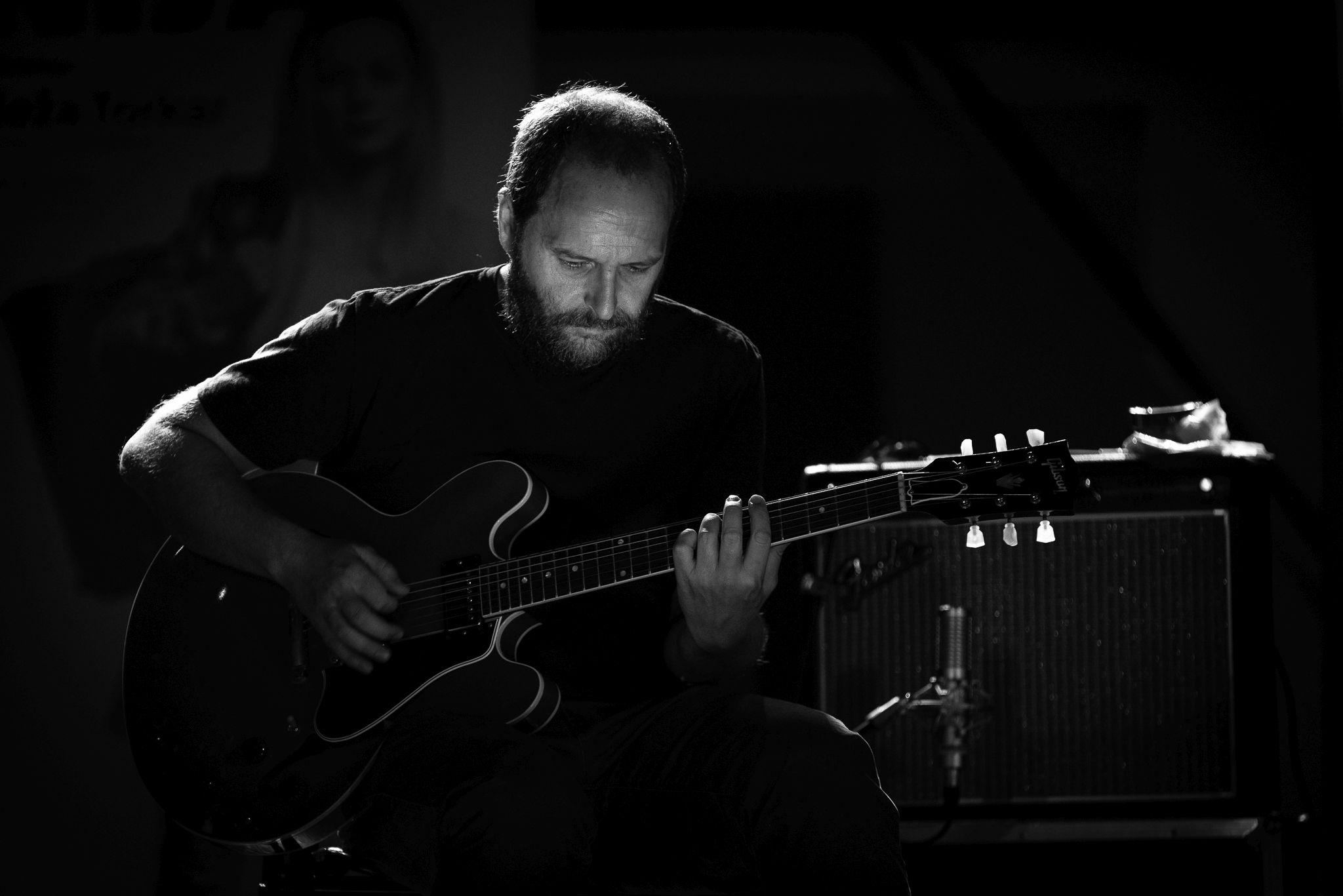
Published
Name: Broodmen
Nationality: Serbian
Members: Dragan Alimpijević Pik (guitar), Zoltan Šimon (drums), Lazar Novkov (accordion)
Interviewee: Dragan Alimpijević Pik
Current release: Broodmen's new album Liminality is out via Road.
If you enjoyed this Broodmen interview and would like to stay up to date with their music, visit their official website. The band are also on Instagram.
What were some of the musical experiences which planted a seed for your interest in jazz?
Mr. Louis Armstrong was the one for me. The magnificence of his voice, the trumpet, and the atmosphere of his songs ... A fairytale that shook my entire being as a youngster.
It still shakes me as a man - I can still feel that rush to this day.
How do jazz and jazz culture factor into your artistic processes and the music resulting from them?
It makes me feel free, free to say what is on my mind, free to express (or play) my emotions.
It helps me understand that there is no purpose in being a slave to any genre.
What does the term jazz mean today, would you say?
I really don't dare to make such an assessment; I can only speak for myself.
For me, jazz today is an attitude, a journey through space-time without moving. Freedom, a way of thinking, mental hygiene almost. And, of course, a great inspiration.
Jazz was about a lot more than just music in the 60s and 70s, from politics to fashion. For you personally, is jazz still a way of life – and if so, in which way?
In some ways, yes. As I already said, it's an attitude, a way of thinking, etc. Music is a way of life. You have to live it 24/7 to truly feel it. It's demanding.
And if we are talking about the importance of music in today's world, I’m afraid I have to say no. I mean, I am surrounded by music and people who are into music all the time, I can't imagine a different world for myself anymore. But I’m afraid that’s just my bubble. The outside world is a completely different place. It's oversaturated with information, politics, innovations, and social media.
Sadly, I think there isn't much space for music in this ADD world at the moment. It's just not as important as it was during the 60s and 70s, in my opinion.
Many people perceive jazz as a genre with high barriers of entrance, both for listeners and musicians. What have your own experiences been in this regard?
I can see why some perceive jazz that way, and it’s an understandable perspective. However, I believe that's just one way of thinking.
To me jazz is an expansive, ever-evolving landscape where each individual can discover something deeply personal, something that resonates with their essence.
In the end, it’s about surrendering, letting the music guide you. Relax, go with the flow, no one will get hurt.
Derek Bailey defined improvising as the search for material which is endlessly transformable. As of 2024, what kind of materials are particularly stimulating for you?
A walk, a movie, a trip, a conversation with my partner, listening to music, arguing about politics with my friends.
What, would you say, are the key ideas behind your approach to improvisation?
It's pretty tough to put into words. The most important thing for me is to feel free in the moment—that removes all boundaries.
And for me, it's all about emotions. I try to translate my thoughts and feelings into music. Although "translate" is not the best word, it makes it sound like there’s a process behind it where there really isn’t. It’s just music taking control of you, and your thoughts simply turn into notes. Or maybe it’s better to say they become one.
I’m trying to communicate something, except instead of using my voice, I’m using my instrument. Sometimes it's much easier that way actually, and not just easier, but more to the point.
How would you describe your relationship with your instrument – is it an extension of yourself/body, a partner and companion, a creative catalyst, a challenge to be overcome, or something else entirely?
I would say a tool, a weapon. I strongly believe that music is within us. The instrument is just an instrument.
Some of them have souls, I admit that, but without a person behind them, they are lifeless.
Jazz has always had an interesting relationship between honoring its roots and exploring the unknown. What does the balance between these two poles look like in your music?
I would like to say it leans much more toward "exploring the unknown," but unfortunately, that's not true.
As human beings, we will always carry the burden of heritage, no matter how hard we try to escape it. And I love to fool myself into thinking that I’ve learned to enjoy that in some way.
What are the current directions in jazz or jazz-adjacent communities that you personally find interesting?
I would say freedom again. I think it comes from jazz, and I can hear it more and more in all kinds of music these days.
For many artists, life-changing musical experiences take place live. How do you see that yourself?
I couldn't agree more—concerts and albums, whether the ones you play or the ones you experience as a listener.
I've been very lucky to work with some really big names (as a house sound engineer at a number of jazz festivals), Nathan East, Dee Dee Bridgewater, Dennis Chambers, Jeff Tain Watts, Mark Guiliana, Antonio Sánchez, Christian McBride, Joachim Kühn, to name just a few.
And man, did those concerts change me? Yes, I would say those were life-changing experiences.
[Read our Mark Guiliana interview]
How, would you say, are your live performances and your recording projects connected at the moment? How do they mutually influence and feed off each other?
Tough one. The stage is a very strange place where strange things can happen. Although we record our albums live in the studio, there is something about being on stage that makes us play songs differently every time.
To be honest, after all these years, I can't describe what that is. A sense of unity, the energy of the audience, the atmosphere of that particular place, the mood of each musician, including the sound guy. Probably all of the above, or maybe none of it. Maybe it’s something else entirely, I just don’t know.
We are always working our asses off to bring that crazy stage atmosphere into the album, and at the same time, we give our best to transfer those carefully crafted album arrangements to the stage. So, I would say they are thoroughly intertwined.
There are various models to support jazz artists, from financial help to mentorships/masterclasses. Which of these feel like the best way forward to you?
Coming from a country where there is no support for any kind of musicians whatsoever, everything is very welcome. But I've learned not to rely on anybody for anything.
The best way forward for me is commitment to the moment, to what you are trying to say. Be honest with yourself. That’s not just the best way forward for me, but the only way.
Are there approaches, artists, festivals, labels, spaces, or anyone/-thing else out there who you feel deserve a shoutout for taking jazz into the future?
I really do believe what Matt Fripp is doing with his Jazz Fuel community deserves a big and loud shoutout!
The Montreux Festival intends to preserve its archive of recordings for future generations. Do you personally feel it's important that everything should remain available forever—or is there something to be said for letting beautiful moments pass and linger in the memories of those who experienced them?
There is nothing that compares to being in the presence of a great musician for me.
But please, save those recordings. Some of them are treasures of humankind.