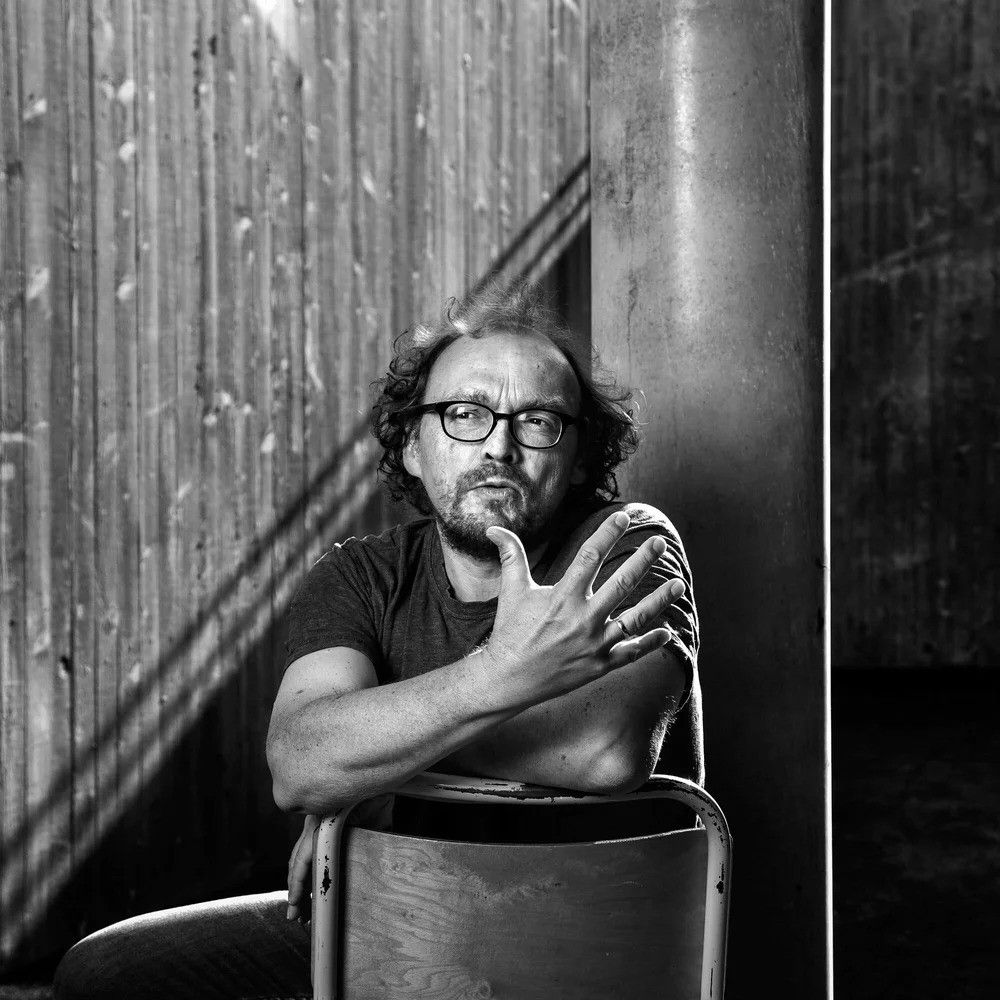
Name: Bugge Wesseltoft
Occupation: Pianist, keyboard player, producer, composer, improviser
Nationality: Norwegian
Current release: Bugge Wesseltoft's new album It's Still Snowing on my Piano is out October 31st 2025 via ACT.
If you enjoyed this Bugge Wesseltoft interview and would like to know more about his music and upcoming live dates, visit his official homepage. He is also on Instagram, Facebook, and bandcamp.
For a deeper dive, read our earlier Bugge Wesseltoft interview, and our conversation with him about improvisation.
You didn't play an acoustic piano for many years. Would you say you felt more comfortable with the organ for a long time?
Yes. I love the piano, but, for example, when I recorded It's Snowing on my Piano, I was super nervous about it.
I was used to the the weight and the touch of my synthesizers. The Rhodes is maybe a little closer to the piano, but you have to remember that we recorded the album at the Rainbow Studios in Oslo and that's a legendary place and Keith Jarrett had played on the very same piano.
I was sitting there by myself, and I was so nervous and I played so soft that the engineer had to really compress the results to get the right sound from the recording. In the end, that's why a lot of people feel that album is so intimate - I think it's because I was almost shaking when I tried to play!
I just wanted to play as beautiful and soft as possible, and I think maybe that's what created a special form of attention.
It's a form of playing that's quite common today. But at the time, it was practically unheard of.
Right. Since then, we've had someone like Nils Frahm and his felt piano, which created more intimacy in music than having a huge grand piano. Which is great. I like that, and I like him.
But my personal favorite at the moment is Víkingur Ólafsson. He plays classical pieces by Bach and Mozart and Kurtág on upright piano – and that's fantastic to hear.
[Read our Nils Frahm interview]
I read that you worked in a psychiatry for a while and that influenced It's Snowing on my Piano.
That was a lot earlier, in the early 80s, just after my gymnasium. But, yes, it was one of the reasons I made the Christmas album. I wanted to approach it in a very quiet way, as an act of caring for others, you know?
There were so many suffering people with traumas and Christmas would be the most difficult period for them very often. So my focus was to create something soothing for people who were struggling.
At the same time, I wasn't a big fan of recording a Christmas album. Honestly, I was very dubious when Siggi [Loch of ACT records] asked me. But ultimately, I did it and people seemed to like it.
ACT has this tradition of jazz-tinged Christmas albums. Looking back, what I think makes yours stand out is that you only did one.
True, although I have been giving Christmas concerts every year starting with the 10-year-anniversary of It's Snowing on my Piano.
Initially, I really didn't to do these concerts because I'm, in general, not a fan of Christmas and this hysterical shopping craziness. But then my wife convinced me to do it because so many people really wanted it.
Now, I'm doing a follow-up to the debut and it's called It's Still Snowing on my Piano. It's not a studio record, though, but a collection of live versions of the songs. It's something I'm proud of because I felt that I managed to if not find an entirely new direction as such, but to get deeper into each song and interpret it differently than I did in the 90s. And to then see if people would like it.
Tell me about your approach to the shows and returning to that album.
Every year in December, I'll play around 20 Christmas concerts around Norway, and the performances on the album are taken from those gigs in 2024. I know that the listeners coming to those concerts really love that album.
I think they would be feel disappointed if I played something completely different. There are so many people who put on that album every year, and listen to it from December first up until Christmas.
At my concerts, there are grandfathers and granddaughters, three to four generations of listeners that grew up with my music …
There's a clear focus on acoustic piano on these recordings. That's interesting, since you're known mainly for your electronic projects.
I do love synthesizers and the possibilities of creating textures with them. I went really deep with the DX7's FM concept for a while and created all my own sounds with it. I recently returned to FM synthesis and I also bought all these analogue synths which sound fantastic.
I'm drawn to the combined world of the stunning acoustic piano sound versus the possibilities of soundscapes coming from electronic sound sources, synths, effects, samples, and algorithms. The combination of electronic textures with the beauty of an acoustic instrument.
But if I'm to play a melody, I would always play that on the piano.
Is it a sound question?
No, that's not it. Sometimes, when I am working on material for people in my studio or a film music job, I might use a plugin. And actually, the sound is fantastic. It's almost better than the sound of a piano!
I think for me, it's about feeling. I'm trying to be personal when I play. It's like my expression doesn't quite get across when I'm playing a digital piano. In front of an audience, something gets lost when I use the digital channel.
For example, with It's Snowing on my Piano, which is a Christmas album, I could never even imagine playing that with a digital piano. But maybe it's just in my head.
The new album does sounds really intimate and personal as well – even more so than the “original” perhaps.
I recorded all the shows with a small handy four track Zoom recorder which I just put it inside the piano.
When I started playing, I put it in and when I was done, I took it out - and it sounds great to me.
How far would you take your new interpretations?
Maybe we can compare it to the variations between performances of classical repertoire, even if you play a Brahms repertoire, it'll be different each night.
But still, I always tried to play something new or to improve myself or come up with fresh ideas. And the solos are different, of course, and the energy of each song – it's still improvised.
Did you do any editing to the pieces afterwards?
Not really. The original was already not heavily edited in the sense that I think I just did two or three versions of each song.
With It's Still Snowing on my Piano, I didn't mix versions of two different concerts. It wouldn't have worked anyway, because the piano was different each night. So, out of those 20 versions of one song from all the different nights, I would choose the one where I felt I played best, that had the best energy.
What I gather from your explanations is that you still love to explore the moment and keep planning to a minimum.
What makes jazz a unique art form is the improvised aspect. The fact that the audience will see music being created in front of their eyes.
I just played in Paris before my gig here in Berlin, music from my latest album Am Are. Joining me on stage was legendary bass player Arild Andersen and in the band, we also had a tabla player. Arild is fantastic, he's eighty years old and my mentor in music.
And the thing is: People love these concerts so much because they can see how we interact. The way Arild plays music and the reason he plays music is to connect. He's playing something on the bass to the tabla player and the tabla player respond, and then he's playing to me, and then we all play to the audience - and they respond in turn.
We're living in a world where everything is so formatted. If you go to a huge pop concert, almost everything is mapped out and formatted and synced. But when we play, people really see the music is happening in front of them. It's real human interaction. And that is something that is getting rare now.
But to me, that's the essence. The essence of music is to express something. Music is an amazing gift to humanity. It really is. Of course, you can have a nice poem as well, but then you have to understand the language. But instrumental music - you can just be there and absorb it.
I wonder why it would be enjoyable for the musicians doing something this formatted.
I don't know. I think improvisation, for me, is one of the reasons I do music. And jazz is a unique art form. I'm not saying that jazz is better in general, but for me it is.
When I go to a concert, I love to hear something new, something that I've not heard before. I'm not really that interested in something that someone played 50 years ago.
I actually just interviewed Nils Petter-Molvaer about his “reenactment” of the Khmer album. I think his concerns were similar in a way – but the results were spectacular.
Yes, I saw him play the album live twice recently. I, fact, I saw the original also in the 90s.
You're right, it's similar, there's the same group, but the solos are of course different and obviously, the dynamics will be different.
Is it a question of age? I find myself returning to albums from my youth as well right now and it's an interesting experience.
It might be! Petter and me are the same age and when I talk to people, they may remember something I did 40 years ago!
As you may know, I had this project called New Conceptions of Jazz and that's already close to its 30 year anniversary. So we'll do some shows, and I will play those old songs again - but in a different way. I'll play the material on an acoustic upright piano.
We'll see how that will work! I'm looking forward to it, actually, and give a new life to those old songs that people can recognize. I'm excited to see if people can relate to it or if they'll say: we prefer the old album. And you know what – that's okay, too.