Published
Name: Camila Nebbia
Nationality: Argentine
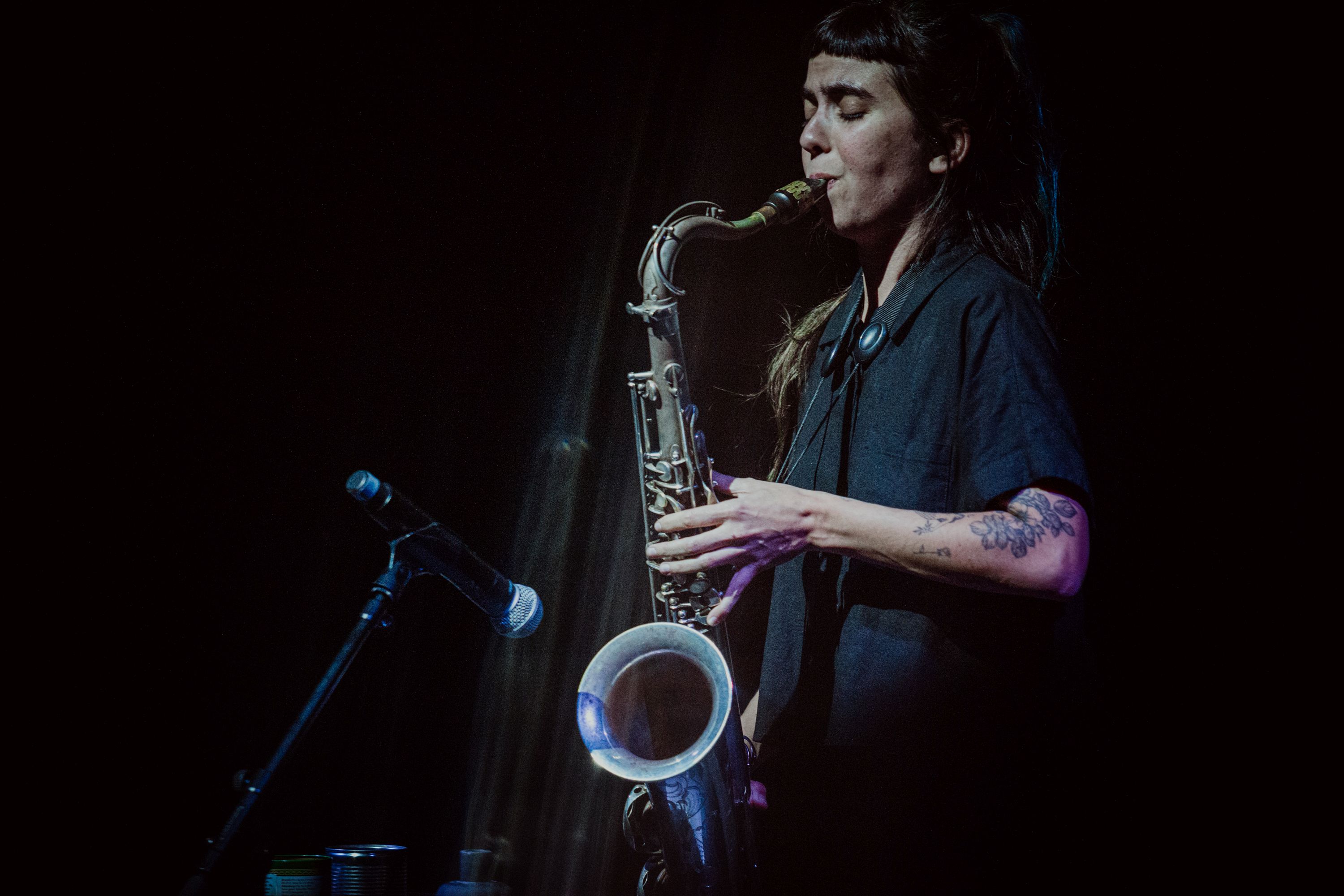
Occupation: Saxophonist, composer, improviser
Current release: Camila Nebbia teams up with Gonçalo Almeida (double bass) and Sylvain Darrifourq (drums) for their new LP Hypomaniac, out via defkaz.
Recommendations for Buenos Aires, Argentina: La Catedral del Tango.
Topics I am passionate about but rarely get to talk about: I love films. I studied film direction at the same time as music, this is one of my passions as well. My favourite directors are Agnes Varda, Lucrecia Martel, and David Lynch, among others.
If you enjoyed this Camila Nebbia interview and would like to stay up to date with her music and upcoming live dates, visit her official homepage. She is also on Instagram, Soundcloud, bandcamp, and Facebook.
When did you first consciously start getting interested in musical improvisation? What was your first improvisation on stage or in the studio and what was the experience like?
I don’t remember exactly which year it was, but I do remember listening to Ornette Coleman’s album Crisis, and it completely blew my mind. I knew immediately that my path was leading toward that music, it felt so mysterious, deep and free.
My first experiences came from getting together with friends who were also interested in free improvised music, to play and explore. I still play with them whenever I’m in Buenos Aires.
Tell me about your instrument and/or tools, please. What made you seek it out, what makes it “your” instrument, and what are some of the most important aspects of playing it?
I started playing the saxophone when I was 8 years old, but it wasn’t until many years later, when I entered the conservatory, that I got my first tenor saxophone.
I love developing my sound; I am always searching for ways to express what I feel through it. That is my first need: to be honest with my instrument.
How would you describe your own relationship with your instrument – is it an extension of your self/body, a partner and companion, a creative catalyst, a challenge to be overcome, something else entirely?
It's definitely everything you have mentioned, an extension of myself and a companion that has been with me through many moments in life.
Derek Bailey defined improvising as the search for material which is endlessly transformable. What kind of materials have turned to be particularly transformable and stimulating for you?
Every sound I can get from my instrument, and everything that happens when I play with other people, is a source of inspiration. Communicating with other musicians is a continuous source of inspiration and transformation.
I also find the sounds of each city very stimulating, particularly those of my hometown, Buenos Aires.
Do you feel as though there are at least elements of composition and improvisation which are entirely unique to each? Based on your own work or maybe performances or recordings by other artists, do you feel that there are results which could only have happened through one of them?
I think the approaches can be very different, but there are also similarities between them. It depends on the project and the ensemble; I think each encounter is unique and special.
When I work on written music projects, it is usually because I am searching for something very specific to express through melodic material. Even when the music is highly atonal and includes a lot of free improvisation, I value the possibility of articulating certain concepts that are important to me.
If what I want to express can be achieved through improvisation, I usually prefer not to write anything and leave it completely free.
Artists from all corner of the musical spectrum, not just “free jazz” have emphasised the importance of freedom in their creativity. What defines freedom for your improvisations?
Being present in the moment.
In your best improvisations, do you feel a strong sense of personal presence or do you (or your ego) “disappear”?
I feel that I'm present, aware of the moment, but not letting my mind dictate what will happen. It is about listening, leaving expectations behind, and accepting whatever happens as right.
In those moments, I definitely feel a detachment from the ego.
What are some of your favourite collaborators and how do they enrich your improvisations?
I have so many, I love playing with, people that I not only like as musicians but also as human beings, and that they are pushing towards something new.
Some of them are: John Edwards, Kit Downes, Marta Warelis, Andrew Lisle, Marilyn Crispell, Lesley Mok, Chris Corsano and so many more.
[Read our Marta Warelis interview]
[Read our Chris Corsano interview]
In a live situation, decisions between creatives often work without words. From your experience and current projects, what does this process feel like and how does it work?
It feels like magic when there is chemistry in a band.
I love playing with ensembles for the first time when it feels as if we have been playing together forever, and also developing over time with the same ensemble.
For example, Exhaust trio with Kit Downes and Andrew Lisle, the trio Hypomaniac with Sylvain Darrifourcq and Gonçalo Almeida, or the trio with Marilyn Crispell and Lesley Mok. Each one has an own identity, and it's shaped by the togetherness of the band.
Stewart Copeland said: “Listening is where the cool stuff comes from. And that listening thing, magically, turns all of your chops into gold.” What do you listen for?
Always different music.
My listening is very hectic; I change drastically what I listen to, usually following whatever inspires me in the moment. I can listen to the same song for an entire day, or even longer.
As I mentioned before, I also love listening to the sounds of each city, as well as archives and sounds from nature.
As a listener, do you also have a preference for improvised music? If so, what is it about this music that you appreciate as part of the audience?
An honest one, people playing what they are.
I always say this, I can enjoy any type of concert if its made with heart and honesty.
In a way, we improvise all the time. In which way is your creative work feeding back and possibly supporting other areas of your life?
I love the openness, flexibility and endless curiosity that comes with this music.
I try to apply it to my life as well.