Published
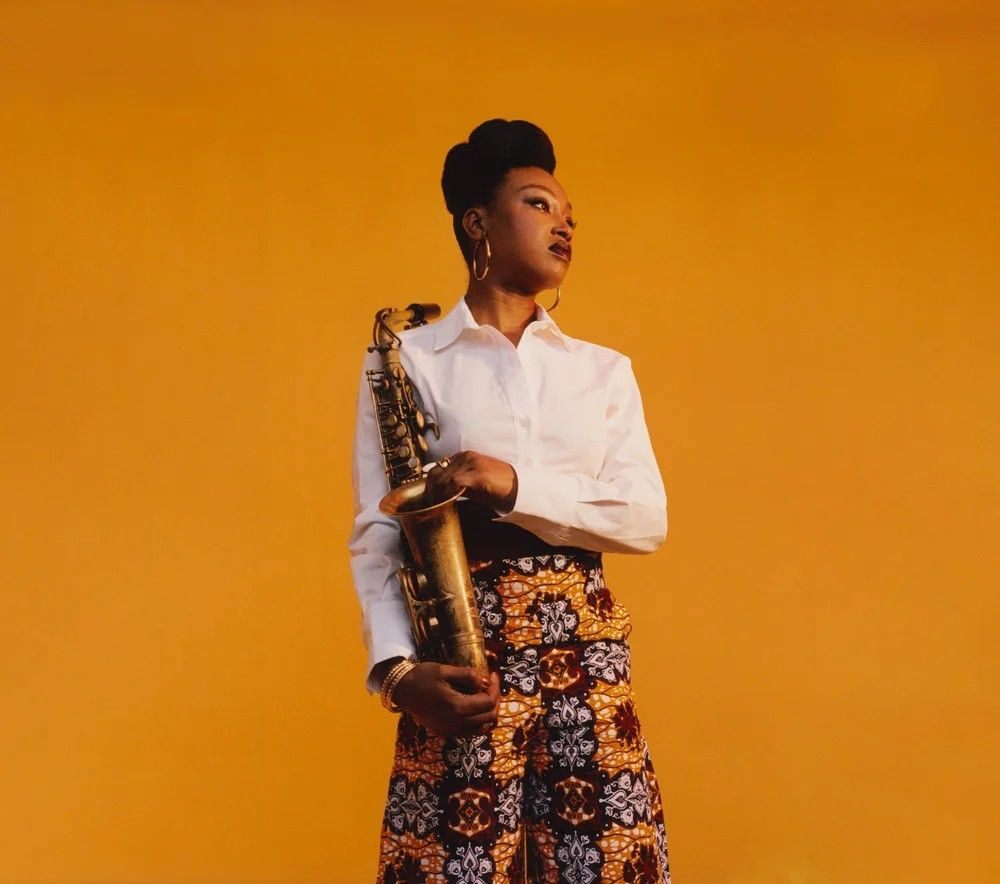
Name: Camilla George
Nationality: Nigerian
Occupation: Composer, improviser, saxophonist
Current event: Camilla George is one of the artists featured in this year's 30th Anniversary edition of the Cheltenham Jazz Festival. For more information and tickets, go here.
Current release: Camilla George's latest album is 2022's Ibio-Ibio is out via Ever. It features Daniel Casimir (bass), Shirley Tetteh (guitar), Winston Clifford (drums), Sheila Maurice-Grey (trumpet), Rosie Turton (trombone), Renato Paris (vocals), Sarah Tandy (keys), Kadialy Kouyate (kora), Daru Jones (drums), Lady Sanity (vocals).
Shoutouts: Gosh there are so many- firstly a big shout out to Tomorrow’s Warriors who are a UK based charity that provide jazz education free of charge- they have shaped the future of UK jazz which alumus such as Ezra Collective, Shabaka Hutchings, Moses Boyd and Nubya Garcia. I think Serious are amazing also- their yearly jazz festival is inspiring and they put on seriously exciting gigs all year round. The recent pop up at Village Underground with Robert Glasper and Common is an example of this!
Recommendation for London, UK: If I had to recommend one thing to visit in London I think I would go for the V&A museum. I lose myself there every time I go. It has such amazing collections and they do a late session where you can wander around at night with a drink- incredible!
Things I am passionate about but rarely get to talk about: This will make me sound like a lush but … wine! I am taking a Sommelier course at the moment and would love to have a wine and jazz bar someday!
[Read our Ezra Collective interview]
[Read our Nubya Garcia interview]
If you enjoyed this Camilla George interview and would like to stay up to date with her music and upcoming live dates, visit her official homepage. She is also on Instagram, Facebook, and bandcamp.
What were some of the musical experiences which planted a seed for your interest in jazz?
I first got into jazz by listening to my Dad’s vinyl records- he was an avid jazz fan and he had some corkers- Sonny Stitt, Jimmy Smith and Stanley Turrentine.
He later took me to see Sonny Rollins at the Barbican and I remember he played “A Nightingale Sang in Berklee Square” just solo sax- I think that was one of the most beautiful things I have ever heard.
What does the term jazz mean today, would you say?
I think the term jazz has always been a difficult one.
For me it is improvised music but it has always been a form of dance music in my mind. From the swing era and looking back to photos from bebop clubs, there were people moving to the music.
It has the ability to move you in ways I think other music doesn’t.
As of today, what kind of materials, ideas, and technologies are particularly stimulating for you?
I am very stimulated by Kenny Garett’s compositional output. I love the genius in the power of his music. Some pieces are nursery rhyme esque like “Sing a Song of Song” but are often harmonically complex.
I think that is real genius- rather than showing off writing complicated music that sounds hard, Kenny writes masterpieces which are so powerful that despite their rhythmic or harmonic complexities, they can actually reach people.
For me, I think that is the goal- to reach people and spread a message or ideas through music.
Where do most of your inspirations to create come from – rather from internal impulses or external ones? Which current social / political / ecological or other developments make you feel like you need to respond as an artist?
I am very inspired by stories- and my music is steeped in tales from the Ibibio people and beyond in South East Coastal Nigeria.
I love researching something or reading a story and writing music to fit that tale.
Tell me a bit about the sounds & creative directions, artists & communities, as well as the colleagues & creative hotspots of your current hometown, please. How do they influence your music?
I live in London and I think it has influenced my creative output more so in recent years with the new wave of UK Jazz which has embraced our cultural diversity.
My first album, Isang, came out just before this new generation of UK and particularly London focussed jazz, and I got a lot of criticism because people couldn’t pronounce the names of the tracks or couldn’t understand their relevance (it referenced my Nigerian heritage).
The new wave jazz in London meant that there was an openness and an embracement of different cultural influences.
What role do electronic tools and instruments play for your creative process?
I am still a bit of a luddite but I have Logic and have been getting more into that but I mainly use Sibelius to write all my music.
I have an electronic sax that was gifted to me by Roland and I am looking forward to exploring that more!
Thanks to technological advances, collaboration has become a lot easier. What have been some of the most fruitful collaborations for you recently and what approaches to and modes of collaboration currently seem best to you?
During lockdown I collaborated on an album with Keyon Harold which was amazing.
I also was able to collaborate with Daru Jones on my last album, Ibio-Ibio as he was based in the US.
Jazz has always had an interesting relationship between honouring its roots and exploring the unknown. What does the balance between these two poles look like in your music?
I think that is very much something I adhere to.
I still work hard to master the traditional jazz idiom and I think those foundations allow you to launch yourself and truly find your voice.
How much potential for something “new” is there still in jazz? What could this “new” look like?
I think there are loads of opportunities for new sounds- there are so many fantastic players coming through who are making really interesting music- it’s exciting!
For many artists, life-changing musical experiences take place live. How do you see that yourself?
Yes, I love to play live- there is nothing quite like it! Long may that continue!
How, would you say are your live performances and your recording projects connected at the moment? How do they mutually influence and feed off each other?
Well, I am currently working on my fourth album and whilst this will be a studio recording, I am aiming to play the new material as much as possible live because I think the live experience can shape a really good recording.
Due to budget, I have always done it the other way round, record and then shape the music on live gigs but I have made a special effort to gig the music this time round.
Improvisation is obviously an essential element of jazz, but I would assume that just like composition, it is transforming. How do you feel has the role of improvisation changed in jazz?
I think improvisation will always transform as the music develops really.
What, would you say, are the key ideas behind your approach to improvisation?
Oh that is hard actually!
Well obviously the harmonic and rhythmic framework but also making sure I am in the moment listening to what the rhythm section are doing whilst trying to convey the mood and message of the music.
The Montreux Festival intends to preserve its archive of recordings for future generations. Do you personally feels it's important that everything should remain available forever - or is there something to be said for letting beautiful moments pass and linger in the memories of those that experienced them?
That’s an interesting one as so much of my musical education has come from me checking out recordings and videos of gigs from before I was born.
It was a magical experience and I think we owe it to younger generations to keep those recordings so they can also enjoy them and learn from them.