Published
Name: Carmen Souza
Occupation: Singer, songwriter
Nationality: Cape Verdean
Current release: Carmen Souza's new album Port’Inglês is out via Galileo. To support the release, she will embark on a tour. Select dates are:
02 Oct, Darmstadt (DE) Centralstation
04 Oct, Wien (AT) Sargfabrik
05 Oct, Estarreja (PT) Cine-Teatro de Estarreja
31 Oct, Folkstone (UK) Ethnic Jazz Festival
30 Nov, London (UK) Crazy Croqs: Album Launch
If you enjoyed this Carmen Souza interview and would like to know more about her music, visit her official website. She is also on Instagram, Facebook, and twitter.
For an even deeper dive, we recommend our earlier Carmen Souza interview.
Do you think that some of your earliest musical experiences planted a seed for your interest in your voice and singing? How and when did you start singing?
I am sure they did, I have always been interested in music and singing from a very young age. I believe that this had a profound impact on my childhood.
Not only that, but I would sing whatever came up on the radio and every Sunday I would sing in church, too.
If you're also playing other instruments, how does the expressive potential of these compare to your own voice?
I play the guitar and the piano, although I do not consider myself to be a guitar player or a pianist. I play these instruments as accompaniment, and what I feel is that the expressive potential of the instrument complements and enhances my voice and the message.
Each instrument for me has its own unique qualities and capabilities for expression, and when combined with my voice, it can create a richer, more dynamic musical experience. I like it because the instruments that I play not only pave different musical paths for me to follow but also it can convey emotions, add depth to the music, and create harmonies that inspire the way I sing. It allows me to explore different musical textures and expand my creative range, adding layers to my performance that may not be achievable with voice alone.
Also, I love exploring unconventional sounds from instruments and my voice. It's so inspiring to create something unique and unexpected.
Singing is an integral part of all cultures, and traditions. Which of these do you draw from – and why?
Singing is indeed an integral part of all cultures and traditions. I draw inspiration from various cultures and traditions because each one offers a unique and diverse approach to music, which enriches my own artistic expression. Being a tour musician I am privileged to get to know so many cultures and I feel that they all teach and show me new musical avenues.
Last year I was doing a Master’s Degree in Ethnomusicology, and one of the subjects was about Performance as Research, so I briefly dived into Indian Classical Music. This was such a great experience for me, because Indian Classical music and its perspective of the voice and music is very spiritual.
What were some of the main challenges in your development as a singer/vocalist? Which practices, exercises, or experiences were most helpful in reaching your goals – were there also “harmful” ones?
One of the biggest challenges for me was honing my performance skills. In the beginning I had stage fright and my voice would tremble, and I felt like I had no control over my voice at all. The fact that I didn’t give up and kept on confronting this fear, made me improve significantly over the years.
One of the practices that also helped me a lot was visualisation of the theatres and venues, where I visualise I am in front of an audience and prepare myself mentally for the performance. Of course, last but not least a lot of rehearsing, I went to the “shed”. Practice, Practice, Practice and recording myself was something very useful for detecting issues and efficiently resolving them.
Harmful practices such as overstraining the voice or neglecting vocal rest can cause damage to the vocal cords, that is why when I am touring I am very disciplined with my rest.
How do you see the relationship between harmony, rhythm and melody? Do you feel that honing your sense of rhythm and groove has an effect on your singing skills?
Harmony, rhythm, and melody are deeply interconnected. The harmony supports the melody, the rhythm provides the framework for the timing and flow of the music. Melody is the sequence of single notes that are perceived as an entity, heavily reliant on the rhythm. When a singer has a strong sense of rhythm and groove he or she can have complete control of the music.
An example of this for me is Kurt Elling, his sense of rhythm makes the whole difference in his vocal performance because the melody flows effortlessly in the music.
For me it is one of the skills that I work on consistently because it helps me as a singer to maintain a steady tempo, and deliver my vocals more precisely and with expression, enhancing my ability to interpret and convey the emotions of the song.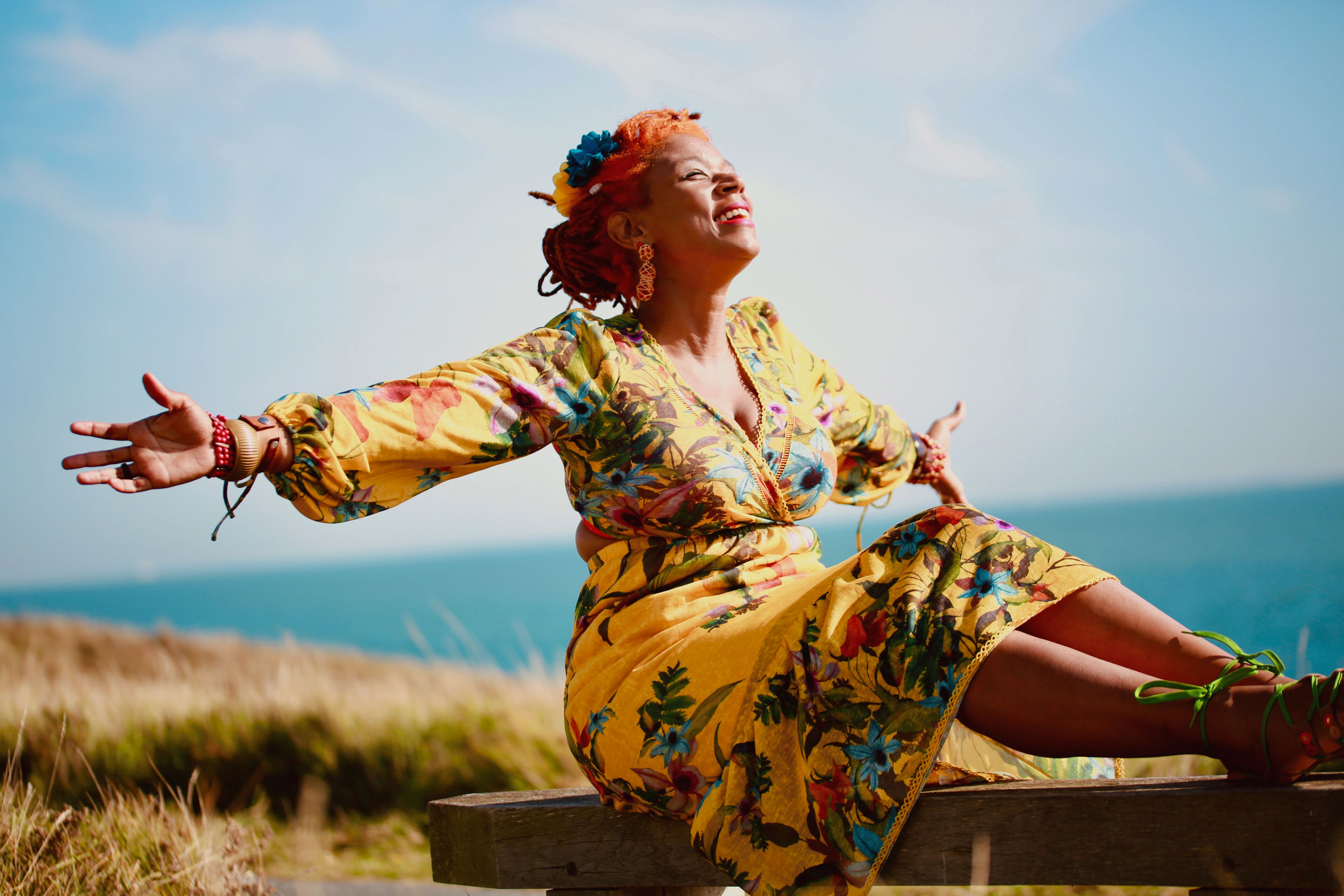
Carmen Souza Interview Image by Patricia Pascal
What are the things you hear in a voice when listening to a vocalist? What moves you in the voices of other singers?
When I listen to a vocalist, and I just mentioned one of my favourite ones Kurt Elling, but also Ella Fitzgerald and Sarah Vaughn, I pay attention to aspects such as tone quality, vocal range, control, intonation, expression, diction, and unique timbre. These elements contribute to the overall emotional impact and artistry of the performance.
What moves me in the voices of other singers is the ability to convey genuine emotion, tell a compelling story (because in truth we are storytellers) and connect with the audience on a deep level.
How would you describe the physical sensation of singing? [Where do you feel the voice, do you have a visual sensation/representation, is there a sense of release or tension etc …]
I feel vibrations in my chest, head, throat, and face. This is very physical for me, because my whole facial expression moves with my singing. There is a resonance and vibration that is felt in my body, particularly in the chest and head. The more relaxed I am the more I can convey that sense of flowing, release and relaxation in my vocal box to achieve the open and free sound.
Again I use the visualisation of open fields or skies to reach that sensation or representation in my voice, such as imagining the sound moving through a green forest or a blue sky or a night starry sky. This helps me connect with my soul and my emotions. It is a moment of delivery, where I am serving as a vehicle for the music.
What kind of musical settings and situations do you think are ideal for your own voice?
My ideal musical setting is when I am playing with my band. Because we are so used to playing together, we know each other very well. So there are perfect moments when we are all in the same vibration, and the music and message are flowing through us in another dimension. Where all the techniques, practices and worries don't matter any more, and we can just be in the music.
We let go of everything and that’s when magic happens.
We have a speaking voice and a singing voice. Do these feel like they are natural extensions of each other, ends on a spectrum or different in kind?
The speaking voice and singing voice are certainly related, as they both come from the same source. However, they are also different. The way I see it, my speaking voice is generally more relaxed and informal.
However, because I use my singing voice in different ways where I try to find different and unconventional singing sounds, almost singing as if I was not a singer, I can still express that informality and relaxation of the speaking voice.
But the singing voice can often be more controlled and expressive, which requires a different set of techniques and skills to produce different pitches, tones, and dynamics.
From whispers to screams, from different colours to dynamics, what are the potentials and limits of your voice? How much of your vocal performance can and do you want to control?
My voice gives me some versatility in terms of vocal range, and this helps me to convey a wide range of emotions and expressions.
Although I rarely resort to screams, I like to explore the very high and the very low pitches in my voice. Jazz also helps me to develop my voice because it is improvisation in real time and it helps me to free myself of conventions and rules and fly. Also, I like to emulate instruments like the saxophone or the trumpet with my voice and that makes me incarnate a different attitude.
I strive to control aspects of my voice to deliver a better performance. This includes managing breath support, vocal resonance, articulation, and expression. However, it's important for me to leave some space for the spontaneous, because sometimes it's when you let go of the control that magic takes place.
But this process for me is a continuous journey, and every performance offers new opportunities for growth and refinement.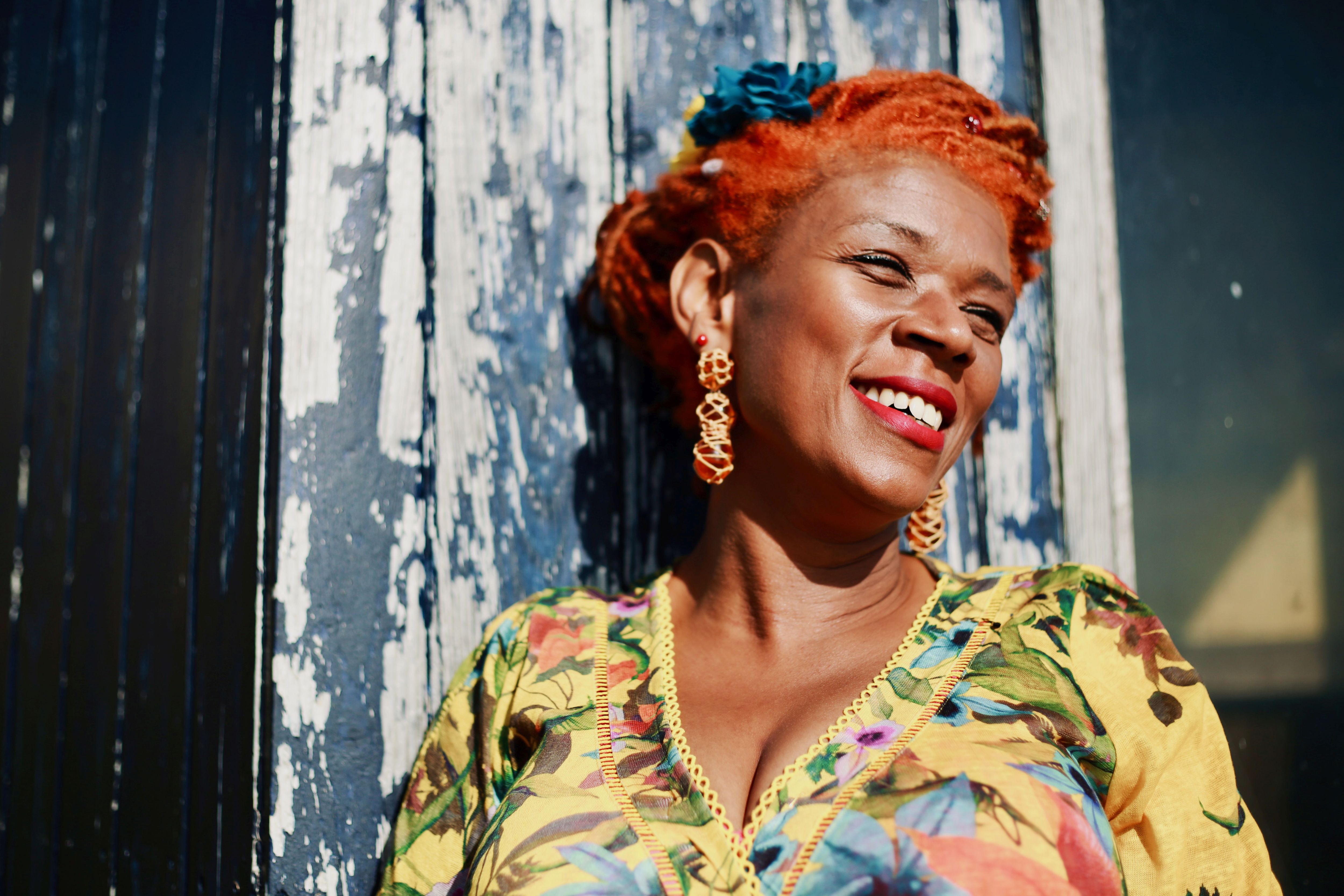
Carmen Souza Interview Image by Patricia Pascal
When you're writing song lyrics, do you sense or see a connection between your voice and the text? Does it need to feel and sound “good” or “right” to sing certain words? What's your perspective in this regard of singing someone else's songs versus your own?
I write lyrics mainly in the dialect of Cape Verde, which is the creole, and this dialect gives me the freedom to play with pronunciations because the dialect changes from island to island. There are 10 islands and between them there are strong variations in pronunciations, phrasing and expression.
When I am writing lyrics, there is indeed a strong connection between the voice and the text. Normally, Theo Pascal who is my long-time musical partner and collaborator writes a melody, and as soon as I hear it, his notes already suggest words for me to write. The words need to feel and sound "good" or "right", as the vocal delivery can greatly influence the overall impact and emotion of the song.
Certain words and phrases may naturally lend themselves to specific melodies or vocal inflections, and I do take in to account the musicality of the lyrics when writing them. I pay attention to phonetics, syllables because this will have an impact on the rhythm, and flow of the song.
When singing someone else's songs, all this work has already been done for me:). Because the composer and the singer already went through that process to deliver the song. So I can forget about all of this and just focus on my own interpretation, the emotion behind the words and finding a personal connection to the material. Of course, when I am singing my own songs, I have a deeper personal connection to the lyrics, as I wrote them inspired by on my own experiences and emotions. This can bring an added layer of meaning and depth to my performance.
In both cases, whether singing someone else's songs or their own, the connection between the voice and the text is key.
Strain is a particularly serious issue for many vocalists. How do you take care of your voice? Are the recipes or techniques to get a damaged voice back in shape?
All singers know that It's very important to stay hydrated, avoid smoking, and limit caffeine and alcohol intake. That being said, I absolutely love coffee, so that is a tough one for me. But I try to keep my intake to 2 max per day.
Additionally, practising good vocal techniques, such as proper breathing and vocal warm-ups, also paying attention to the repertoire to see if there are any songs that feel uncomfortable in the set list.
When I have problems with my voice, like a cold or flu, I drink loads of tea like, Globe Amaranth with honey, ginger tea, turmeric tea, and of course, my bottle of water is my best friend. I avoid talking too much and try to sleep as much as I can to allow the vocal cords to heal.
How has technology, such as autotune or effect processing, impacted singing? Has it been a concrete influence on your own approach?
Technology has deeply impacted, the way we record and it's a science that keeps on evolving. Autotune and other DAW (digital audio workstations) are becoming more and more effective and easy to use tools. Anyone can make a song without even knowing how to play one instrument.
And this where I draw the line with technology and AI because it basically becomes a supermarket of formulas to create music or art, but it discards the humanity out of the process. During this interview we have been talking about a deeper level connection with audiences, with yourself, with music, with instruments, and here is a tool that completely eradicates this personal growth and gives you music made by statistics and formulas.
In regard to Autotune, I have nothing against it, but artists/singers cannot depend on it for it to do the work that we should be doing in the shed, working your intonation and pitch. Also, the imperfections is what makes us human, without them the sound becomes dull and bland for me. So no, I don't use it.
Effect processing, on the other hand, enables singers to experiment with different vocal styles and create unique sounds that were not possible before. And I really love this, because I am very passionate about sound recording, and I have a studio with Theo Pascal in Lisbon, and we love analogue technology from the BBC golden era. And we love to experiment with different techniques and effect processors.
Since I have a studio I have now become very familiar with the process of producing sound, but the kind of vintage technology that we have here in the studio, requires the performer to connect to its artistry too, because studio recording is a very transparent experience it will show you all the details.
For recording engineers, the human voice remains a tricky element to capture. What, from your perspective, makes voices sound great on record and in a live setting?
It can be a very complex and dynamic instrument to record. Capturing the nuances of a voice in a way that sounds great on a recording and in a live setting requires a combination of technical expertise and creativity, from both engineer and performer. So many variants can alter the sound of a voice like microphone selection, placement, room acoustics, and signal processing all play a crucial role in capturing the natural timbre, expression, and emotion of a voice.
Additionally, in post-production, the engineer can use effects such as reverb, compression, and equalization which do further enhance the quality and a vocal performance. But the original track needs to have good quality from the start. Vocal sound recording involves a deep understanding of both the technical and artistic aspects of audio engineering.
Motherese may have been the origin of music, and singing is possibly the earliest form of musical expression, and culture in general. How connected is the human voice to your own sense of wellbeing, your creativity, and society as a whole?
In Portugal there is a saying: when you sing, you cast all your troubles away.
Singing for me is everything, it is the best form of expression, and everyone should be doing it to release stress and depression.