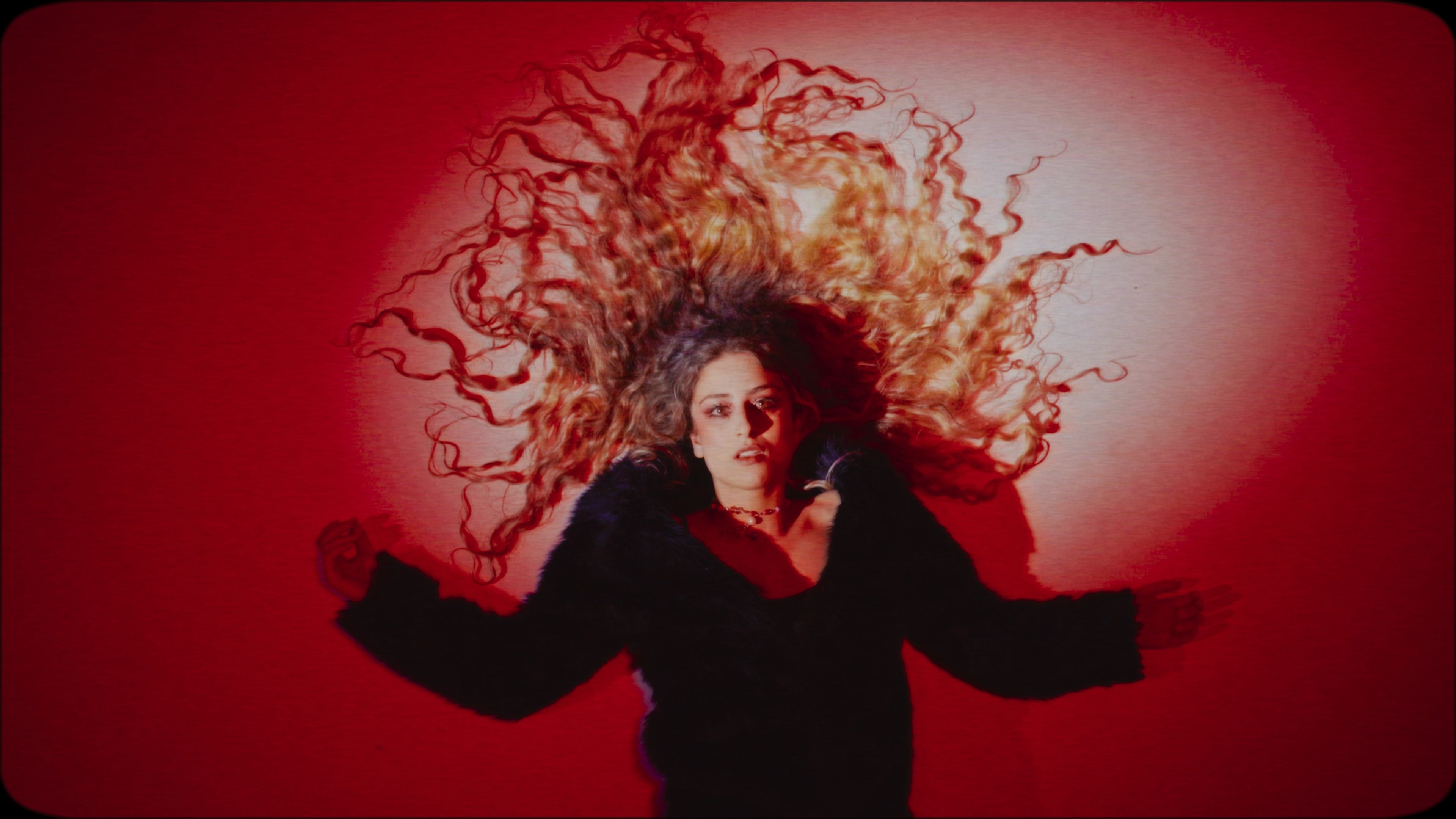
Published
Name: Carolina Cury
Nationality: Brazilian-Italian
Occupation: Pianist, composer, vocalist
Current Release: Carolina Cury's new album GLISSBLISS is out via Bait.
Recommendations for Venice, Italy: Venice is my hometown. The city is full during the day and empty at night. 3am, summer. Stroll around and listen to Venetian Dust. You can dance and maybe feel some wind on your sweaty skin.
If you enjoyed this Carolina Cury interview and would like to know more about her music, visit her on Instagram, Facebook, and bandcamp.
Where does the impulse to create something come from for you? What role do often-quoted sources of inspiration like dreams, other forms of art, personal relationships, politics etc play?
Dreams have always been important to me.
I once dreamt that I was holding a baby through a screen and soon realised that the baby was baby-me. At first I was overjoyed to be my own mother, but then I became anxious because I realised I couldn't be the baby anymore. The baby me needed me to be responsible for her. However, the baby suddenly melted into the screen, and I felt a strange relief, because I could BE the baby me again.
I continued developing this dream while awake, weaving it together with stories of friendship, freedom, and the feeling of feeling young. Out of that process, the song “Baby Me” emerged.
“Watermelon Sand” also grew from a dream. I had been having nightmares about Gaza for several nights in a row. In this dream, I found myself in a deserted landscape devastated by war.
At some point, I heard a sigh and turned around to see these hopeful "honey eyes". They seemed to belong simultaneously to all Palestinians and to my father, who was of Lebanese descent and passed away some years ago.
The melody from this song comes from “Sleep” by Max Richter, whom I was lucky enough to work with, and I happened to be listening during the night of the dream while sleeping.
[Read our Max Richter interview]
For you to get started, do there need to be concrete ideas – or what some have called a 'visualisation' of the finished work? What does the balance between planning and chance look like for you?
I almost never begin with a complete vision of a finished piece. More often I start from a sensation, a texture or a character. I’ll tell you a bit about my piece “Ligeti Spider.”
I happened to spend some time alone with a spider, as an arachnophobe, and I decided to try to understand the creature and face my fear. I used a particular rhythm that Ligeti used in his etude for piano no.8 (Fem), where he superimposes two independent rhythmic patterns creating a generative web of pulses.
I played that piece a lot, it always made me think of spider dances. That’s how the piece started: a character and a musical element.
From there, I allow accidents, wrong turns and unexpected connections to happen. The planning comes later, when I begin weaving together the material that has appeared.
Do you have certain rituals to get you into the right mindset for creating? What role do certain foods or stimulants like coffee, lighting, scents, exercise or reading poetry play?
Practising the piano gets me in the zone. It’s a form of meditation that prepares my mind for new ideas and connections.
For GLISSBLISS, what did you start with? If there were conceptual considerations, what were they?
Some of the songs on the album planted their first seeds around 2020, during isolation. Pieces such as “Awakening of a Numb Creature,” “Baby Me” and “Mater Larum” began back then, but at the time I wasn't thinking about making a coherent project.
I often have the feeling that songs exist in layers of time. They can remain dormant for years before I find them again. Sometimes I feel less like their composer than their adoptive parent. They appear as abandoned children or artefacts from the past, found among the rubble. Then, after spending time with them, I realise that I am in fact their biological mother.
The impulse to finally make GLISSBLISS came later, after my father passed away. Grief became a propeller, creating an urgency of expression. “Oh Sunday” is the clearest example of that. Other pieces arrived much later. “Gliss Myss Belcanto Miao” emerged from live performance and was added almost at the last minute. It is an improvised transition piece, a humorous intermezzo, inspired by the light-hearted intermezzi of Baroque opera.
Another last minute addition is my arrangement of Handel's Lascia Ch'Io Pianga, which I made for my voice collective SORORI. Kostako (the producer) and I like to imagine it as an ancient artifact discovered in a post-apocalyptic landscape, the last piece of human music.
As I put things together, the concept became clear: this is music that is meant to transform you. That's where the title GLISSBLISS comes from: the bliss of the glissando (a frequent musical element in the album), the joy of being inbetween, constantly becoming something else.
What makes lyrics good in your opinion? What are your own ambitions and challenges in this regard?
I like lyrics that feel like spells.
In “Venetian Dust,” for example, I repeat the Italian phrase "Nella città, dove si va" ("In the city, where do you go?/where you go"). This is meant to hypnotise you. Other times, I take a more theatrical approach and illustrate my surreal worlds.
In “Awakening of a Numb Creature,” I describe a molluscan creature sleeping inside a shell at the bottom of the ocean. By the end of the song, the narration turns into an incantation: "Breathe and rise, your beauty is erupting!"
I also enjoy letting words echo across different songs. The phrase "punch in the heart" appears in different contexts throughout GLISSBLISS: humorously in “Ligeti Spider,” in relation to my arachnophobia, and then again in “Oh Sunday,” where it takes on a very different meaning through grief. I like the idea that words can accumulate memories as they travel through an album.
I like writing lyrics in different languages, as I did in my previous album Carnaval for example on “Toca Bem.”
Using different languages (I speak 5 myself! a bit of bragging!) and experimenting with them is definitely something I’d like to explore more in the future, and it feels like an exciting moment for this practice with so many interesting artists experimenting with what a language can be (for example Marina Herlop, Rosalia, La Nina del Sud).
[Read our Marina Herlop interview]
There are many descriptions of the creative state. How would you describe it for you personally? Is there an element of spirituality to what you do?
The strongest creative state for me happens during performance. That's where composition and performance stop feeling separate.
When I perform, I feel like a witch casting spells and enchanting the space. Many of my compositional ideas actually come from performing. What I do later in the studio is often an extension of experiences I've already had on stage. In that sense, composition is a way of recreating a ritual.
Also, is there really a boundary between performing and living? With the people I feel very intimate with I’m constantly doing little performances, little dances, comical sketches, voices, accents. It can be so liberating to escape from the prison of identity.
In terms of what they contribute to a song, what is the balance between the composition and the arrangement (including production, mixing and mastering)?
I find it very difficult to establish clear boundaries between composition, arrangement and production. I always found the idea of the composer as a singular authority a bit weird. I prefer to think of composition as a form of gossip: ideas travel, transform, pick up influences and are passed from one person to another.
That's very much how GLISSBLISS was made. I worked closely with Kostako, the producer of the album, and the lines between composing, arranging and producing became so blurred that we ended up sharing credits across all three roles. His contribution was particularly remarkable on “Mater Larum,” where the production became almost baroque in its complexity, full of counterpoint, polyrhythms and detail.
The same was true with Will Purton, who mixed most of the album. He was incredibly sensitive to my vision, but also brought wonderful ideas of his own. I had so much fun.
Music and the accompanying artwork are often closely related. Can you talk about this a little bit for your current project and the relationship that images and sounds have for you in general?
I really enjoy collaborating with dancers and visual artists.
For the “Ligeti Spider” music video, the dancers create spider-like formations by layering their bodies on top of each other, almost like a living organism built from rhythm and movement.
In the upcoming “Mater Larum” music video, the dancers appear more like statues. I like to think of music as an embodied practice.
I would love to know a little about the feedback you've received from listeners or critics about what they thought some of your songs are about or the impact it had on them – have there been “misunderstandings” or did you perhaps even gain new “insights?”
I once performed the album in a very different context from my usual audience, at a jazz festival in the Venetian countryside, where the average age was higher and probably there was no familiarity with experimental pop. I was a bit scared!
But the response was incredibly moving. One woman told me: “I didn’t understand anything, but I couldn’t stop crying from so many unknown emotions.”
The feedback I’ve had from the studio version of GLISSBLISS has often been similar: people describing it as something that moves them through disturbance and healing, or as a kind of transformative experience. I actually welcome that space of not fully understanding. It’s an album that can be endlessly misunderstood, that is part of its concept.
To my listener: I want to challenge you and I want to love you.