Published
Name: Carolyn Zaldivar
Nationality: American
Occupation: Sound artist, field recorder
Current release: Carolyn Zaldivar's Tangent Universes is one of the contributors to the new i u we compilation connected #3. “Martha of i u we reached out to me online over Instagram,” Carolyn remembers, “I was surprised by it since I had not corresponded with her in the past.” Other artists included on the release include Silver Galaxy, Francesca Guccione, Andrea Cichecki, Danielle Nia, Nadia Struiwigh, Never Sol, Tunegirl, and lil.lili.
[Read our Nadia Struiwigh interview]
[Read our Francesca Guccione interview]
[Read our Danielle Nia interview]
If you enjoyed this Carolyn Zaldivar interview and would like to stay up to date with her music, visit her official homepage. She is also on Instagram.
How would you describe the local scene for modular synths for the city you're currently living in? Which other artists or festivals are you in touch with?
I live between Washington D.C. and Baltimore, Maryland in the US. Both have collectives and communities explicitly for modular synths. D.C. has a thriving techno community utilizing these tools, and Baltimore has an incredible and storied experimental community viewing these machines as communal and experimental.
Some artists I admire in my community that stand out to me for innovation are Matthew Cha who is thoughtful about the improvisational aspects of these machines, Jamar Ali who is based in Maryland and started Ali Modular to contribute to the design of these machines.
My closest friends in modular synths locally are Atograph who performs incredible hip hop compositions, and Null Phi Infinity who has the distinction of being part of the assembly of many KNAS Moisturizer (spring reverb units used notably by NIN).
The last few years I have spent more time in the noise community situated around the DC venue Rhizome, where I have met so many wonderful and experimental people. I love humans in the modular community who start small labels, host shows, make their own machines, and tend to gravitate towards DIY oriented people.
When you look at the artists who have been part of i u we – do you think that, other than a preference for the modular, there are musical/creative aspects that most of you share?
I U We is very vocal about celebrating the diversity of women. I think all of us accept the rich breadth and depth of being women. This can mean bridges across class, perceptions of femininity, occupation, choosing to be a parent or not.
Likewise I think many of us are self-taught with these machines. I think it takes a certain obstinacy to want to learn something so complex, while recognizing there’s many roads to mastery.
I tend to be in the school of thought that we learn by doing, that knowledge is practice based.
Describe the creative process for your contribution to connected #3, please.
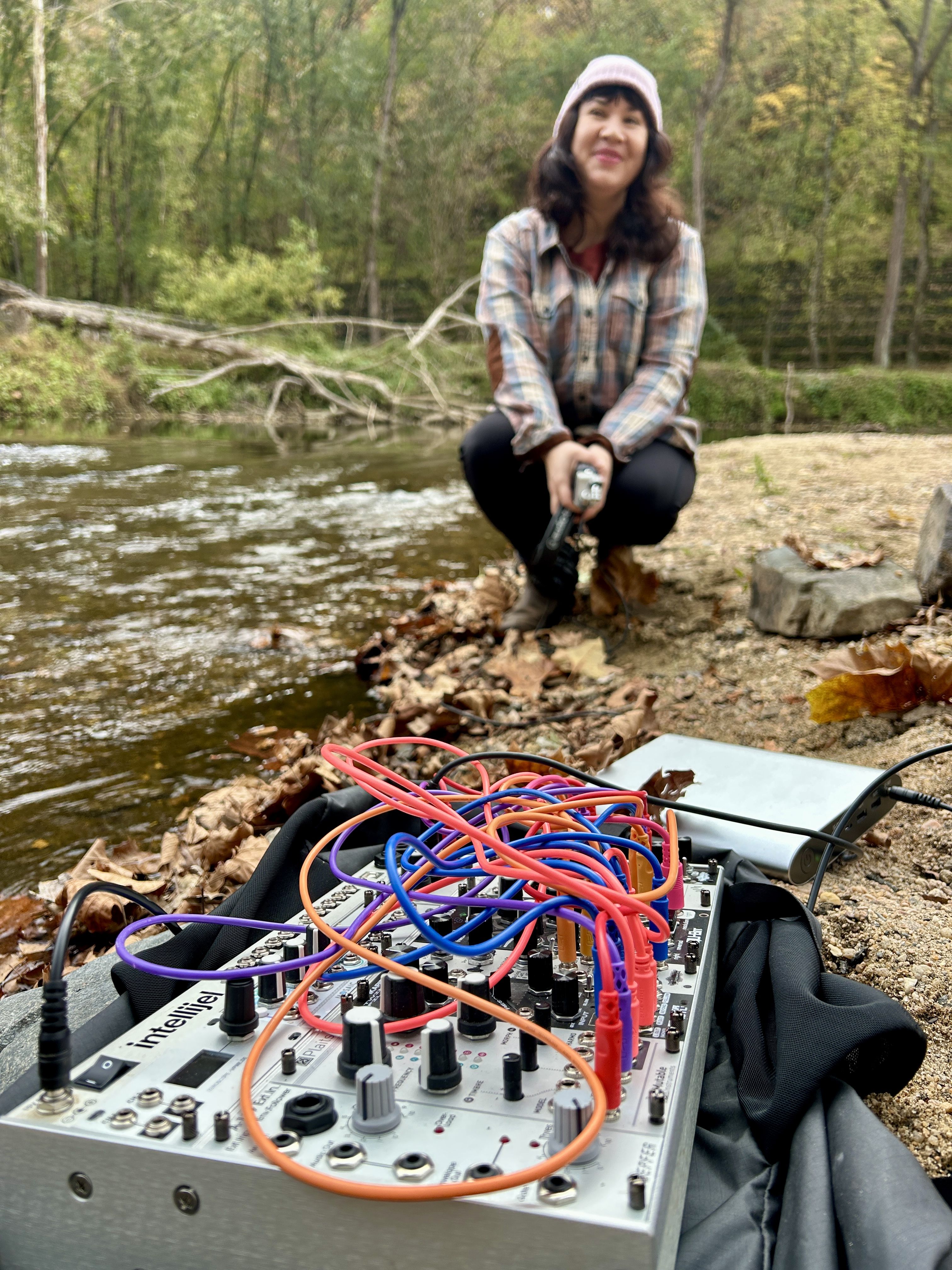
I work outdoors in a river system that feeds into the Chesapeake Bay in Baltimore, Maryland US. I would consider myself primarily a field recordist, and view my modular system as an effects board and tape delay for manipulating samples. My son is often with me on these adventures helping with hydrophones, or listening for things I often don't pick up the way children are seemingly distracted -- and then you find out they are even more intentional than you thought possible.
I am a reader and find solace in authors like Shirley Jackson and Flannery O'Connor who write about women and the supernatural in compelling ways that resonate with me. I think I am always trying to tell stories with my modular case and field adventures in the same vein.
This track mangles drones with recordings of my son pretending to be a ghost, and the weather systems and river sounds that cascade through the Patapsco Valley. It's a story of autumn. The title is inspired by the novel We Have Always Lived in the Castle.
Could you name one or two pieces by other artists from the compilation that stand out for you - and why?
I adored Never Sol’s work “Dark Mountains, Red Dust.” The work is such an atmospheric piece of storytelling.
Personally I love dark ambient works, noise, drones– but Never Sol’s vocal treatment was incredible. The work is rich, immersive with this beautiful low-end.
i u we is an all-female label, up to and including the artwork. It did seem to me that the modular scene seems to be very diverse and inclusive. What's your own experience been like in this regard – and if you agree, why do you think this is?
I think this can be true, or not true. I have experienced many of the same learning curves, interpersonal conflicts, trials, celebrations, gracious support anyone else in music might have. I would first argue that modular as a practice/ instrument is a male dominated pursuit. I find that interesting because so many developers and pioneers have been women.
I think the modular scene in the US and Europe are very different. There has been a wave in the last few years which crested just after the pandemic of prosumer curiosity motivating sales and meetups, shows. A lot of men with high paying work-from-home jobs take this on as a curiosity or a way to pass the time.
It’s not the same route to experimentation as perhaps Berlin where things are communal, large studio machines are shared, and live performance may be the goal. It is also different from early waves of experimental music in the US often coming out of collaboration in lab and sometimes militarized research spaces.
I think mostly the scene has felt inclusive– meaning my experience has been people have made space for me– but in addition to the gender divide in modular synths, I have really noticed class divides in both training
and acquisition of gear. I went for years to a modular meetup in Washington D.C. where I was often the only woman in a room of 20 other men, and while they certainly allowed me to be there– I did not find the time fruitful.
In this particular meetup I felt there was more an emphasis on showing off new gear like being at a car show– and less an emphasis on creative practice. That’s not inherently wrong, but I realized I was looking at my tools as documentation to the world around me (like film, or painting, or writing), and creative practice – while others looked at their tools as demonstrations of affluence.
What did your first modular look like? Tell me about the first pieces you produced and performed on it, please.
My first modular setup makes me smile.
I originally thought I would make a percussion setup. At the time those tiny 2HP modules were popular and inexpensive so I assembled a small kit of Make Noise Maths– the 2HP Kick, Snare, Hat, then Beads from Mutable Instruments. I purchased used homemade rails and a power supply from an internet friend.
My first little works were percussive and without a definitive BPM, sometimes they sounded like The Talking Heads or Tom Tom Club. I was amused by this because everything was accidental, and everything was new. I almost miss this because I had no idea how to do anything and there’s a freedom in a beginner’s mindset.
I am under the impression that choosing the modular is not just a musical decision, but somehow extends into other parts of one's life as well. Can you reflect on this a little bit?
I like this question.
I do think at times I have personified my machine, or made choices with modules to kind of include parts of my friends or an engineering ethos into the machine. Whether they contributed to a module design (my friend Markus Cancilla comes to mind at Noise Engineering) or they were someone I admired at a distance for their engineering and ethos (I will very much miss Winterbloom’s presence).
I like using my machine to process field samples, so I think of it as a wiley pedalboard, or a complex series of tape delays and glitches. I enjoy hiking in the morning, then bringing back what I found that day to the machine. It often feels like making a diary entry with close friends.
Can you take me through the evolution of your modular system up to your current set-up? What are aspects you consider when buying a new module?
The largest change in approach to my modular system comes from being influenced by being part of the Rhizome (DC) noise and experimental community. I went from tightly sequenced work to assembling my machine in a way I could improvise.
I have opted for touch plates like the Make Noise Pressure Points and Bela Gliss (I have two of these). I try to add physicality to my live performances which has been challenging because I completely freeze up on stage, but the touch plates allow for reactive movements. I have a line into my system using a Doepfer A-119 where sometimes I use my guitar, or maybe a typewriter I thrifted to process in real time with a microphone. (I collect manual typewriters.)
I don’t buy too many modules anymore because for me they’re very expensive, and I have been really happy with my system– but the last purchase was an Intellijel Sealegs and I have been absolutely happy with this as a stereo delay.
I think currently with modules I have been experimenting with improvisational, spatial setups– and special attention to the low-end in the spaces I play the most. I play in this little record shop called Art Sound Language that has a great in house system with a great subwoofer and I enjoy authoring patches for that space.
Modular synthesizers allow for the most diverse and personal set-ups. What were some of the most surprising/inspiring configurations or ways of playing the modular that you've seen?
I really want to sign up for a Matthew Ryals class out of Brooklyn. I think Ryals shows incredible diversity in noise, and mastery of the instrument in a responsive and improvisational way.
[Read our Matthew Ryals interview]
[Read our Matthew Ryals interview on Modulars]
I also really admire Ipek Egineli. She improvises with piano and modular, a hand on each instrument. I like looking at these machines as open-ended tools that can have space in new music, jazz. I have been headed this direction for a minute.
I am interested in a-tonal work, and tunings beyond a western scale. Or even considering Sonic Youth’s early work, breaking the rules of anything is appealing to me.
Sometimes I do get ribbed about only making pops and clicks and drones, so just to mess with people I’ll recreate a mainstream song on my modular to let them know– yes, I can do that too– I just don’t choose to express myself in that way.
Which modules incisively changed your way of making music – and why?
Good question again. I started with a Make Noise Maths and went through what I reference as the “stages of owning a Maths” where– everyone around you in modular says– do not start with that! It’s hard! I don’t get it!
I had one person tell me in an online forum he thinks people like me should be banned from owning a Maths. But you know what? I kept it, I kept at it. I went through a giant patch book. It’s so fundamental to how these machines work, that I consider it an important module for any level of player. More than that it’s a great value. I of course did not walk into the whole bit understanding Tony Rolando as an engineer and his blend of east and west coast synthesis– what I began to do through experimentation and practice is mangle sounds in a unique way that was pleasing to me.
I have wanted to add a second Maths to my setup, then I actually met a friend at Art Sound Language named Zach Mason who had two Maths in his case. He was wearing a Merzbow cap. Because of course, you must make friends with someone wearing a Merzbow cap.
[Read our Merzbow interview]
[Read our Merzbow interview about improvisation]
With a keyboard and a traditional synth, I would instantly know what something would sound like if I pressed down the keys a certain way. Would you say the same is true for the modular and certain patches and modules? How does working with wires, cables, and plugs change your perspective on music?
Oh it can be a miserable machine in the context of certainty.
This question makes me smile because I was in a duo for a while with a classically trained clarinet player and he would become so frustrated trying to tune my oscillators. I don’t use MIDI (I know, I know.)
Modular systems are expansive. They are open ended. Maybe the whole reason I like these machines is because music is expansive.
Many modular set-ups still do not support saving patches or quickly switching between them. What possible benefits or inspiring consequences does this quite severe limitation have for your own music and creative practise?
There can be a ritual to a clean slate.
In my twenties I was a standup comedian around Chicago– and I was thinking about the way each performer handled material. Some would tour material to many dates, have a standard 45 minute set, a 20 minute set. Me– because I did not know any better at the time, I would try to write a fresh set for each new audience.
I think of modular synth players this way– touring a patch for a season that always remains and learning its intricacies and maintaining that muscle memory– or someone like Lisa Bella Donna who is so remarkable she patches fresh at each venue in line with how the space sounds, feels. I love this approach and tend to want to start fresh at each show.
While my current system does not have a way to save patches, and I accept that even if I keep patch notes in my journal and patch again, it will always be a little different.
For you personally, is the goal to become as proficient and fluent on the modular as others might get at the piano – or to keep discovery mode on forever?
I think I sit in both factions. I like gaining knowledge with my system which is why I am still open to taking formal coursework.
Foundations stay the same with these machines, but for example I’d like to make more spatial works and that requires study, trial and error, learning new modules. Likewise I don’t think proficiency or mastery means a binary cancellation of discovery.
I think so many of us are fascinated by and driven to make as weird and unique a sound as possible– so I let that propel me whether it appears through practice and study, or pure chance.