Published
Name: Cenobium
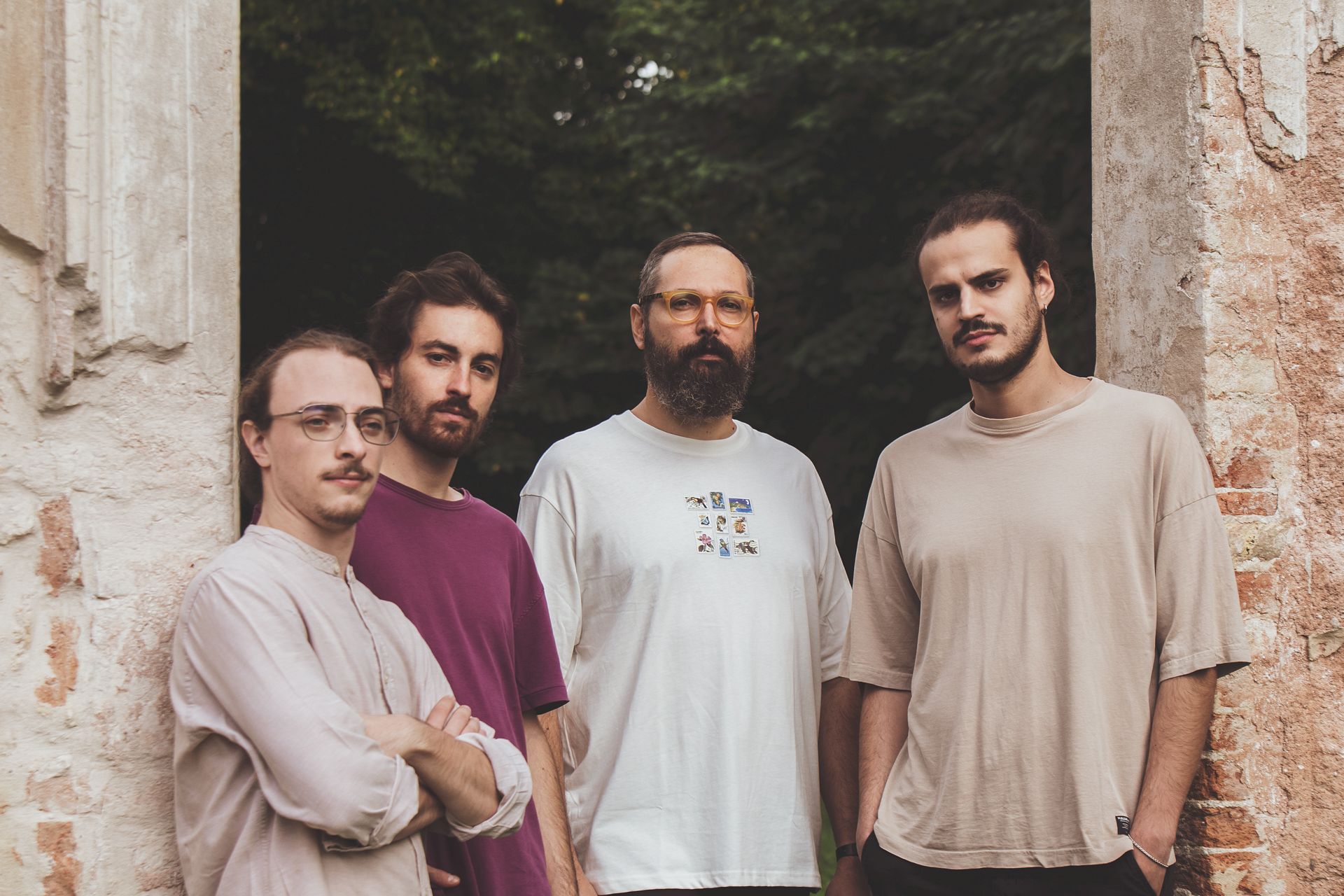
Members: Andrea Lombardini (bass), Edoardo Cian (guitar, vocals), Giulio Jesi (tenor saxophone, EWI), Francesco De Tuoni (drums)
Interviewee: Andrea Lombardini
Nationality: Italian
Current release: Cenobium's debut album MMXXIV is out via Hodie Files.
If you enjoyed this Cenobium interview and would like to know more about the band and their music, visit them on Instagram, and Facebook.
What were some of the musical experiences which planted a seed for your interest in jazz?
When learning the instrument, as a teenager, I was looking for more examples of self expression on the bass. This quickly brought me to 80s-90s fusion players and from that, back to acoustic jazz.
Meeting electric bass pioneer Steve Swallow when I was very young was the single main experience that paved the way into what I am now. We are still good friends
How do jazz and jazz culture factor into your artistic processes and the music resulting from them?
Jazz music brings the act of playing to a deeper communication level with the other players. It teaches you how to manipulate the content in real time, like having a real conversation.
When you bring this practice to different material or blend different aesthetics, like rock or pop, you can keep a fresher sound, more in the moment.
What does the term jazz mean today, would you say?
When Charles Mingus was asked the same question his answer was "I don't know, and I don't care".
When I speak about "jazz" I think about the style of American music from the late 40s to the early 60s. Now I prefer to speak about Afro-American or Black American Music, referring to all the branches of the big three, coming from the blues/gospel roots, including mainstream jazz, soul, R&B, hip hop, funk, rock and modern pop music. I hear the connections in all of it.
Think, for example, about the great rock drummers like John Bonham, Keith Moon, Mith Mitchell … their heroes were Elvin Jones and Buddy Rich and it's clear. Even Dave Grohl clearly said he stole from Tony Thompson of Chic.
Jazz was about a lot more than just music in the 60s and 70s, from politics to fashion. For you personally, is jazz still a way of life – and if so, in which way?
I think that art is authentic when it's in the moment, when it's bonded to the Zeitgeist. So it was a natural thing for American musicians to bring the fight for rights up to their music. And this was not only a prerogative of jazz players in that period.
Speaking about a way of life I think the practice of improvisation changes your way of thinking and relating to others. When something happens on stage, it just happens and it's seen as an opportunity to change what you are doing in relation to what happened. This is how life itself works.
Many people perceive jazz as a genre with high barriers of entrance, both for listeners and musicians. What have your own experiences been in this regard?
Modern art in general allows for a level of complexity and sophistication that sometimes creates an invisible wall to the public. Deeper experiences need some training before, even eating at a three star restaurant could be a horrible experience to anyone addicted to junk food.
What I try to do with my music is to offer different layers of perception. You could just enjoy a song or the lyrics or get a feeling for more colourful harmonies or rhythmic freedom.
With CENOBIUM I try to keep a high intensity factor because, regardless of the material, it's something that bonds with the audience on a subliminal level.
Derek Bailey defined improvising as the search for material which is endlessly transformable. As of 2024, what kind of materials are particularly stimulating for you?
As a composer I try to explore different harmonic and rhythmic landscapes that enable the improvisers to go into different places.
Sonicwise I like to blend the sound of acoustic instruments with electronics. From an aesthetic point of view CENOBIUM it's all about blending different styles in an organic way.
What, would you say, are the key ideas behind your approach to improvisation?
Learn the language, then be in the moment. It's important to be able to speak with your instrument and this means you have to practice, but also to be yourself.
I'm Italian, I live in a town with one thousand years old city walls, churches have a ten seconds reverb time. So we've heard organ and vocal music, not blues and gospel. I can't make music that seems like I'm living someone else's life.
How would you describe your relationship with your instrument – is it an extension of your self/body, a partner and companion, a creative catalyst, a challenge to be overcome, something else entirely?
It depends. The electric bass feels like a natural extension, I can get the sound I hear. The double bass is more of a struggle, something you have to fight for sound, but I like this also.
Struggling is important.
Jazz has always had an interesting relationship between honouring its roots and exploring the unknown. What does the balance between these two poles look like in your music?
My personal heroes always evolved and never got stuck in the past. Miles, Herbie Hanckock, Wayne Shorter, they all keep changing the music, hearing what's around. I'm bringing this to CENOBIUM. I like a lot of different music (and I can play it) so I just blend them naturally.
Hearing, practicing, loving traditional jazz does not mean you have to always play in that aesthetic. To me that is an exercise in style.
What are currently direction in jazz or jazz-adjacent communities which you personally find interesting?
I think the edge of contemporary jazz has shifted (mostly) from NY to LA, I hear the most fresh ideas coming from the west coast.
David Binney, Louis Cole, Henry Solomon and also fellow bass players like Logan Kane, Tim Lefebvre, Thundercat.
[Read our Tim Lefebvre interview]
For many artists, life-changing musical experiences take place live. How do you see that yourself?
100% agree. In the end I've realized that I love to play, the physical act of it, and I love to do it with people, to lay it down, to provoke. I think a life-changing jazz experience is when you realize you are there witnessing the musical content developing itself in real time, you are part of it, music is also because of you, back in the audience.
This is why I totally hate the abuse of backing tracks in modern live pop music, it's not in the moment anymore.
Let me tell you about one time I went to see The Who live, and after a few songs a bad summer storm interrupted the concert. It was raining on stage as well, we were all soaked and cold. After like 20 minutes they came back on stage, did half a tune but Daltrey completely lost his voice due to the temperature change so they went back again, I thought it was it.
Well, after another 15 minutes I see Pete Townshend with a musical stand with a book and he proceeded on ending the concert playing and singing himself. Maybe it was not the best concert ever of the band - but it was in the moment, it was special and unique.
How, would you say are your live performances and your recording projects connected at the moment? How do they mutually influence and feed off each other?
I think of CENOBIUM as a true live band. We are all from the same town so we rehearse regularly, and this may seem natural but it's not the norm anymore.
We all play live in the studio but as a producer with pop and rock experience I've learned my method of bending a natural band recording with the added tools the studio situation has, and use them in a creative way.
There are various models to support jazz artists, from financial help to mentorships/masterclasses. Which of these feel like the best way forward to you?
While I think that art should be more supported on a national level, I think that jazz has something to learn from the rock scene. If your music relies only on financial help then it can not survive in a market.
From this point of view I think of CENOBIUM as more of a rock band that also plays creative music. This means working on growing a fan base, selling merch, and doing active promotion.
Are there approaches, artists, festivals, labels, spaces or anyone/-thing else out there who you feel deserve a shout out for taking jazz into the future?
I've played at several jazz festivals in Europe that I think really understand contemporary jazz directions. I especially want to mention the UBER JAZZ festival in Hamburg.
The Montreux Festival intends to preserve its archive of recordings for future generations. Do you personally feels it's important that everything should remain available forever - or is there something to be said for letting beautiful moments pass and linger in the memories of those that experienced them?
I think that for a festival it's really important to make such an archive.
From an artist point of view I must confess that sometimes NOT listening is important too. Yyou need silence to make your roots grow.