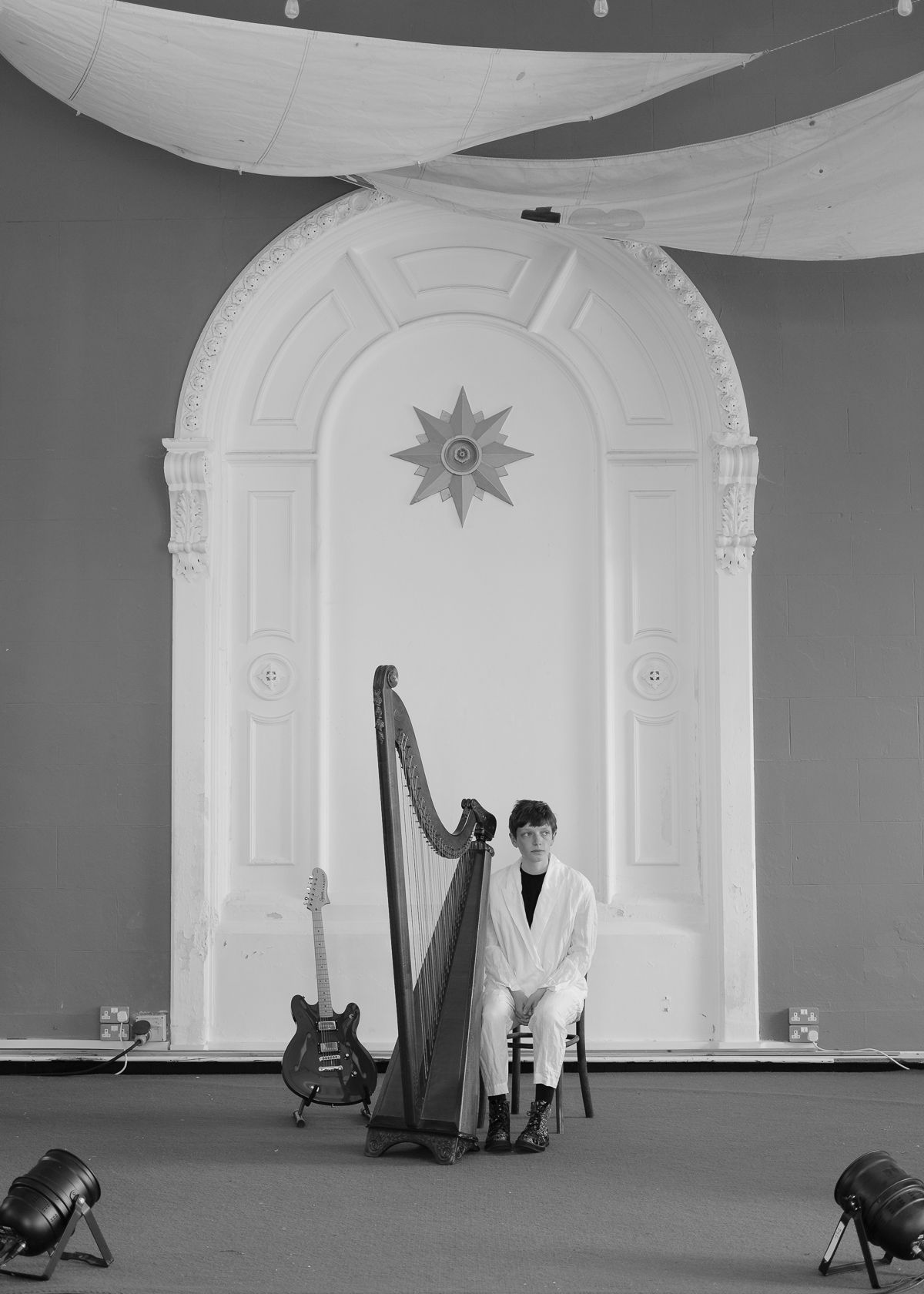
Published
Name: Cerys Hafana
Nationality: Welsh
Occupation: Triple harpist, composer
Current Release: Cerys Hafana's new album Angel is out via Glitterbeat.
Hometown recommendations: The Wynnstay pub in Machynlleth on a Friday night when the folk session is on.
Topics I am passionate about but rarely get to talk about: Cats and pipe organs. But I don’t actually have anything to say about them, I just think they’re magical and cool respectively.
If you enjoyed this Cerys Hafana interview and would like to know more about their music, visit their official homepage. They are also on Instagram, Facebook, and Soundcloud.
Where does the impulse to create something come from for you? What role do often-quoted sources of inspiration like dreams, other forms of art, personal relationships, politics etc play?
I think for me the impulse to create something comes from the need to just make or do something. I like that singing with the harp or piano occupies my whole brain and body.
The main inspiration for my work comes directly from traditional melodies and songs, rather than anything more personal to me, but I’m sure all those things (dreams, art, personal relationships and politics) get channelled through those source materials in quite abstract and vague ways.
Personally I would find it strange to make ‘folk’ music directly about my life on the triple harp. I like that I get to remain one step removed whilst still creating music that feels personal and unique to me.
For you to get started, do there need to be concrete ideas – or what some have called a 'visualisation' of the finished work? What does the balance between planning and chance look like for you?
Sometimes I decide I have a concrete idea and then realise during the composition process that it isn’t actually the direction I want to go in. Usually I think it’s better to just focus on creating individual pieces that I like and find interesting and at some point the way in which they all fit together will make itself clear.
This album was slightly different to my other ones in that it did have a fairly specific concept – it all hinges around one song I found in the Welsh National Library’s archive about a man who goes for a walk in the forest and hears a bird (or perhaps an angel) singing in the trees, which makes him fall asleep for 350 years.
I split this song in two and used it to bookend the album, and decided that I wanted the rest of the album to vaguely follow the narrative arc of this song.
But I already had some pieces that I’d been working on prior to this discovery (like “Carol Mynyddog” and “350 Mlynedd”), which helped to dictate the musical style of the album.
It's also nice when a piece you made years ago but which never found a ‘home’ and never got released suddenly seems to belong on a current project. This happened with “Atsain,” which is the last track on the album.
I’d created it back in October 2020 when I got to spend a week making music in an empty chapel near where I live, by multitracking piano, harmonium, voice and various other things.
I always really liked the feel of it but it never seemed to fit with any of my projects until this one, and it was amazing to watch it come to life recreating the multitracked elements with other musicians.
Is there a preparation phase for your process? Do you require your tools to be laid out in a particular way, for example, do you need to do 'research' or create 'early versions'?
I would love to be able to have my tools laid out in a particular way at all times, but my current living situation means that isn’t really a possibility. And also because I’m always gigging so much and constantly packing and unpacking all my things.
The research phase is quite important, because I’m drawing so much from archival materials and books of folk songs. The song about the old man and the angel is in a very common poetic metre in Welsh folk music, and so can be sung to the tunes of many folk songs. I spent a really long time trying out lots of different combinations before deciding to split the song in two and write my own melodies.
I generally compose by improvising, and just repeating small ideas until they turn into something bigger. It can take me years to finish pieces in this way, and I usually end up with hundreds of voice note recordings of the pieces at different stages.
Do you have certain rituals to get you into the right mindset for creating? What role do certain foods or stimulants like coffee, lighting, scents, exercise or reading poetry play?
Usually just tuning my harp, but apart from that not at all.
I could say ‘making a cup of tea’ but I think that’s procrastination more than preparation.
Tell me a bit about the way the new material on Angel developed and gradually took its final form, please.
Musically, I was playing around with lots of different ideas. “Carol Mynyddog“ was probably the piece that really defined the musical approach of the album – I wanted to push the dynamic range further than I have on past projects, and I think this piece does that the most (by going from unaccompanied singing to quite intense, overwhelming instrumentation).
It also confirmed that I wanted to include some piano on the album, whereas before that I’d thought it would be all harp. I also knew I wanted to draw some inspiration from Breton folk music, which partly inspired the incorporation of the saxophone.
It was my first experience of booking in studio time and musicians before having a completely finished product. I ended up moving all my equipment into an empty house that my mum’s friend was trying to sell, and spent a couple of weeks there to concentrate on finishing the album uninterrupted.
It was more intense and disciplined than my usual experience of composing, and I enjoyed really getting to focus on it completely.
There are many descriptions of the creative state. How would you describe it for you personally? Is there an element of spirituality to what you do?
I wouldn’t say there’s an element of spirituality in my creative process. I’m quite practical about it really – I just like writing things that I enjoy playing.
But it’s cool to then go and perform those pieces and see other people have what might be described as spiritual, or just emotional, reactions to the music.
And it’s always interesting when recording in the studio to really notice the difference between the takes that have some sort of extra ‘feeling’ or atmosphere and the ones that don’t, even if they were recorded immediately after each other. It can feel a bit like trying to capture some invisible, mysterious magic.
Once a piece is finished, how important is it for you to let it lie and evaluate it later on? How much improvement and refinement do you personally allow until you're satisfied with a piece? What does this process look like in practise?
Generally with my harp music I don’t need to sit with it for a long time once it’s finished. The writing process can take ages, or be very fast, but if the finished product is something that I enjoy playing and it feels like a complete piece of music I don’t want to overthink it.
We didn’t have much time to rehearse or record for this album, and went straight from rehearsing into recording with no break. In some ways I think the perfectionist in me would have been more at-peace if we’d been able to have a bigger gap between the rehearsal time and studio time, to reflect on certain elements of the arrangement and performance.
But I also think it’s cool that the album is a document of what happened in one week when the music was quite fresh and we were all having to concentrate and listen to each other very hard.
How do you think the meaning, or effect of an individual piece is enhanced, clarified or possibly contrasted by the EPs, or albums it is part of? Does each piece, for example, need to be consistent with the larger whole?
I think it’s difficult for me to judge this about my own music, but I would hope that the effect of an individual piece is enhanced by the larger body of work it’s part of.
Whereas my first album Cwmwl was just a collection of all the pieces I had written and arranged up until that point, Angel had a much more conceptual / conscious writing process, where I could think about how all the pieces complimented / contrasted with each other, because I knew that I wanted the album to follow the story of the old man in the forest hearing the angel.
To me the sounds and textures of Angel feel like they combine those of The Bitter (an EP I released at the beginning of 2024) and my two previous harp albums, as well as bringing in some of the piano of Difrisg.
This didn’t happen on purpose but it was a relief to realise that it could be seen in that way, because I always worry that my genre-jumping-around just seems a bit chaotic and random to the outside eye.
What's your take on the role and importance of production, including mixing and mastering for you personally? In terms of what they contribute to a song, what is the balance between the composition and the arrangement (performance)?
Pretty much everything I’ve ever written starts off as a piece that I can perform solo, either on the triple harp, piano or guitar, and then I open it up to other instruments.
“Helynt Ryfeddol” is probably the first piece I’ve ever written that is almost impossible to perform solo. The other instruments and musicians feel much more essential to this album than in the past, and are responsible for so much of the atmosphere and scene-setting.
I wrote out a lot of the ideas for the other instruments as part of the composition process, but then also left certain parts open to improvisation. Part of the challenge in finding the right musicians to play on the album was knowing that they’d need to be able to move between quite precise score reading and very free improvising multiple times within a piece.
Owain Fleetwood Jenkins engineered and mixed the album in his studio in southwest Wales (StudiOwz), and I think he did an amazing job of just capturing what was happening in the room, without letting the technology ever get in the way. The studio is a beautiful converted chapel so it has a lot of its own natural reverb and atmosphere.
And it seemed important to find mastering engineers who understood the importance of the dynamic range in my music, and allowed it to go from very quiet to quite loud and back again.
Music and the accompanying artwork are often closely related. Can you talk about this a little bit for your current project and the relationship that images and sounds have for you in general?
Even though the artwork came about quite a while after finishing recording the album, it’s still felt like a crucial part of the creative process this time around.
Maybe because I’m creating in a language not a lot of people speak, and the translations never fully capture the feeling of the original lyrics, the artwork and music videos often feel like an important opportunity to communicate something about the subject matter of the music.
I knew I wanted to use a picture by Abby Poulson for quite a long time before asking her. There’s something so Welsh and also ghostly and mysterious about her work. We discussed different ideas and then she went off to take lots of different photos.
The ones we ended up using are mostly from the Hafod Estate, which is a forested area with the ruins of an old mansion. The picture of one of the arches in the forest, which we used as the cover art for the first single, “Helynt Ryfeddol,” almost took my breath away the first time I saw it.
After finishing a piece or album and releasing something into the world, there can be a sense of emptiness. Can you relate to this – and how do you return to the state of creativity after experiencing it?
I often find releasing an album, especially the period just after it’s come out, very weird.
I’m hoping that it will feel slightly different this time because I’m releasing through Giltterbeat, and so there are other people involved in every aspect of the release process. In the past it’s felt like quite a lonely experience. I’m also aware that I’m going on tour almost immediately after releasing the album, so won’t have much time to think about writing and creativity for a few months.
I think my ‘state of creativity’ is always a bit chaotic and interrupted though, so it’s not something I’ve ever had to consciously return to. I just try to get on with it and hope for the best whenever I have the chance.
I would love to know a little about the feedback you've received from listeners or critics about what they thought some of your songs are about or the impact it had on them – have there been “misunderstandings” or did you perhaps even gain new “insights?”
Sometimes I find the response people have to harps slightly frustrating. I’m often told I’m like an angel, or some magical Celtic being, and these things feel very distant from who I think I am.
In a way, that was the initial inspiration for going to look for Welsh folk songs about angels, and building up an entire album around that theme. The word ‘angel’ had been on my mind a lot because of these comparisons and my reaction to them, and I thought it would be funny to have a whole project called that, and also to focus more on sinister or scary depictions of angels.
I’m not at all religious but I think I feel more of an affinity with those weird Old Testament angels that are like big clouds of eyeballs with wings than the lovely, heavenly contemporary ones. I also find it slightly strange (in a nice way mostly) when people tell me that my music helps them to sleep or relax because I’m bad at sleeping and never relaxed.
On a more practical level, it’s always interesting seeing people’s reactions to singing in a minority language that they maybe didn’t know existed. I did a tour in Europe in April supporting Charlie Cunningham and compiled a list of the languages people said they thought I was singing in. It included Arabic, Kazakh, Icelandic and Gaelic.
It’s also always important to me to try and tell people that Welsh is a living language, that people speak to each other in social and professional capacities every day, because I think often people assume it only really exists in artistic and historical contexts.