

Name: Cheryl E. Leonard
Nationality: American
Occupation: Sound artist, field recordist, producer, composer, instrument builder
Current Release: Cheryl E. Leonard's new album near the bear is out via forms of minutiae.
Recommendations on the topic of sound: An Immense World by Ed Yong; The Sounds of Life by Karen Bakker; Do Glaciers Listen by Julie Cruikshank; Hungry Listening by Dylan Robinson; A Year of Deep Listening edited by Stephanie Loveless
If you enjoyed this Cheryl E. Leonard interview and would like to know more about her music, visit her official homepage. She is also on Instagram, and bandcamp.
What happens to your body when you’re listening? Do you listen with eyes closed or open?
When I am truly listening I am able to access an intense focus. I am 100% in the experience of the moment and am not consciously aware of my body.
I like to keep my eyes closed when listening to recordings. I often feel that music is world-building, that it summons into existence new environments or topographies which we then travel through, or just hang out in, as a piece unfolds. This process can feel a lot like physical exploration of a place.
Other times, the listening experience is more like being in the middle of a weather event, and I become clouds, a storm, a stone warming in the sun. Having my eyes closed makes it easier to access these sensations.
When I attend a live performance with a visual component I generally keep my eyes open. I like to watch the physical expressiveness of performers, see how sounds are produced, observe interactions between players and with other mediums (video/film projection, dance, etc.), and see how the performers relate with audiences.
How do listening with headphones and listening through a stereo system change your experience of sound and music?
Unless I’m in a fairly pristine situation for listening through speakers, I generally prefer headphones. This often feels more intimate, private, and transportive. I’m more used to recording, editing, and mixing via headphones than via speakers, as I rarely have a proper recording studio to work in. Also I do a lot of field recording where I’m monitoring on headphones.
Of course when listening via speakers, what one hears is a collaboration between the sound source, speakers, environment, and everyone/everything you are sharing the space with. Sometimes that is the point of a performance or event, and one has a fantastic full-body, multi-sensory experience.
Other times, the speakers or space are inadequate, or there are ruinous distractions.
Tell me about some of the albums or artists that you love specifically for their sound.
Maggie Payne summons three-dimensional worlds out of nuanced electronics, extended instrumental techniques, and processed field recordings.
Alvin Curran embraces all sounds, especially the mundane, as musical voices. I love how he brings highly-disparate sound sources into relationship with one another.
Annea Lockwood studies, invokes, and honors wild places and phenomena in many of her compositions and installations. I also enjoy the innovative ways she mixes field recordings with extended techniques on musical instruments.
Douglas Quin has documented many incredible underwater sounds in the polar regions.
His Antarctic field recordings were one reason I wanted to visit there myself, and his walrus recording on Fathom (58º 37' N 159º 59' W) was an important reference as I composed my walrus piece "Moffen."
Do you experience strong emotional responses toward certain sounds? If so, what kind of sounds are these and do you have an explanation about the reasons for these responses?
Yes! Fog horns, especially at night, make me feel cozy and childlike because I associate them with family summer vacations on the coast of Maine (Side note: the foghorn by our family cottage is hilariously unpredictable. It’s often silent when the region is socked in with fog, and will start up at random times on sunny days!). After moving to San Francisco in the 1990s, I was delighted to discover that I can hear the foghorns on the Golden Gate Bridge from my apartment.
Thunderstorms and calving glaciers are very exhilarating. If I was more practical, these sounds would probably incite fear and apprehension in me, but instead I just get really excited and want to set up my microphones and start recording as soon as possible. I love the primal power of these sounds, and that they give me perspective on how small and relatively unimportant I am. It’s great fun when I find a place for them in a composition.
For example, in my piece “Meltwater,” after a very long, slow crescendo, the piece explodes into a climax punctuated by calving glacier sounds.
Howling and whistling sounds (wind, coyotes, wolves, elk, etc.) intrigue me with their mysteries. They feel like indecipherable voices or bits of song in languages I don’t understand.
I have a whole set of wind pieces I have yet to release, and when I made “Autumn Orisons,” I got to blend coyote howls with elk bugles and whistle tones I played on kelp flute.
There can be sounds which feel highly irritating to us and then there are others we could gladly listen to for hours. Do you have examples for either one or both of these?
Sounds that I find irritating include engines and motors (cars, planes, motorboats, drones, leaf blowers, refrigerators, HVAC, etc.), construction noise, TVs playing in public spaces like airports and waiting rooms, and music that is inflicted on me by others and that I can’t turn off or escape from (neighbors, muzak, portable speakers in national parks, etc.). Also late-night parties next door and people clomping around on the floor above me. I probably should move out of the city to a quieter location.
Droning, subtly-changing elemental sounds from the natural world are what I enjoy listening to for long periods of time. Some examples are ocean waves, burbling streams, white-noisy rivers, blooping edges of lakes, rain on all kinds of surfaces, wind blowing through different materials, insects (crickets, cicadas, grasshoppers), frog and bird choruses, and underwater pond plants.
Are there everyday places, spaces, or devices which intrigue you by the way they sound? Which are these?
I love the spectrum of sounds that imperfect tea kettles emit as the water inside approaches boiling, as well as the whistles they produce, especially when they are somewhat peculiar because the top of the kettle is leaky.
These kettles each have their own unique voices. We used to have quite a lovely sputtery, squealing one in my apartment, but, sadly, it has been replaced with an electric kettle, which is more-energy efficient, but quite boring sonically. Another notable kettle was the one in the Mueller Hut in Aoraki/Mt Cook National Park in New Zealand.
I’m also partial to wind whistling and water dripping through faulty window and door seals, and squeaky doors.
Have you ever been in spaces with extreme sonic characteristics, such as anechoic chambers or caves? What was the experience like?
I have played in extremely resonant structures, spaces with decay times that were so long it was difficult to have a conversation inside them. These include abandoned concrete military bunkers and the old wooden gym at Headlands Center for the Arts in California.
At first, the extreme reverb was shocking and marvelous. As I began to adapt to it, the spaces became fun to play in, as long as I accepted the reverb and worked with it rather than fighting against it. Later though, after a certain amount of time, I would reach a saturation point (pun intended) and the never-ending reverb started to feel heavy and oppressive. If I continued on after that, my relationship with the space kept changing and cycled through these modes.
I have also been in extremely quiet situations. Last autumn on a solo backpacking trip in Yosemite I had a few nights where there was no wind at all and, because the seasonal streams had all dried up and it was too cold for birds or insects to be active, there was just nothing to hear.
Those nights were also very clear, so for me the sonic stillness complemented the clarity of the night sky, my ability to see the stars and the Milky Way. I was alone in the wilderness, but instead of being unnerved by the silence, it actually made me feel safe. If anything dangerous approached me I knew I would hear it.
A few times I’ve been in nearly silent storms up in the mountains in the backcountry in winter, either outdoors or in a remote ski hut. In these instances, it wasn’t windy and the heavy snowfall with large fluffy flakes seemed to absorb all sound. I found this kind of quiet cozy and comforting, a relief from the constant sonic input and chaos that I have to live with in the city.
The very soft beginning of my piece “Mørketid” alludes to these experiences, with the subtle sounds of sea salt falling on stones simulating snow fall.
What are among your favorite spaces to record and play your music?
Outside, in quiet spaces, and in venues with high quality speakers and good acoustics, especially smaller, intimate rooms.
Do music and sound feel material to you? Does working with sound feel like you’re sculpting or shaping something?
Sound absolutely feels material. Each new piece is its own universe. Sometimes it’s a landscape, sometimes a breathing body, sometimes a vast system.
For me, much of the process of creating work is discovering/uncovering, learning, and blending into these realms.
How important is sound for our overall well-being and in how far do you feel the "acoustic health" of a society or environment is reflective of its overall health?
Sound and silence are extremely important for our well-being, and sounds are significant indicators of the health of ecosystems. We can hear the richness or loss of species in an environment.
Birds and insects are particularly obvious examples of this. We are also now able to hear (via microphone) sounds that plants emit when they are in distress. The stress caused by noise pollution is very detrimental to human health and quiet and natural soundscapes aid in healing.
Sound, song, and rhythm are all around us, from animal noises to the waves of the ocean. What, if any, are some of the most moving experiences you've had with these non-human-made sounds?
Back in the 1990s, on a trip to McCarthy, Alaska, my friend Ann and I went out onto the toe of the Root Glacier searching for sounds to record.
As we wandered between crevasses and moulins, sticking our heads down inside the ice to better hear the burbling, roaring, sputtering water sounds, other folks on the glacier asked us what we were doing. Once we told them, they also began listening to the glacier’s drainage system, spreading out across the ice and then pointing out potential recording locations for us.
Not only were the sounds enchanting, but the occasion became a mini-community project and a way to experience wonder together with strangers.
A couple years ago I backpacked up to Young Lakes in the high country of Yosemite National Park despite a somewhat-concerning weather forecast. The first day we hiked through a thunderstorm to reach our campsite near an alpine lake surrounded by lofty granite peaks. The next day we squeezed in a morning hike before scary black clouds (including mammatus clouds!) took over the sky, and we scrambled hurriedly back to our tents.
What ensued was a crazy thunderstorm during which cracks, booms, and rumbles reflected wildly off the mountains, including Ragged Peak, which we were camped right next to. The bounced sounds transformed in peculiar ways, as if they were being run through a series of electronic effects, and spatially they whizzed about helter-skelter.
Furthermore, once the storm began, the thunder never came to a complete stop. It just roiled around us continually for hours. Meanwhile, in between torrential downpours, a hermit thrush sang beautiful melodies atop a nearby tree over the bed of creepy, distorted rumbling.
Many animals communicate through sound. Based either on experience or intuition, do you feel as though interspecies communication is possible and important? Is there a creative element to it, would you say?
Yes, interspecies communication is possible and important. Anyone who has had a pet or spent a lot of time working with animals will attest to this.
Moreover, given the interconnectedness of ecosystems, I think this is happening all the time, at least on some rudimentary level, even when we are not consciously aware of it.
The real question is: how deep of a conversation might we be able to have with more-than-human species? Given that plants, animals, fungi, etc. have such vastly different sensorial inputs than human, can we ever truly understand what they have to say?
Perhaps their perceptions are universes utterly beyond human comprehension, or perhaps we can grow enough to have a meaningful dialogue. Either way, I think we should try. There’s so much we might learn! And, creativity will be required.
We can surround us with sound every second of the day. The great pianist Glenn Gould even considered this the ultimate delight. How do you see that yourself and what importance does silence hold?
Certainly there are many sonic delights available to enchant and inform us, but moments of silence are vital. Silence frames the sounds and allows us space to breath mentally. Working in field recording has highlighted the rarity of silence in today’s world, and helped me appreciate how exceptional and valuable it is.
Many people are afraid of quiet and can’t stand to be alone in it. Having constant background music or noise can become a crutch, a distraction from facing ourselves and our thoughts. There have been times when this was true for me, but now I savor the moments when I am treated to sonic stillness.
Seth S. Horowitz called hearing the “universal sense” and emphasised that it was more precise and faster than any of our other senses, including vision. How would our world be different if we paid less attention to looks and listened more instead?
There is so much important information that is not available to us visually. When we humans fail to listen properly - to ourselves, to each other, and to the ecosystems we are part of - there are vast worlds of understanding we miss out on.
I see this as a fundamental problem of our time, and a major factor in the profound social and environmental issues we face currently. If we improved our listening, I believe we could better grasp the interconnectedness of all things.
Hopefully this would help us become less self-centered as individuals and as a species, which would increase our chances of having a future on this planet.

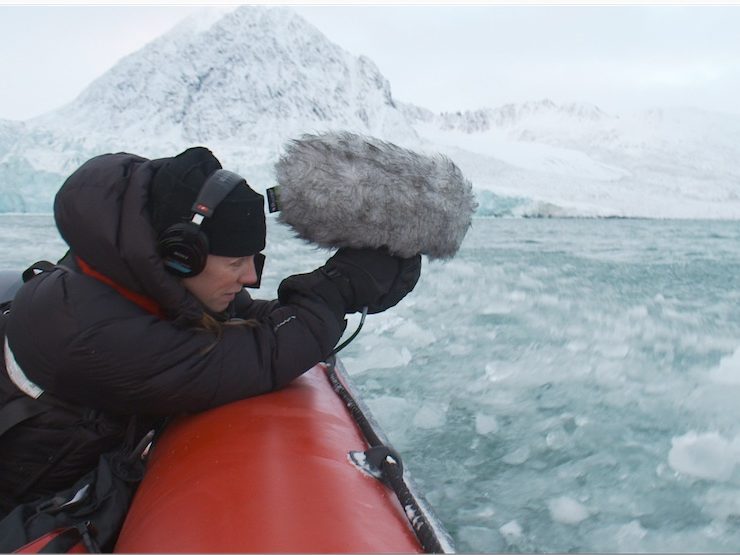 Cheryl E. Leonard Interview Image by Saeed Taji Farouky
“Music is world-building. It summons into existence new environments or topographies which we then travel through.”
Video
