Published
Part 1
Name: Chloe Kim
Nationality: Korean-American
Occupation: Drummer, percussionist, composer, improviser
Current release: Chloe Kim's new album Ratsnake is out via Kou.
If you enjoyed this Chloe Kim interview and would like to stay up to date with her music, visit her official homepage. She is also on Instagram, and bandcamp.
In this interview, Kim expands on the bounce-gather technique to realise her playing ambitions and avoid RSI. If you’re reading this and you’re curious to talk about the technique, she'd be more than happy to chat. You’re welcome to reach out to her at chloe.kim@sydney.edu.au.
It seems as though most aspiring artists are drawn to the drums and percussion for one of two reasons: Creating sound/noise and creating rhythm. What captivated you?
Lately I’ve been really into composing and producing platforms for different musical instruments to shine. I came around to really loving the sound and capacity of instruments like the bass clarinet, bassoon, organ, and church bells (British style).
I am not a trained composer, so I often come across to a blank wall, where I am unsure what my next move should be. In these moments, I close my eyes and imagine intuitive decisions I might make if I were playing the music on the drum kit, or what I would like to hear if I had to respond to the music on the drums. This practice always helps me to discover new ideas and move on from my own musical cliché.
On the drum kit, I love playing “in time.” I have a lot of fun. It reminds me why I picked up the drums initially: because I love grooving along the music. On the other hand, I love being cheeky and fly across the division of different bars and rhythms. These moments are very personal, because sometimes, my decisions are not only based on trained rhythmic knowledge, but also a subtle difference of my body movements.
For instance, where only one beat should be played, I would drop my hands way faster from way above than usual, and produce 5 short and fast notes to fit it in the one-beat space. This effect is very different to, say, if I tell my brain to play a ‘buzz roll stroke’. It allows a faster physical agility, an alternate universe-like experience where I feel like I am being a professional dancer, swimmer, or an archer – some things I I would never achieve in my current life.
For this experience, I love returning to the drums. It is a generous friend, teacher, and a company in my life.
When I listen to music, I see shapes, objects and colours. Others experience emotions. Everything around drums, on the other hand, is based on touch, vibration, and movement. Does this mean that your own perception as a listener is also more connected to touch, vibration, and movement? What happens in your body when you're listening?
I think the experience really depends on what kind of music I’m listening to. Each piece of music brings out something different in me.
Sometimes it makes me want to drum in new ways, other times, it opens up my compositional perspective. A lot of the time, I feel encouraged to be more creative.
Listening to certain music gives me permission to imagine new possibilities for myself as a musician, to experiment and study further.
What was your first drum set like and what are you using today? What, to you personally, are factors in terms of build and design that you appreciate in drums and percussion instruments?
My very first drum kit was a Sonor. I can’t quite remember the exact model name, but I do remember buying it second hand and absolutely loving it.
It was one of the first things I asked my parents to get for me when I moved to Australia. When I was younger, living in Korea, having a drum kit wasn’t an option because everyone lives in apartments. So having the luxury of living in a unit where I could play a muted drum kit felt like a huge upgrade.
These days I play a Canopus Yaiba Bop kit, but lately, I’ve been feeling the need for a new kit. I’ve used this one for ten years, and I’m interested in seeing what different sounds I could make with a new drum kit, especially with bigger and deeper-sounding drums.
Apart from the main kit, I’ve been adding elements around it, like two Rototoms (8-inch and 10-inch) to replace the crash cymbal. On the left side of my hi-hat, I often set up a frame drum, a djembe, and a jungle drum, which gives my left hand the freedom to move in a more open manner. On the right side of my floor tom, I usually have a collection of smaller percussion: chimes, woodblocks, bells, and other interesting objects I find that make unique sounds.
I feel like whenever I go outside, I’m always keeping an eye out, both consciously and unconsciously, for little objects with the potential to join this percussion family. This includes places like the Brandon Street Christmas market, stationery shops, and toy shops.
Late Rush-drummer Neil Peart said: “The equipment is not an influence. It doesn't affect the way I play. It's an expression of the way I play.” What's your take on that?
I used to strongly agree with this statement. I used to think that no matter how special or expensive the instrument is, it is the player that makes the real difference.
I think this belief came to me partly because there was a student I studied with at university who used to laugh at how all my gear was second hand and cheap, while he owned all the best equipment he could possibly get in town. So, I used to pull myself together and believe that lacking quality of my gear did not matter and just focused on practicing.
I think that mindset was a great training, because it helped me work on the specific sonic timbres I wanted to get out of the drum kit. Now, no matter which surfaces of the drums I play on, I am confident that I can produce the consistent level of speed and control.
But over time, I have also had the opportunity to try different gear, and I have realised that good equipment really does make a difference. For example, I recently bought a fleece kick beater, and it allows for a grounded, warm sound that I was not able to achieve with a hard beater.
So as my taste and experience in music has evolved, my thoughts on this have changed, too. The combination of a proficient instrumentalist and good gear creates a powerful synergy, but if one or the other is lacking, it does not seem to work.
The drums and percussive instruments are an integral part of many cultures, and traditions. Which of these do you draw from in your playing – and why?
I naturally draw towards Korean traditional drumming culture because I grew up listening to it. Growing up, though, I never thought of learning them properly. I was too occupied enjoying drum kit playing.
It was when I came to Sydney Australia to study jazz drumming that I was re-introduced to Korean drumming. This is because I studied with Dr Simon Barker who has many decades of knowledge and experience in traditional Korean drumming music. Through Simon, I was actually introduced to the different rhythmic cycles that have existed in Korean music for hundreds of years, and often on the holidays I would visit my family in Korea and take Korean drumming lessons.
Traditional Korean drumming demands incredibly high energy. Sometimes it can even be played for days or weeks without stopping, because a lot of it comes from ritualistic and ceremonial traditions. It really asks a lot from the drummer, and through that, I have learned that beyond the joy of playing, there is also a deep sense of work, commitment, and care that needs to be put on to drumming. I think that is one of the biggest lessons I always get from playing traditional Korean rhythms.
Structurally, I love how balanced the Korean drumming is; the way it builds up and then resolves. It also uses a lot of quintuplets and septuplets, which I find so satisfying to play and listen to for hours. And I really love how the double-sided drums work-one surface is looser, one tighter-so there is this constant conversation between low and high tones. That idea translates beautifully onto the drum kit.
And then there is the experience of many drummers performing together. It is so powerful and inspiring to watch, so it is something I want to do more often with my drummer friends.
What were some of the main challenges in your development as a drummer / percussionist? Which practices, exercises, or experiences were most helpful in reaching your goals?
About 10 years ago, I started to question why my playing sounded so bland, as if I made a dish without enough salt. The phrasing and notes did not have enough dynamics and dimensions to them.
That made me focus on clarity of the notes, and on how much faster and more precise my arm movements needed to be. I enquired about this to my teacher Simon all the time, and he never ran out of patience or generosity to expand the discussion and helped me to understand how this should be practiced.
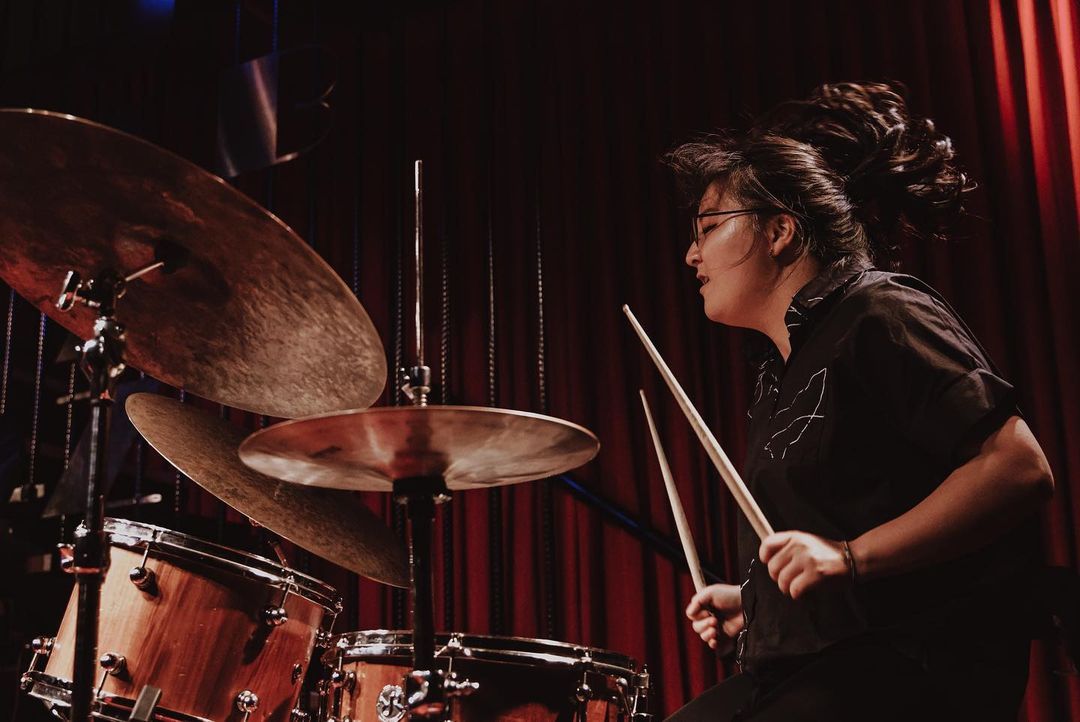
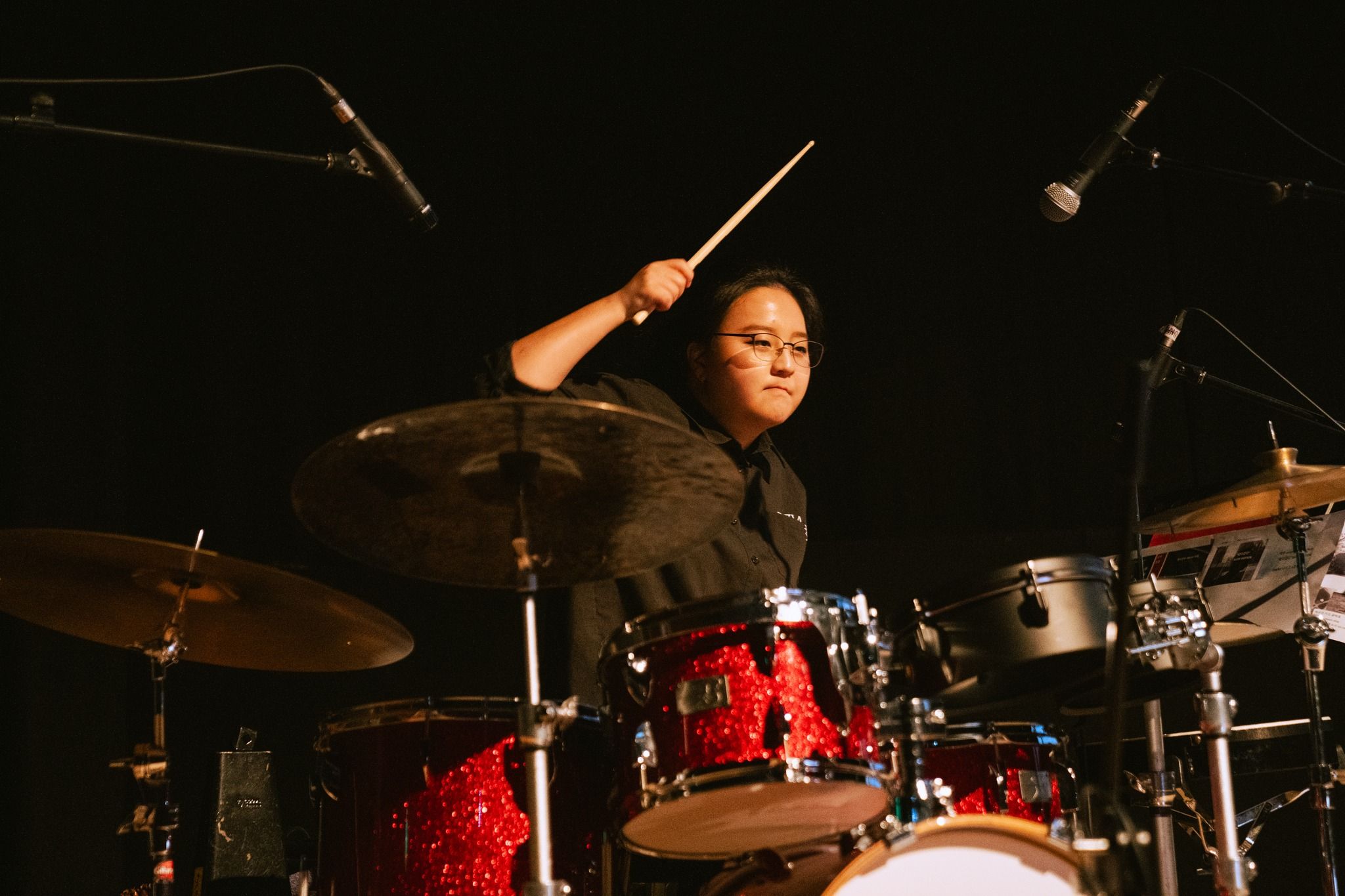
Understanding and controlling that very moment (just before the tip of the drumstick hits the drumhead) became one of the biggest questions in my practice, and probably the thing I dedicated the most time and attention to throughout my bachelor degree. I spent a lot of time practicing this in front of a mirror, learning how to bounce and gather my sticks. I practiced this for at least three hours a day as the first thing in the morning, for about four years non-stop.
As a result, I developed a wide range of dynamic control - not just 1. accented note and 2. non-accented notes, but the ability to control distinct levels of accents across 10 to 15 different ranges. Being able to gradually apply that in all my playing and musical contexts felt like a huge breakthrough in my drumming.
How would you describe the physical sensation of playing the drums? [Where do you feel the resonances/pulse/groove, what are emotional sensations, is there a sense of release or tension etc …]
Once I understood how to control my arm movements and their speed, relying on gravity and the constant movement of my core, drumming stopped feeling physically demanding. Ever since then, it feels more like going for a walk. Not exactly being “relaxed,” but moving with a natural flow, like a walk that does not require extra effort.
Other equivalents I often think of are swimming, where the arms move in wide motions to create waves, or bouncing on a trampoline, where the up-and-down motion just carries you. That is what drumming feels like to me: the pendulum of my core moving up and down so steadily that I am simply grooving with the music.
I feel and control all of my drumming from my core, from my abdomen, while my groove comes from my thighs. And the pulse of it all really locks in with the snare drum note cracking through.