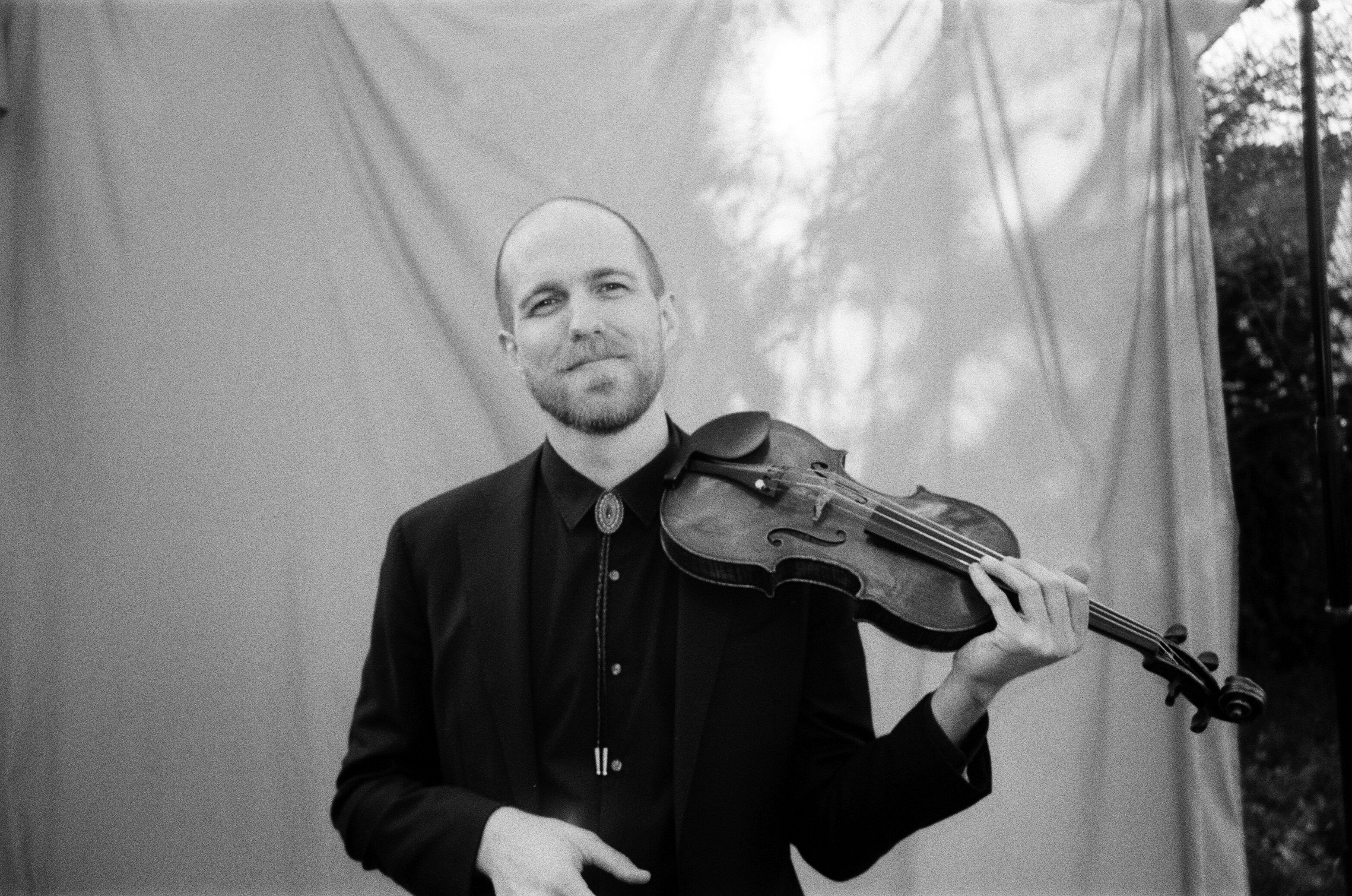
Published
Name: Chris Whitley
Nationality: Canadian
Occupation: Violinist, composer
Current event: Chris Whitley's new album almost as soft as silence is out now.
Recommendations: There are two records I’ve been loving recently by Canadian artists I admire greatly. The first is Cassandra Miller’s Traveller Song/Thanksong on Black Truffle records. This record has gotten a lot of love internationally and it’s well deserved. I think Cassandra Miller is one of the finest Canadian composers working today and her reimagining of Beethoven’s Op. 132 quartet is unbelievably moving.
The second is Luka Kuplowsky’s How Can I Possibly Sleep When There is Music. Luka sets poetry from the past thousand years to song structures and improvisations that are at times deeply meditative and at others quite playful. The backing band is just amazing.
[Read our Luka Kuplowsky interview]
If you enjoyed this Chris Whitley interview and would like to know more about his music, visit his official homepage. He is also on Instagram, and bandcamp.
Do you think that some of your earliest musical experiences planted a seed for your interest in improvisation?
My earliest training was in the context of Western classical music.
Improvisation exists in classical music but has a pretty limited scope. It’s there but it’s very specific and in many cases requires a lot of knowledge of treatises, performance practice, and theory. It takes years of training to get to a point where you’re playing around with improvisation.
I have a vivid memory of improvising on my violin in the early years of my training when I “should” have been practising my scales and repertoire. I had it in my head that improvisation was something that was allowed after the “real” work was done, so it always had this feeling of being a forbidden fruit.
When did you first consciously start getting interested in musical improvisation? Which artists, teachers, albums or performances involving prominent use of improvisation captured your imagination in the beginning?
I had an amazing high school music teacher, Doug Friesen, who really sparked my interest in improvisation, particularly free improv and experimental music practices.
He introduced me to the music of John Zorn, John Cage, Morton Feldman, Iva Bittova, and Thelonious Monk. He was also my ninth grade math teacher and would play Naked City records at the beginning of class. As a classical music kid I had never heard anything like it and it was pretty life changing. Doug put together a string trio that played pieces from John Zorn’s Masada project and that was where I gained my first real experience with improvising.
I had always wanted to learn to play more straight ahead jazz but it took me years before I really dedicated myself to learning how to play in that context. I still feel most comfortable with free improvisation and spontaneous composition and feel like a bit of an impostor when I tackle Charlie Parker or Coltrane charts.
Tell me about your instrument and/or tools, please. What made you seek it out, what makes it “your” instrument, and what are some of the most important aspects of playing it?
I’m first and foremost a violinist. I spent a handful of years in my late twenties trying to resist this truth by working with production, song-writing, and experimental electronics. I’ve spent most of my life as a violinist but the instrument has also been a real source of challenge, insecurity, and fear. I’ve always struggled with pretty terrible performance anxiety and I think my classical training exacerbated a lot of my issues with perfectionism and confidence.
All this challenge has made my relationship with the instrument pretty complex but in recent years I’ve noticed that the time I spend with my violin, especially in the practice room, is some of my most cherished. I can get to the end of a day and feel frustrated or out of sorts and I realize that I didn’t get to touch my instrument that day. It’s a centering, meditative experience.
I have some ability on different instruments but I’m absolutely at my most fluent on the violin. As an improvisor, the violin is where my truest musical self exists. I’ve studied so many different musical languages on the instrument that my resulting improvisational voice is synthesis of all of those different styles.
I’m not much of a gear head in terms of the specific instrument I use. I feel like any instrument can sound amazing with enough work. That being said, I’ve been pretty lucky to play on some incredible instruments. My new record [‘almost as soft as silence’] was recorded entirely on a Stradivari violin from 1700. Same with my 2023 record ‘Describe Yourself’, which featured a handful of newly commissioned works for solo violin.
That instrument was on loan from the Canada Council for the Arts Musical Instrument Bank, which is an amazing program for young string players in Canada. I’m currently playing on a 1900 Scarampella violin from that same collection which I might love even more than the Strad.
Derek Bailey defined improvising as the search for material which is endlessly transformable. What kind of materials have turned to be particularly transformable and stimulating for you?
I love this definition and in many ways it feels directly in line with my new record. Each improvisation on ‘almost as soft…’ was built from a simple musical gesture or melodic idea. I wanted to see how far I could take these tiny molecules of music.
I like to think of this approach like slowly turning at a vase or a sculpture in order to see it from all angles. How do subtle shifts in light or positioning reveal something altogether new? Something apparently simple or whole can suddenly become endlessly multidimensional and changeable.
Do you feel as though there are at least elements of composition and improvisation which are entirely unique to each? Based on your own work or maybe performances or recordings by other artists, do you feel that there are results which could only have happened through one of them?
I’ll always remember playing for Malcolm Goldstein when I lived in Montreal. I performed a solo improvisation for him and he told me that I wasn’t really improvising, I was composing spontaneously. Instead of purely following intuition and impulse I was constructing a piece in real time.
I had never considered that spontaneous composition and improvisation could be two different things. So in a way, the term “improvisation” can encompass elements of both “pure” improvisation in the Goldstein sense and composition.
It’s hard for me not to see improvisation everywhere. I play in a string quartet (Thalea String Quartet) that performs mostly notated music, both canonic classical works and new compositions. Even though the notes are written down, we are constantly improvising with each other, albeit on a subtle level. Shifts in tempo, shaping, voicing - they’re all improvised to a certain extent.
I suppose there are structural elements that composition allow for that are difficult to reproduce in an improvisation. But I’m also sure you could get 80 improvisers to create a pretty wonderful improvised symphony.
When you're improvising, does it actually feel like you're inventing something on the spot – or are you inventively re-arranging patterns from preparations, practise or previous performances? What balance is there between forgetting and remembering in your work?
I’d like to think I’m always inventing on the spot, but I know I have certain patterns that I rely on. I don’t have the same bag of tricks that a seasoned jazz player might have, which has its benefits and drawbacks.
On my new record I hear myself repurposing elements of different improvisations from previous tracks (ie. repeating myself!). I hope I’m forgetting more than remembering but it’s difficult to say.
Are you acting out parts of your personality in your improvisations which you couldn't or wouldn't through other musical approaches? If so, which are these? What, would you say, are the key ideas behind your approach to improvisation?
Definitely. I think my solo improvisations especially represent the truest version of my musical voice. There is a certain element of spontaneous self-editing but there is also a deep trust in myself that I haven’t found anywhere else.
As someone who interprets a lot of other people’s music there is always this fear that I’m “interpreting wrong”. In other musical approaches, like songwriting or production, I feel like a bit of a fraud, even when I’m happy with the work.
I would say that trust, open-mindedness, and acceptance are all essential aspects of my approach to solo improvisation.
In terms of your personal expression and the experience of performance, how does playing solo compare to group improvisations?
When I play with a group I’m trying to create something that is larger than the individual members; I’m collaborating to build something that is an amalgamation of all of these different voices and experiences. I’m part of a conversation that require me to hold space for others, to support, to listen. I’m trying to connect with the other players as deeply as I possibly can.
Solo improvisation is like getting lost in thought. I’m still listening but I’m listening to the material, to the space around me, to my gut. It’s hugely liberating but I feel like the friction of collaboration is where the truest magic happens.
In your best improvisations, do you feel a strong sense of personal presence or do you (or your ego) “disappear”?
I love to look back at an improvisation or a composition and wonder “Where did that come from? How did I do that?”
I think those ideas or gestures or actions come from somewhere beyond the ego - they are a part of me but are in a place that I can’t access every day.
In a live situation, decisions between creatives often work without words. From your experience and current projects, what does this process feel like and how does it work?
As a chamber musician and teacher I’ve spent a lot of time studying and exploring non-verbal communication. It is such a powerful tool both on stage and off.
I love how subtly we can transmit an idea, change the feel of a room, or communicate emotion without a single word. It’s like magic.
Stewart Copeland said: “Listening is where the cool stuff comes from. And that listening thing, magically, turns all of your chops into gold.” What do you listen for?
I feel like listening is one of the best ways to stay open and receptive to what’s going on around us. For me, thinking and analysis can really get in the way of accessing the essence of an improvisation, composition, or performance.
Following my ear, rather than my hands or some kind of technical concept, always results in a more honest musical experience. It’s not easy for me to stay true to this idea but I do my best
There can be surprising moments during improvisations – from one of the performers not playing a single note to another shaking up a quiet section with an outburst of noise. Have you been part of similar situations and how did they impact the performance from your point of view?
I’ve definitely been part of similar situations. I love that improvisation invites a certain type of prankster energy to the stage.
Sometimes that energy is essential and sometimes it can feel excessive but that’s the joy of playing with other people - a lot of times the energy you don’t think you want is the exact energy you need.
I have always been fascinated by the many facets of improvisation but sometimes found it hard to follow them as a listener. Do you have some recommendations for “how to listen” in this regard?
I can totally relate. I’ve often found myself struggling with this, particularly when I listen to long form improvisation. Maybe that’s why all the pieces on this new record are so short.
I feel like experiencing improvised music can require a lot of focus and investment on the part of the listener. But it can also be like a choose your own adventure book. I find my ears and eyes moving around. I listen to individual players and their instrumental approaches, I listen to the sonic tapestry as a whole, I watch how improvisers interact non-verbally, I drift off into my thoughts, I watch and notice how the audience participates.
The listener and the energy of the listener are integral to the experience of music-making so in a way just being in the room is a contribution to the process at work.
In a way, improvisations remind us of the transitory nature of life. When an improvisation ends, is it really gone, just like a cup of coffee? Or does it live on in some form?
This question is funny because I’ve just recorded a bunch of improvisations and frozen them as fixed pieces of music.
But in many ways I do think an improvisation is gone when it ends. I’ll never recreate these pieces in real time again. I may never do another solo improv record again. We can capture an improvisation on record but it’s really just a fleeting glimpse at one particular moment of one particular day.
It’s gone and that’s the best part. I guess that’s why we have to pay attention and listen while it’s happening.