Published
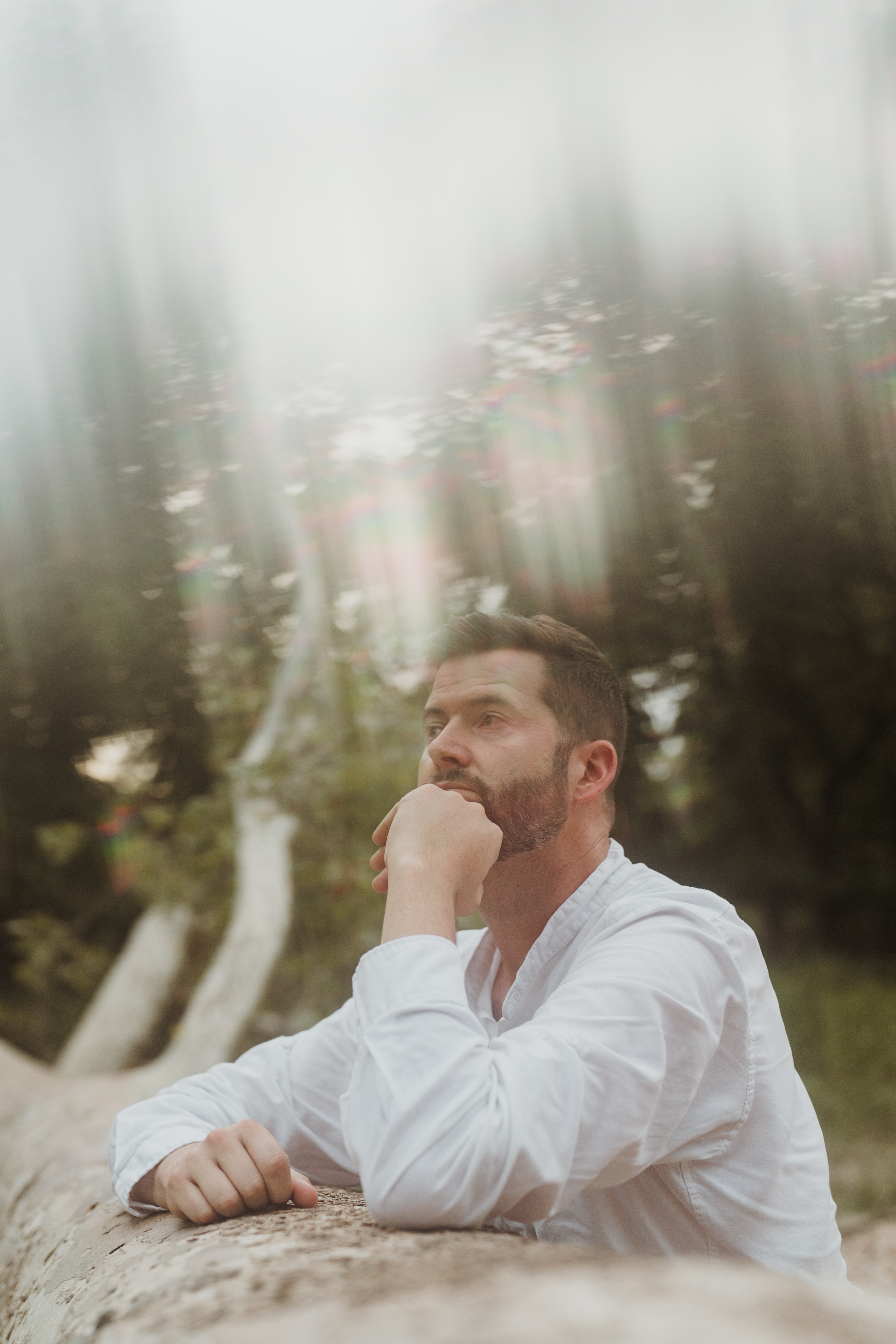
Name: Christopher Stark
Nationality: American
Occupation: Composer
Current release: Christopher Stark's Fire Ecologies, performed by Unheard-of//Ensemble is out October 19th 2025 via New Focus. The ensemble consists of Ford Fourqurean (clarinet/bass clarinet), Matheus Souza (violin), Iva Casian-Lakoš (cello), and Daniel Anastasio (piano/sampler)
Shoutouts: I’m a big fan of the Norwegian label HUBRO. I love the music of Norwegian musicians Kristine Tjøgersen, Benedicte Maurseth, and Øyvind Torvund. They seem to approach composition with a feeling that anything is possible, and it feels very fresh to me.
I also closely follow the music of my friend, Samuel Adams. I think his musically is incredibly heartfelt and timeless.
Global Recommendations: If you ever visit Polson, Montana, you have to go for a dip in Flathead Lake and then grab lunch at the Lake City Bakery. The cream-filled maple bars are a must.
If you enjoyed this Christopher Stark interview and would like to stay up to date with his music, visit his official homepage. He is also on Instagram.
The borders between producers, sound artists, and even songwriters are becoming increasingly blurry. What does being a composer mean today, would you say?
With the availability of so much information and the possibility of communicating through so many avenues, I think most composers today are practicing and participating in a lot of different scenes and communities. Naturally, we are going to express all that difference, overlap, and mixture in our music.
I was worried about this, in my own work, for a long time (that I was two or three different composers, and that I didn’t have a singular vision), but over time I’ve become less concerned about this.
It can be difficult to know how to spend one’s time when there are so many possibilities, but I’m hoping that by the time I retire (die) this will come into focus, and perhaps this new album is a step in that direction.
Many people perceive classical music and contemporary composition as having high barriers of entrance, both for listeners and musicians. What have your own experiences been in this regard?
I think that is accurate.
It took me a long time to appreciate some of the music that I now love the most––like, honestly, Beethoven. Understanding the logic of how new-to-you music progresses through time is tricky.
That said, as someone who has listened to a lot of music, it’s now one of the things that excites me the most when I hear something new.
As of today, what kind of materials, ideas, and technologies are particularly stimulating for you?
For the past few years, I’ve been really inspired by artists who want to express themselves through large-scale forms. I’m super interested in how the long-range pacing of harmony, melody, rhythmic processes, orchestration, etc. can create a deep connection and profound experience.
Using recording and sequencing software (DAW), and having the ability to mock-up a work sonically without fussing over notation, has made large-scale forms easier to conceptualize for me.
I love people who are making album-length works, like Samuel Adams’ and The Living Earth Show’s Lyra.
[Read our Living Earth Show interview]
Where do most of your inspirations to create come from – rather from internal impulses or external ones? Which current social / political / ecological or other developments make you feel like you need to respond as an artist?
I oscillate between responding to internal and external impulses. World events always find their way into my music, even when I’m not consciously thinking about them. We live in such fraught times, and it’s nearly impossible not to feel outrage or sadness daily.
This summer, I wrote a piece for the Aspen Contemporary Ensemble, and there is a movement titled “Healing Song” that was a response to the starving children in Gaza. In 2014, I wrote a piano quartet and the second movement ruptures in the middle, because Michael Brown had just been murdered in St. Louis (where I live) while I was writing the piece.
You wouldn’t know this about these pieces unless I told you, and the works were not intended to be programmatic, but these events were emotional for me, so they found their way into the work.
I have other music that is explicitly related to external impulses, and almost all this work is about the environment, like an album I put out last year called The Language of Landscapes and this new record, Fire Ecologies.
Tell me a bit about the sounds & creative directions, artists & communities, as well as the colleagues & creative hotspots of your current hometown, please. How do they influence your music?
St. Louis has always been a hotbed of Black music. Chuck Berry, Ike and Tina Turner, Scott Joplin, Miles Davis, as well as living musicians like Metro Boomin, Sexyy Redd, and, of course, Nelly. This is by far the most active and interesting scene in St. Louis.
I’ve been inspired by Mvstermind, Damon Davis, and Blvck Spvde, and I took some lessons from Mvstermind, which helped me create the fourth scene of Fire Ecologies, which is built around a trap beat made out of prepared-piano samples.
There’s a great jazz scene, and the guys who started the online platform Open Studio are good friends and inspiring colleagues. I also work regularly with members of the St. Louis Symphony, and I curate contemporary music for them. They’re a world-class orchestra and a huge resource in the city.
Lastly, there’s a local org called New Music Circle that produces amazing experimental shows.
Composing has always had an interesting relationship between honouring its roots and exploring the unknown. What does the balance between these two poles look like in your music?
As far as exploring the unknown, I’m always trying to learn about new artists and different kinds of music making. My favourite composers are the ones that keep their work open to the world –– Ligeti comes to mind. I also try to keep up my traditional chops –– sometimes those roots can fall into the category of the unknown, haha!
I’m endlessly fascinated by blues music, which is so foundational to growing up in the United States, and the classical music I studied in college.
I’m learning new things about these traditions all the time. It’s the reason I began composing in the first place, I knew I’d never run out of things to learn.
How much potential for something “new” is there still in composition? What could this “new” look like?
Infinite. There are endless permutations and new combinations of existing music that are always being uncovered.
That said, and in my opinion, I think the idea of being “new” isn’t really in the air in this current cultural moment. I think there’s a lot of scepticism around the idea of constant progression.
We made A LOT of stuff in the last hundred years. Maybe we need to take some time to sift through it all, like a clothing bin at the local vintage shop.
What role do electronic tools and instruments play for your creative process? What does your creative space / studio look like and what tools does it contain?
Electronic tools are essential to my creative practice.
I work simultaneously in a DAW (Logic Pro), notation software (Sibelius), programming environment (Max/MSP), and with an acoustic piano/paper and pencil. I also regularly record in the field and with live musicians, and I then manipulate those recordings in software.
I have a small studio setup in my attic and a grand piano downstairs in my living room that a friend loaned me.
It is my impression that adding a conceptual, non-musical dimension to one's work is almost a prerequisite for commissions and grants. How do you view this tendency and how “conceptual” is your own approach to writing?
I’m not sure I agree about the non-musical dimension. I think you could write a compelling grant about something that is specifically about music and not have to include something extra musical to secure it. Also, I think different granting agencies care more or less about the concept or language you use to describe your work.
I do think it’s important for an artist to have a point of view and being able to describe what you’re trying to accomplish helps people feel more confident when granting money or commissions. Storytelling is a big part of translating what you do to the public. Sometimes that story gets written for you, sometimes you have to write it for yourself.
I used to struggle to explain my work, but that’s because I didn’t really know what I was trying to do. It’s gotten easier the more I’ve come to understand my motivations as an artist.
Working with long forms, complex concepts or new vocabulary is potentially more challenging today because they require us to remember things that happened perhaps minutes ago – while most of us are finding it hard to focus even on what's happening right now. Both as a composer and as a listener yourself, how do you deal with this?
That’s the composer’s job, to figure out how to manage that, and I love that challenge. It’s true that today people consume a lot of short-form content, but people also binge hours of TV series and watch four-hour-long comic book movies, so there’s still an appetite for long-form content.
I’m not sure I fully understand how to do this, but I’m trying to learn, and a lot of it for me has to do with the way musical gestures create an expectation of time, trying to understand and recognize those expectations, and then knowing when to fulfil or defy those expectations.
For example, the first movement of Fire Ecologies develops very slowly. I’m really trying to stretch time, so that one might settle into the 50-minute journey.
For many artists, life-changing musical experiences take place live. Few works these days, however, are performed beyond their premiere. What, do you feel, does this mean for composers, and the music they write, and how does this reality influence your own work?
That’s a good question. It’s something I don’t think about very much. I know a lot of us are trying to make high-quality recordings, both audio and video, so that our work can be accessed more frequently and readily, but that isn’t the same as an amazing live performance.
I guess a part of what makes an unusual live experience life-changing is that it’s rare and that it lives on (mostly) in memory––where things tend to become more grandiose. That said, there are a lot of composers who are collaborating closely with smaller ensembles, that can play a work many times in many different places, and part of the conception of the work is that it’ll become a regular part of a group’s repertoire.
But at the end of the day, I remember the big, one-off concerts, like Ligeti’s semi-staged opera at the NY Phil in 2010 or Peter Ablinger’s “Remove Terminate Exit” at the 2018 Borealis Festival in Norway.
How, would you say are live performances of your music and your recording projects connected at the moment? How do they mutually influence and feed off each other?
If I’m using electronics or any kind of signal processing, they are quite different, because live sound mixing is incredibly hard to do well unless you have a lot of time to work in a venue––or a lot of money to hire a proper crew. Having the ability to properly edit and mix the electronic sounds makes a huge difference. My acoustic recordings are more or less the same as you might experience them in a live performance.
In general, live performance has an energy that you are always trying to capture when you’re recording, and recording has a precision that you’re always trying to bring to a live performance.
To some, the advent of AI and 'intelligent' composing tools offers potential for machines to contribute to the creative process. What are your hopes, fears, expectations and possible concrete plans in this regard?
I don’t think about this at all. Tools for making art are always changing, so this is a natural progression. I don’t mind people using it.
I’m personally not interested in using it, because I believe in the excitement (struggle) of the search for artistic meaning.