Published
Name: The Chuchchepati Orchestra
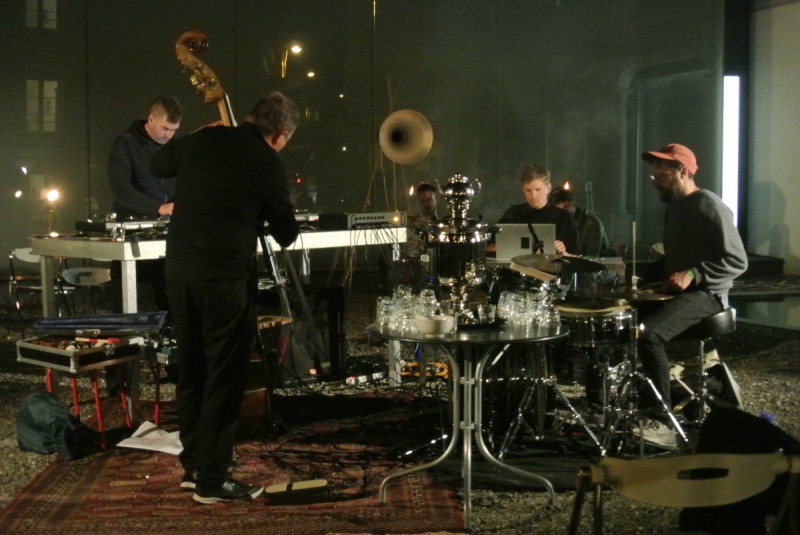
Members: Julian Sartorius (drums), Patrick Kessler (double bass), Ludwig Berger (sound direction, field recordings)
Nationality: Swiss
Current release: The Chuchchepati Orchestra's Flight of the Bumblebee II is out via Unit.
If you enjoyed this Chuchchepati Orchestra interview and would like to keep up to date with the band and their music, visit the group's official homepage.
For a deeper dive, we recomend our earlier Julian Sartorius interview.
How important is sound for our overall well-being and in how far do you feel the "acoustic health" of a society or environment is reflective of its overall health?
Music is played everywhere, often in the background, which can be perceived as stressful. Machines may make life more comfortable, but they also increase noise and speed up everyday life, which raises the question whether this is healthy.
Listening consciously to non-human-made sounds, from animal noises to the waves of the ocean, can sometimes have a calming effect.
The question whether animal sounds can be classified as music has been asked for a long time. What, do you feel, does the answer depends on?
Many people perceive the sounds of animals as music, as they contain micro-rhythms and tonal shifts. In the end, how we interpret these sounds depends on our individual perception.
It is fascinating how different music can be for each of us! For me, for example, insects are very musical.
Recently, sound artist and researcher David Velez voiced his concern that “often artists approach other sounding species/organisms as instruments and resources rather than collaborators with agency.” How do you see that yourself?
We want to make these fascinating creatures heard, as their importance and their influence on our ecosystem are significant. We can also learn from their art of communication, which influences our music.
What sparked the idea for Flight of the Bumblebee II and what interests you about these sounds specifically?
We strive to give the insects a voice by transforming their inaudible sounds into audible sounds, allowing us to communicate with them and create a direct connection between our sounds and the insects.
This process is very physical and allows us to discover and understand the insect world in a completely new way
What was the idea behind slowing the piece down considerably – particularly in relation to combining this with insect sounds? How does that work, exactly?
In this age of ours, the world is getting faster and faster. This accelerated way of life has a significant indirect impact on the environment and wildlife, especially insects. Insect mortality is an alarming sign that the changes in our lifestyle and in nature are not without consequences.
The world record for the interpretation of the onomatopoeic instrumental piece “Flight of the Bumblebee” by Russian composer Nikolai Rimsky-Korsakov is 53.82 seconds … that's 13 notes per second! With the concert installation “Flight of the Bumblebee II”, the Chuchchepati Orchestra contrasts this trend towards acceleration with the slowest interpretation.
Designed as a series, only one bar of the composition will be interpreted per concert - that's eight notes in 40 minutes. In between, we let the insects unfold their sounds and enter into a dialog with them. We are inspired by their sounds, which opens up a whole new and fascinating musical world.
How did you pick the insect recordings? What were some of the sonic characteristics that made a recording particularly suitable?
The recordings are extremely complex and are characterized by unusual rhythms and tonalities. They contain both solos and duos that communicate with each other in a dynamic question-and-answer game.
Interestingly, all communication is not through the air, but through the vibrations of substances such as grasses. Insects need their entire body for communication. The principle is similar with instruments such as the double bass or drums, which are also played with hands and feet. This physical involvement creates a special connection between the musician and the sound. This fascinating field of biotremology and the associated research is still in its beginnings, but offers promising approaches to redefine the way we perceive sound and communication.
In our project, we have tried to select the most diverse and interesting recordings possible. This diversity allows us to present a broad spectrum of sounds and moods that emphasize the complexity and variety of rhythms and tonalities. But at the beginning, it was all about the unheard and new sounds of the scientific recordings.
During the performance, how would you describe what you're responding to and how this process is different from a purely human performance situation?
The concerts are extremely physical and require the full involvement of the body. This intensity could possibly be due to the fact that the insects also vibrate, percuss and communicate with their bodies.
This unique connection between humans and nature creates an intense experience where listeners not only hear but also feel the vibrations flowing through the room and through their own bodies. It is a fascinating symbiosis that dissolves the boundaries between sound and physical presence.
The photos from you playing the music are literally filled with many, many smiles. Why is it so much fun playing with these sounds?
Their concerts offer a completely new experience. The sounds that are produced are also sometimes funny, as they are unfamiliar and new. These surprising acoustic elements invite us to question our own perception and to engage with the unknown.
What was the idea behind juxtaposing the composition of the first half with field recordings on the second?
In consultation with the scientists, we also wanted to give the insects enough space.
The second LP allows listeners to experience the fascinating sounds of insects in their purest form and to enjoy the beauty of nature's sounds without additional musical influences.
Generally speaking, what is the relationship between science and creativity from your point of view, and what can music and science give each other?
Flight of the Bumblebee II is a wonderful opportunity to expand the relationship between science and art and to raise awareness of the fascinating world of insects.
Our music gives science access to a new audience, while at the same time the Chuchchepati Orchestra performs in unusual places, such as greenhouses. This connection not only creates new perspectives for listeners, but also gives the music the opportunity to evolve through scientific knowledge. The result is a creative synergy that inspires artists and scientists alike.
The sounds of insects influence our playing style and help to develop our musical spectrum over time. Each concert is a new experiment.
Many animals communicate through sound. Based either on experience or intuition, do you feel as though interspecies communication is possible and important?
We share the same world. By listening attentively to the sounds of nature, the seemingly different worlds can come closer together. This could possibly lead to a respectful relationship with nature through listening.