Published
Name: Circle
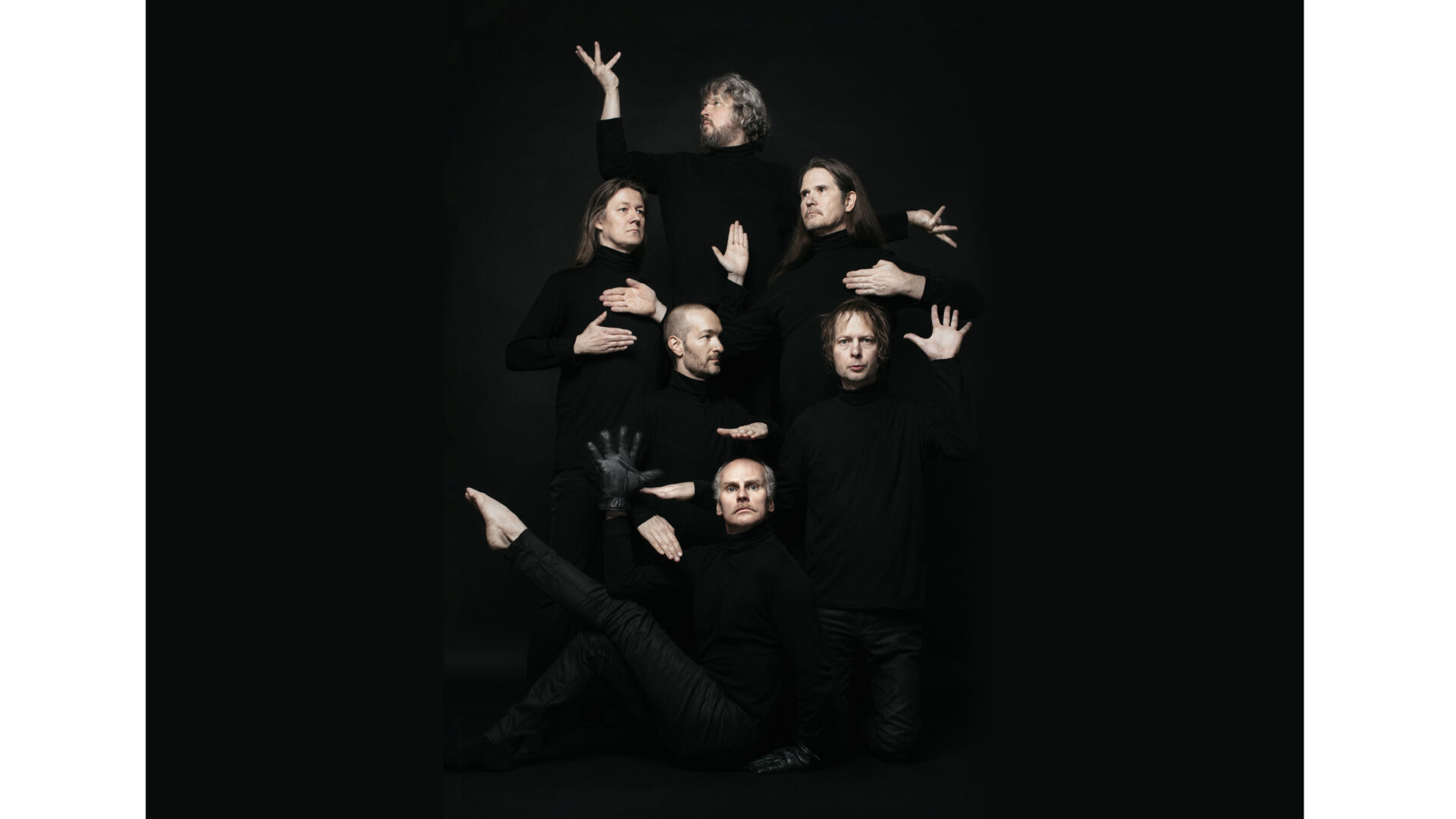
Members: Julius Jääskeläinen, Pekka Jääskeläinen, Jussi Lehtisalo, Tomi Leppänen, Mika Rättö, Janne Westerlund
Interviewee: Pekka Jääskeläinen
Nationality: Finnish
Current release: Circle’s explorative sculptural and sound-based installation Piste ("Point") will open to the public February 1st 2025 at the Pori Art Museum in Finland.
If you enjoyed this Circle interview and would like to know more about the band and their music, visit them on Facebook.
When I listen to music, I see shapes, objects and colours. What happens in your body when you're listening? Do you listen with your eyes open or closed?
I'm constantly listening to music or thinking about music.
I feel like it's a cerebral and bodily part of me. It's both conversational and social and extremely private and solemn at the same time; it's also a way to delve into historical and social contexts, as it offers a way to participate in a conversation without constraints of space and time. It's like being in contact with people whose music I listen to.
Sometimes music takes over my whole body and mind and takes me to unknown territories of pulse and textures and spatial awareness. A piece of music is like an invisible room where I can step in, and there’s an endless number of threads to follow in the sonic labyrinths.
I wear headphones wherever I go but I also love to listen to music really loud through speakers because of the tactile sensation of sound pressure. There’s intimacy in extreme volume levels.
I also perceive the sounds of my surroundings as music, for which I am truly grateful because it allows me to dwell in a unique soundtrack. It's like the earth was a turntable and I were a needle placed on the soundtrack of life unfolding endlessly, until the obvious end of course. It’s a lifelong chanson.
Tell me about some of the albums or artists that you love specifically for their sound, please.
One of the many albums that resonate with me on many levels is Captain Beefheart’s Doc At The Radar Station. I am endlessly intrigued by the emotional rawness that comes through on the tracks, from the vocals and instruments alike (it’s necessary to credit the band also when talking about this gem).
Sonically, it is minimalistic, bare and brutal - what you see is what you get. There are very few, if any, studio embellishments on the record: you can hear the idiosyncratic language of the instruments clearly, with all their weird and funny inflections and analogue inaccuracies. The band’s playing is at times mechanical in the best sense of the word, creating a creaky, quirky, unpredictable sonic beast that is defiantly plodding along toward the looming decay.
I also get goosebumps from long and static soundscape albums like Deep Listening (1989) by Pauline Oliveros, Stuart Dempster and Panaiotis.
[Read our Pauline Oliveros interview]
KMRU, Pan Sonic and other artists who explore sound synthesis and field recordings are also inspirational to me.
[Read our Pan Sonic's Mika Vainio interview]
An aspect of music and art that draws me in is that I don’t understand what I’m hearing or seeing. Often that kind of music lacks obvious melodic and harmonic structures employed in so much of music that is written in the song format. Instead it examines and celebrates the abstract sound as an object and artefact.
There can be sounds which feel highly irritating to us and then there are others we could gladly listen to for hours. Do you have examples for either one or both of these?
Sounds and voices can cause irritation and fatigue, if they are happening in a situation that you haven't any control over and which nevertheless demand a great deal of attention. Most often that happens when someone is ranting about things you are particularly concerned about yourself.
Whereas I can easily listen to the sizzling of food on the frying pan forever. It's a similar sound to having hundreds of crickets walking around and munching pak choi on a sheet of newspaper or cardboard in an eighty-litre plastic container.
Are there everyday places, spaces, or devices which intrigue you by the way they sound? Which are these?
As far back as I remember, I have loved the sound of wind blowing through the pine trees in the woods in the winter time. It's a sound I associate with distance and width because it's really hard to pinpoint the exact source of the sound.
The friction caused by a single pine needle is miniscule and when there are hundreds of thousands of them the sound is just magical. It's like nature's very own noise oscillator.
Have you ever been in spaces with extreme sonic characteristics, such as anechoic chambers or caves? What was the experience like?
There was a studio I visited once on the outskirts of Helsinki that had a really well damped and isolated soundproof room which was so devoid of any kinds of echoes that it had an immediate physical impact on me. It was like being in a sensory deprivation tank.
At the time I thought it would be too awkward to play in a space like that, but afterwards I kind of miss not doing a session there.
What are among your favourite spaces to record and play your music?
I’m not particularly picky about the acoustics of the studios, rehearsal spaces or venues as long as they aren't super echoey.
The best venue I played was probably at Duna Jam in Sardegna when we played on the beach and in between two sand dunes in a remote location somewhere on the island. The sound was really compact and beautiful, and the experience was extraordinary in many other ways too.
Do music and sound feel “material” to you? Does working with sound feel like you're sculpting or shaping something?
To me music is very organic and alive even if it's synthetic or digitally produced.
It is material in the sense that you make these invisible objects and artefacts or temples out of sounds, but I like the idea that sounds have their own character that you learn to appreciate as such rather than just to chop them up in the form you have decided beforehand.
How important is sound for our overall well-being and in how far do you feel the "acoustic health" of a society or environment is reflective of its overall health?
I think sound plays a significant role in our well-being, but I’m not knowledgeable enough to assess the overall impact of acoustics on health on a societal level. Nevertheless, as far as I know, noise pollution is an issue that has a negative impact on the environment.
Due to self-inflicted tinnitus, I am keenly aware that loud sounds are damaging, but still I’d rather listen to my ears ringing than much of what is played on the radio. Luckily, there is a choice involved.
Sound, song, and rhythm are all around us, from animal noises to the waves of the ocean. What, if any, are some of the most moving experiences you've had with these non-human-made sounds?
I have many fond memories of animal sounds from a dog's toenails tapping on the wooden floor in a hostel in Liverpool in the early 90s to the sound of cows breathing through their moist nostrils.
Some sounds that animals make are simply exhilarating because they totally take you by surprise when you first hear them. One of such sounds is the low thumping call of the emus, another is the wailing grunt of the black lemurs.
Many animals communicate through sound. Based either on experience or intuition, do you feel as though interspecies communication is possible and important? Is there a creative element to it, would you say?
My experience is that interspecies communication is possible and necessary when dealing with species other than our own.
Many animal species are more than capable of interpreting the verbal and non-verbal cues that we give them either consciously or unconsciously. I think all animal trainers are well aware of this.
Tinnitus and developing hyperacusis are very real risks for anyone working with sound. Do you take precautions in this regard and if you're suffering from these or similar issues – how do you cope with them?
I have no experience of hyperacusis so I can't say much of that. But I do suffer from tinnitus, probably because I started protecting my hearing too late.
My tinnitus is not severe enough to stop me from enjoying music and the sounds around me, but there is a constant extra layer of high-pitched whistle and hiss going on in my ears.
We can surround us with sound every second of the day. The great pianist Glenn Gould even considered this the ultimate delight. How do you see that yourself and what importance does silence hold?
I agree with Glenn Gould that this is the ultimate delight. I find sound very interesting and important to me.
I consider silence as an integral part of the dynamic variation of sound. I think of it so that all that you don’t hear is silence. Silence is the space where resonance takes place, and in that sense silence is the bedrock of sound.
Seth S. Horowitz called hearing the “universal sense” and emphasised that it was more precise and faster than any of our other senses, including vision. How would our world be different if we paid less attention to looks and listened more instead?
It’s a good question. I really don’t have a clue.
I think all of our senses are so limited that we should embrace them all.