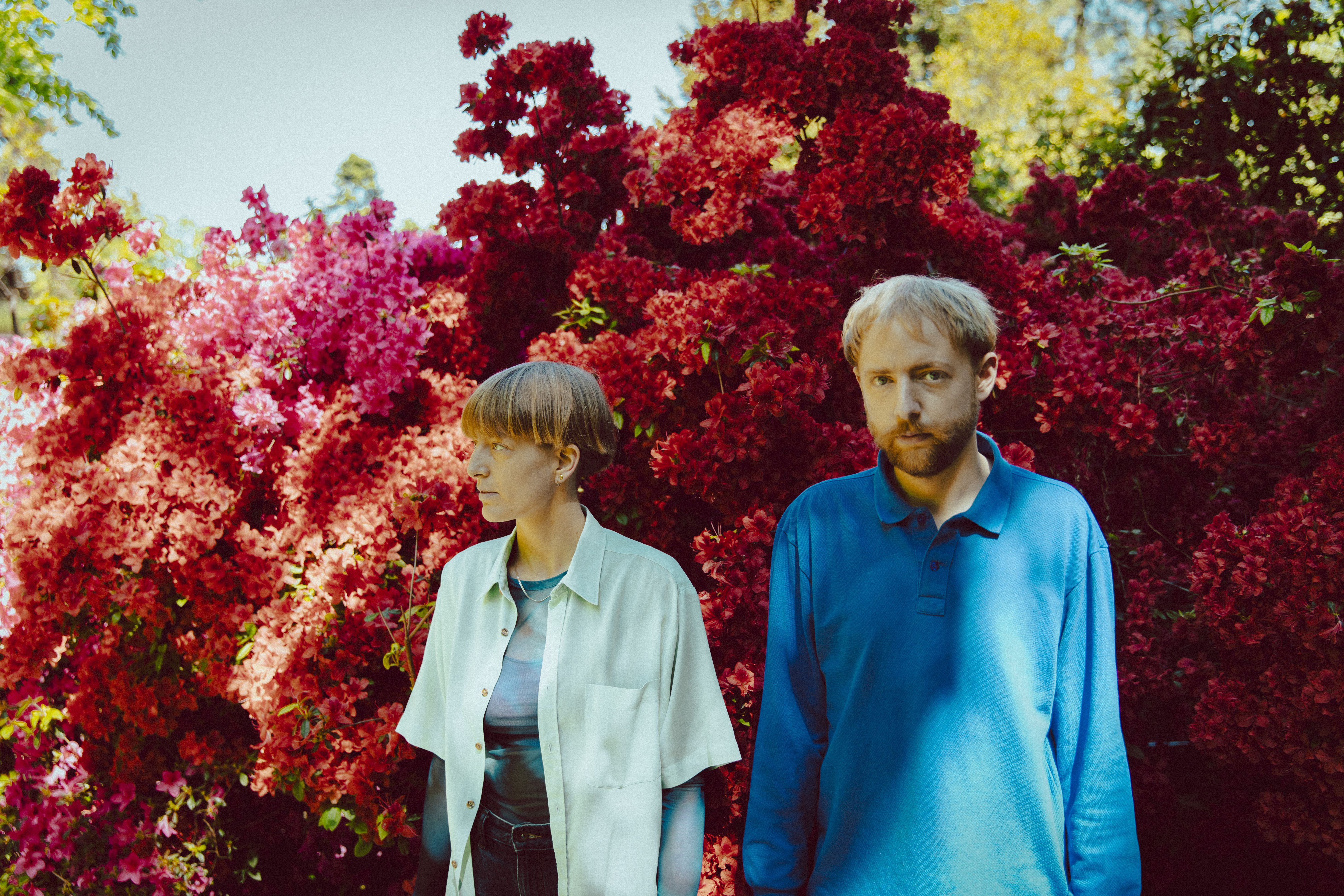
Published
Name: Citron Citron
Members: Augustin Sjollema, Zoé Sjollema
Nationality: Swiss
Recent release: Citron Citron's Maréeternelle is out via Les Disques Bongo Joe.
If you enjoyed this Citron Citron interview and would like to stay up to date with the duo and their music, visit the band on Instagram, Facebook, and bandcamp.
When I listen to music, I see shapes, objects and colours. What happens in your body when you're listening? Do you listen with your eyes open or closed?
A: Often, when I listen to different chords, colors come to me. For example, major 7 chords sound yellow to me, or minor chords sound blue. It's like the days of the week. For me, Monday is red and Friday is light blue. But because my ears aren't perfect, I see hues that I wouldn't have imagined when I listen to songs …
For example, in our song 'Dans ma bulle', the chords swing between A minor 7 and G7, so I see blue and dark yellow flashing by.
How do listening with headphones and listening through a stereo system change your experience of sound and music?
Z: I listen to music mostly on speakers at home or in the car during tours, and for me these are moments of sharing with people I love. Moments of joy, singing loud and laughing in the car to get some energy back when you are super tired, driving since hours. Or moments of curiosity, discovering new music and sharing our «coup de coeur» (crush?) with each other.
Listening to music with headphones is another experience, more introspective and lonely. When I do it, I feel fully into myself, with my emotions, memories and deep thoughts. I did it more as a teenager: I remember going alone by bus to the countryside to do horse riding, listening to Radiohead, watching through the window and feeling everything deeply.
It looks quite cheesy now but these are also moments you build yourself and learn to deal with your emotions.
Tell me about some of the albums or artists that you love specifically for their sound, please.
A: This year, I listened a lot to the Promises album by Floating Points and Pharoah Sanders (with the London Symphony Orchestra).
This music transcends me and makes me cry a lot too. There are so many different sounds, from saxophone to synthesizer to wind and string instruments. Each timbre of sound is highlighted and is important at a given moment, like Ravel's Bolero.
I can hear the wind when Pharoah plays his saxophone. We hear a lot of the air he blows in his sound and I think that's wonderful. That’s something I love: air in the sound. It really comes from the inside of the instrument player so it is really soulful.
Citron Citron Interview Image by Nikita Thevoz
Do you experience strong emotional responses towards certain sounds? If so, what kind of sounds are these and do you have an explanation about the reasons for these responses?
Z: We grew up with a musical education, as both our parents are classical musicians. I play the violin and studied classical violin at the conservatoire for years, and I played in an orchestra.
I got fascinated by the beginning of rehearsals where everybody starts practicing their own parts creating a cacophony of sound. Then suddenly it’s the moment of tuning and everybody merge together on the same note. I love this grace of a crowd of very different people going in the same direction.
I get the same feeling even stronger during demonstrations when the crowd shout slogans together, I get those goosebumps every time.
Have you ever been in spaces with extreme sonic characteristics, such as anechoic chambers or caves? What was the experience like?
A: There’s a room in our grandmother's house with a very special acoustic. It's not very big, but several sound spaces coexist. If two people are in very specific places, they can hear each other whispering in each other's ears even though they're not right next to each other. On the ceiling, there are very special vaults that create this weirdness.
When you take part in the experience, a very strange feeling comes over you. As if something magical existed in this room. There are many legends about this room, and some say that Freemasons used to meet here.
Citron Citron Interview Image by Nikita Thevoz
What are among your favourite spaces to record and play your music?
Z: To record music, I need to feel confident, like in a sweet bubble. Music is so intimate and personal that it makes you face your own vulnerabilities. It’s sometimes hard to feel at ease when you record music and people are around. You can feel the pressure of the result or performance. So it’s important to build a bubble of care and security.
With my brother Augustin, we have a studio in Geneva where we are used to rehearsing. It’s also where we recorded most of our music. I feel very secure there so it helps me to connect myself to my own creativity and feel free to experiment with new sounds and music. That’s why we like to record our music ourselves in our own studio.
Do music and sound feel “material” to you? Does working with sound feel like you're sculpting or shaping something?
A: No, not really. In my opinion, the fact that music can't be touched or seen makes it completely extraordinary. It's in its very essence and it's important to deal with it.
Often when I work with music on a computer I'm afraid of seeing too much of it. Being able to see the layers of recorded sounds, rhythmic patterns or waveforms often causes you forget to really listen. So when we work on our songs with Zoé, we often turn off the screen to listen and step back.
We didn’t have this problem when we were recording our first LP Chagrin Bleu (2022), as we recorded almost everything on a big cassette recorder.
How important is sound for our overall well-being and in how far do you feel the "acoustic health" of a society or environment is reflective of its overall health?
A: Our sound environment can have a big impact on how we feel if we pay attention to it, and therefore on our health.
My sister Zoé and I grew up outside the city in a very calm and rather quiet environment. In the morning, when we woke up, we'd hear the birds singing and not much else. It was very pleasant and yet, when I moved to the city, I loved being woken up by the sound of the tramway or the horns. It was like a change of life, and as if at last I could be part of the global movement of people.
After a few years, I have to admit that I miss the sound of birdsong and that the peace and quiet is still an incredible opportunity and privilege. It's easier to hear your own voice and emotions when your environment is calm.
Sound, song, and rhythm are all around us, from animal noises to the waves of the ocean. What, if any, are some of the most moving experiences you've had with these non-human-made sounds?
Z: When I hear the cries of the seagulls, I think of our grandmother and it fills me with immediate emotion. She passed away 1 year and a half ago and we composed a song for her and sang it to her a few days before she died. Then we decided to record the song and to include it on our second album Maréeternelle.
This song is a tribute to her and to the musical baggage she passed on to us. We called the song “Mer du Nord” because she grew up in Rotterdam, and we included seagull calls in the song. So since then, I want to cry every time I hear a seagull cry.
We like to use fieldrecordings in our songs, because it gives more narrativity and imagery to the tracks. On Maréeternelle, we added train noise, whale’s song, rain, crows cries and the tide of the sea. The title of the album precisely refers to the eternity of the tide.
We can surround us with sound every second of the day. The great pianist Glenn Gould even considered this the ultimate delight. How do you see that yourself and what importance does silence hold?
Z: We're surrounded by sound all the time, so much so that sometimes we don't even realize it. It’s only when we arrive to a very quiet and silent space that we become aware of the noise that was around us before.
As a musician, I love listening to sounds and to music, but as it’s one of my main activities (I am also an actor), I often feel the deep and true need for silence.
Ears get tired very fast. So, I just close my eyes, lying in my bed, and focus on my breathing and heartbeat. Then you realize your own body also produces sound. Sound proves you that you are alive. :))