Published
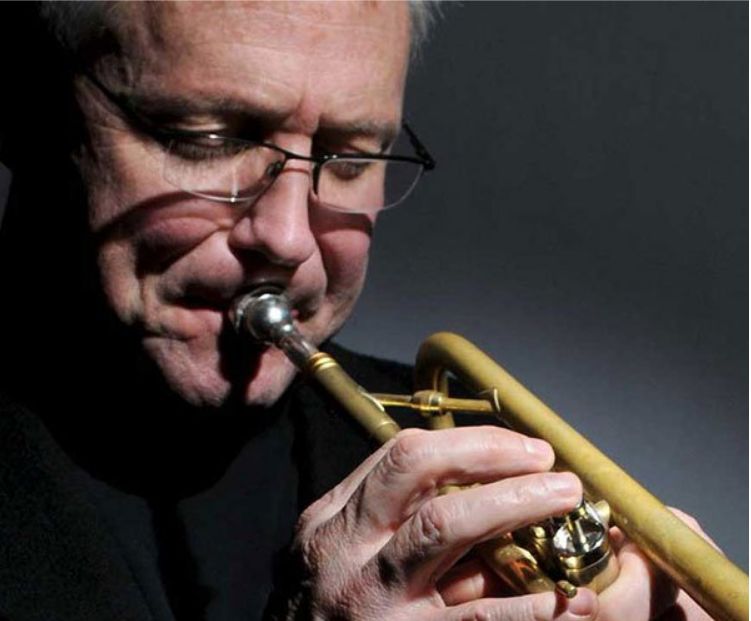
Name: Clay Jenkins
Nationality: American
Occupation: Trumpet player, educator, composer, improviser
Current event: The Eastman School of Music at the University of Rochester is an integral part of Rochester's long and proud jazz tradition. As part of its faculty, Clay Jenkins has helped shape this legacy as well as its continual development.
Current release: Clay Jenkins has participated in a wide range of releases, both as a (co-)leader and band member. Among the most exciting and noteworthy albums have been his two volumes of Electric Miles pieces, recorded with the Charles Pillow Large Ensemble.
Recommendation for Los Angeles, USA: There is a small jazz club in Los Angeles, near the LA Airport. It is called “Sam First.” It is owned by a very soulful and generous man, and the people who work there are very thoughtful and kind. It’s my favorite place to play.
Shoutouts: Certainly all the Masters deserve to be loved and appreciated. Well known players and composers such as Louis Armstrong, Miles Davis, John Coltrane, Elvin Jones, Duke Ellington, Count Basie, Herbie Hancock, Charlie Parker, etc. should be held in the highest esteem. Other artists that are not as well know also deserve to be held in that same position such as Eugene “Snooky” Young, Thad Jones, and Shirley Horn.
Things I am passionate about but rarely get to talk about: I would reiterate the hope and prayer that somehow through music and the arts, we can help lift our world from the despair, fear, and hopelessness that is existing in our country and in our world today. That we can believe in the thought that “Love Wins.”
If you enjoyed this Clay Jenkins interview and would like to know more about his music, visit his personal page on the website of the Eastman School of Music.
What were some of the musical experiences which planted a seed for your interest in jazz?
My parents were both musicians, my father played the trumpet and my mother played and taught piano. My father first introduced me to jazz by taking our family to hear “The Stan Kenton Orchestra,” and “The Modern Jazz Quartet” with Ray Brown and Milt Jackson.
I noticed that the music was so energetic and everyone was having such a wonderful time, and I decided that I perhaps wanted to be a musician and help people feel better.
What does the term jazz mean today, would you say?
“Jazz” is a fairly broad term today, it can refer to anything from early New Orleans style blues and street music to modern and post-modern avant garde music, from solos and duos to large ensembles, from intricately crafted arrangements to free improvisations.
Some people might think of the term from a negative perspective but I still think of it as a truly American artform, coming from African rhythms and culture and including melody, harmony, instrumentation, and other musical influences from all over the world.
As of today, what kind of materials, ideas, and technologies are particularly stimulating for you?
I’m still a bit of an “Analog Man”, though I use my computer for communicating purposes. I still write music by hand and l often copy it by hand as well.
I would like to be more tech savvy, but keeping up with my students, practicing, and being involved with my family keeps me very busy. I would like to speak Spanish but I can’t find the time for that either!
Where do most of your inspirations to create come from – rather from internal impulses or external ones? Which current social / political / ecological or other developments make you feel like you need to respond as an artist?
I have always been an anti-racist, and I have been very active in anti-racist causes. That has been inspirational for me.
Many of my friends have had experiences that stemmed from racism and I hope and pray that somehow my being an involved jazz musician can help that situation.
Tell me a bit about the sounds & creative directions, artists & communities, as well as the colleagues & creative hotspots of your current hometown, please. How do they influence your music?
I have been the Jazz Trumpet Professor at the Eastman School of Music in Rochester, New York since 2000.
My colleagues are all excellent and artistic musicians, so it has been a very inspirational and fulfilling time for me, getting to perform, teach, and learn together for the past 25 years. I am very thankful for the opportunity to serve along with these wonderful friends, and to be a part of the musical growth of our wonderful students.
What role do electronic tools and instruments play for your creative process?
I am an acoustic musician, so I must say that electronics to not have very much effect on my musical life.
Jazz has always had an interesting relationship between honouring its roots and exploring the unknown. What does the balance between these two poles look like in your music?
This is a very interesting question. I’m a firm believer that a musician can’t truly be an innovator without being well informed about the history and legacy of jazz and jazz musicians.
On a personal note, I have been honored to perform with the big bands of Stan Kenton, Buddy Rich, and Count Basie. I am currently a charter member of the Clayton/Hamilton Jazz Orchestra. I feel that my musical growth has been an extension of my being a member of these groups and experienced their legacies.
I hope that through these experiences I can bring that balance of experience and creativity to other groups I plan in, including my own group projects.
How much potential for something “new” is there still in jazz? What could this “new” look like?
There are always new elements that are folded and fused into jazz. Some are rejected and then accepted such as Miles Davis’ introduction of rock, Rhythm and Blues, electronics, fusion, avant-guarde, pop, etc. Other artists have fused Latin Music, Hip Hop, Reggae, and other cultural arts into the jazz realm.
I think that there will always be that situation where a certain style or discipline might be introduced and it will evolve with the music just like other in other styles of performance art.
For many artists, life-changing musical experiences take place live. How do you see that yourself?
Most of my musical experiences happen in live situations.
I have led groups that have had amazing and memorable occurrences when I have the pleasure just to stand back and just listen to the other players play together. I have had great experiences listening to other players play a composition of mine. I have had great moments of witnessing great artists help others sound their best, which is the highest compliment of a jazz musician.
I have certainly had magical moments with players I love and respect. It does not happen every performance, but when it does it can be very moving. That is what makes it so breathtaking.
How, would you say are your live performances and your recording projects connected at the moment? How do they mutually influence and feed off each other?
I often perform and record with players that I have known for many years. There is nothing more fulfilling musically than playing with musicians you love. The live performances can have their joyful magic, as can some recording sessions.
I think perhaps it happens more in jazz recordings because there still exists that element of improvisation and communication that can transcend the layers of production like overdubs and corrections.
Ímprovisation is obviously an essential element of jazz, but I would assume that just like composition, it is transforming. How do you feel has the role of improvisation changed in jazz?
I think it depends on the approach of the artist.
Some improvisers are more interested in showing their virtuosity and polish. There is certainly nothing wrong with virtuosity. As a wise man told me, “Virtuosity comes from the word ‘virtue’ which signifies everything good.”
Other artists strive for perfection with overdubbing and piecing together their improvisations. That is certainly a very valid approach as well.
I approach improvisation in a similar fashion, whether I am playing live or recording, in the hopes that it will be heard as an humble, yet confident personal contribution to the music.
What, would you say, are the key ideas behind your approach to improvisation?
It is my hope that I can express a complete story when I improvise. There are several elements that I think should be developed through diligent practice.
I want to be convincing as an accomplished player in terms of technique and musicality.
I want to be convincing in the fact that I know the material.
I want to be convincing in terms of my tone and my time feel, that my sound is inside my depth of groove and my depth of groove is inside my sound.
I want to show respect to the legacy of jazz players who have influenced me.
I want to show respect to the legacy of the Blues.
I want to have a strong connection to the other players I am playing with, whoever they may be.
I want to be compositional in my improvisations.
I want to have mystery in my improvisations.