Published
Part 1
Name: Cooper Bowman
Occupation: Until recently, social work assistant. Currently, musician, operating Altered States Tapes.
Nationality: Australian
Recent release: Cooper Bowman's An Unfinished Rose by Troth, is out via Night School. Other current releases include Rules For Living by CD3, out on Aguirre, and Guild Standards by Ossifa, available via Förfall.
Recommendations on the topic of sound: RZA's The Tao of Wu, it's basically a bare bones self-help book. David Toop's early 90's book on ambient, An Ocean of Sound. Robert Wyatt's Different Every Time is a great insight into the process of collaboration and the strength of caring his wife has played in his life and work. A work of fiction that, while being 'about' something else entirely, has a great sense of musicality about it is The Town by great Australian author and friend, Shaun Prescott.
I still haven't finished it, but Where Song Began by Tim Lowe. Lowe's contention is that, from what we know of evolution, song may have first existed in southern birds. I love to think about how early ancestors of Australian birds may have been singing into the valleys, with only each other to appreciate it and possibly sing back.
If you enjoyed this Cooper Bowmaninterview and would like to stay up to date with his music, visit him on bandcamp.
When I listen to music, I see shapes, objects and colours. What happens in your body when you're listening? Do you listen with your eyes open or closed?
That sounds like a lot of fun, I don't have the same response unfortunately. I guess I just feel it.
Music is a supportive vibration that travels alongside whatever is going along internally for me, complimenting or shifting it.
How do listening with headphones and listening through a stereo system change your experience of sound and music?
I rarely listen through headphones unless I have to; on public transport or when composing/mixing music myself.
I see music as being all around. Universal, rather than confined, so like to afford it the same freedom. I often find headphone listening to feel a little claustrophobic, rather than the liberation I experience having music spread throughout a room and inhabiting the space freely.
In making music, I try to find a balance to have it work across both forms of listening, so that the message is articulated regardless of the medium. I also like the idea that music played through a system can be more bodily and the same sound can become a more detailed, cerebral experience that draws out all of the small details through a set of cans.
Tell me about some of the albums or artists that you love specifically for their sound, please.
I guess all music I love is for its sound to some extent.
An example that comes immediately to mind are the early recordings of Wu Tang. The first album I bought as a kid was 36 Chambers and I still listen to it, Liquid Swords and Cuban Linx over two decades later.
There is a kind of unrefined alchemy at work in these recordings that I can totally relate to in the way that I put together music myself and that attracts me to music as a democratic method of communication. RZA's production is always described as 'raw', but I see it as arcane and deep.
I do lean towards a 'rawness' in sound generally though. What I mean by that is probably something more abstract and associated with The Spirit or elan in the maker's intention than whatever equipment is (or isn't used).
I try not to be prescriptive, but I often find that there is less space for The Spirit to shine through if something is over-produced. It commonly doesn't retain as much of the difficulty and complexity of being human that I look for in art when it is polished into more of a commodity object.
Some other recordings that I find harness a special kind of magic are Nothing On by Flaming Tunes (and their whole album, of course). Maxine Funke's music has a delicate intimacy, but profound depth that is not often found elsewhere.
[Read our Maxine Funke interview]
My CD3 collaborator David Roeder makes music as Nein Rodere that magically resonates the way it does through his process of assembly.
The jazz I listen to most, Yusef Lateef's Eastern Sounds, Don Cherry's Eternal Now and self-titled album or Mulatu Astatke is much less polished (recording-wise) than many of their peers and allows the message to ring more true for me.
Do you experience strong emotional responses towards certain sounds? If so, what kind of sounds are these and do you have an explanation about the reasons for these responses?
I don't believe there are isolated sounds that elicit emotion in me on their own. Emotional resonance definitely does happen through a combination of tones though. More importantly, it occurs through whatever intention is informing the music and arises through context, my own and that of the song.
Lately I've been really hit by Molly Nilsson's Hey Moon! for some reason, possibly insomnia.
I'm an absolute sucker for Kev Carmody and PK's live version of "From Little Things, Big Things Grow" at Gough Whitlam's funeral. A hugely powerful tune and message, regardless of its ubiquity and usage in ads on Australian TV. More recently, it's been folk song, "Fashioned In The Clay," again - impact and significance in the current context.
From another angle, a few punk songs; Tube Disasters, Get In The Boot, Alternative Ulster and Where Were You really get the system buzzing.
I guess what I am saying is that there is a magic in all of these that resonates with me that I can't always place the provenance of. The power is held in the mystery.
There can be sounds which feel highly irritating to us and then there are others we could gladly listen to for hours. Do you have examples for either one or both of these?
Right now there is someone loudly drilling close-by, so that sound specifically is the most annoying. I never need to hear the sounds of construction ever again.
It is also what this palette signifies - greed, expansion, ongoing development and the evisceration of natural environments. The injustice of people being denied adequate housing while others indefinitely add-on profane extensions. So, it is loaded with a kind of violence, not only in how extreme the sound itself is volume-wise and on a sensory level for people like myself, but also the intention of the act that produces it.
I have aversions to certain frequencies and other sounds I consider illegal for usage in music. I just avoid those where I can, which isn't too hard.
More importantly, on a positive note - rain on a roof is always going to be the most comforting sound. The sound of trees creaking in strong wind, although occasionally loaded with a kind of danger, is a beautiful language. The bushland near where I live is a hotspot for it.
I love complex birdsong, specifically black cockatoos, currawongs and butcher birds. The ocean lapping on a certain type of shell where the sound sifts through, like a gentle, sizzling oil. I've only encountered this in three places I can think of.
Outside of the natural world, as a skateboarder, there are certain four-wheeled sounds I really appreciate. This recent part of Bobby De Keyzer has a lot of space in its soundtracking that allows the ambient sound of activity to be foregrounded beautifully. I recommend it to anyone with an open mind/ear.
Slapping a backside grind down the wedge at Glenorchy skatepark is the closest I can get to realising such beauty.
Are there everyday places, spaces, or devices which intrigue you by the way they sound? Which are these?
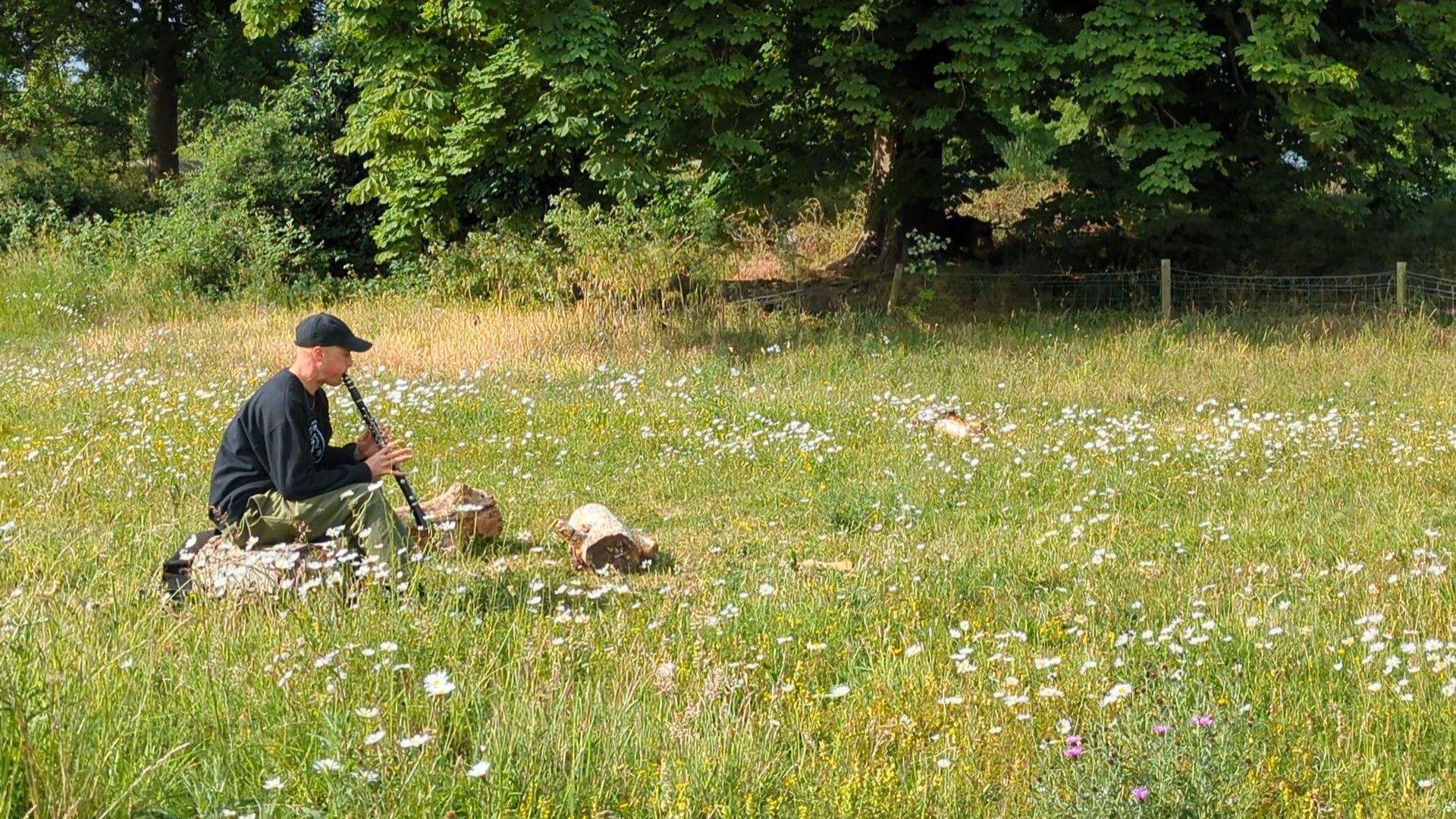
Tapping my wedding rings on a large metal water bottle. The complexity and variety of sounds my wife and I's cat makes. Occasional humming and chanting. Hearing myself play the clarinet and it producing a sound that is beautiful (to me at least).
The capacity for anyone to make sound is phenomenal, it's all powerful and laden with a kind of responsibility to do something decent with the opportunity (or just be quiet).
Have you ever been in spaces with extreme sonic characteristics, such as anechoic chambers or caves? What was the experience like?
I engage with spaces like these whenever the opportunity presents itself.
Around my birthday earlier in the year, my wife Amelia and I visited an abandoned mining tunnel in the north-west of Tasmania. I brought my clarinet along and recorded a little in there. It was exceptionally quiet, like a vacuum, although there were small sweet spots that were massively reverberant. I enjoyed the process of moving through the space and feeling how the sound changed with position.
Forests have extreme sound profiles, the interaction of creatures/space, lack of noise pollution and natural process(es) being left to their devices. One of my favourites as an appreciator.