Published
Name: Cosimo Fiaschi
Nationality: Italian
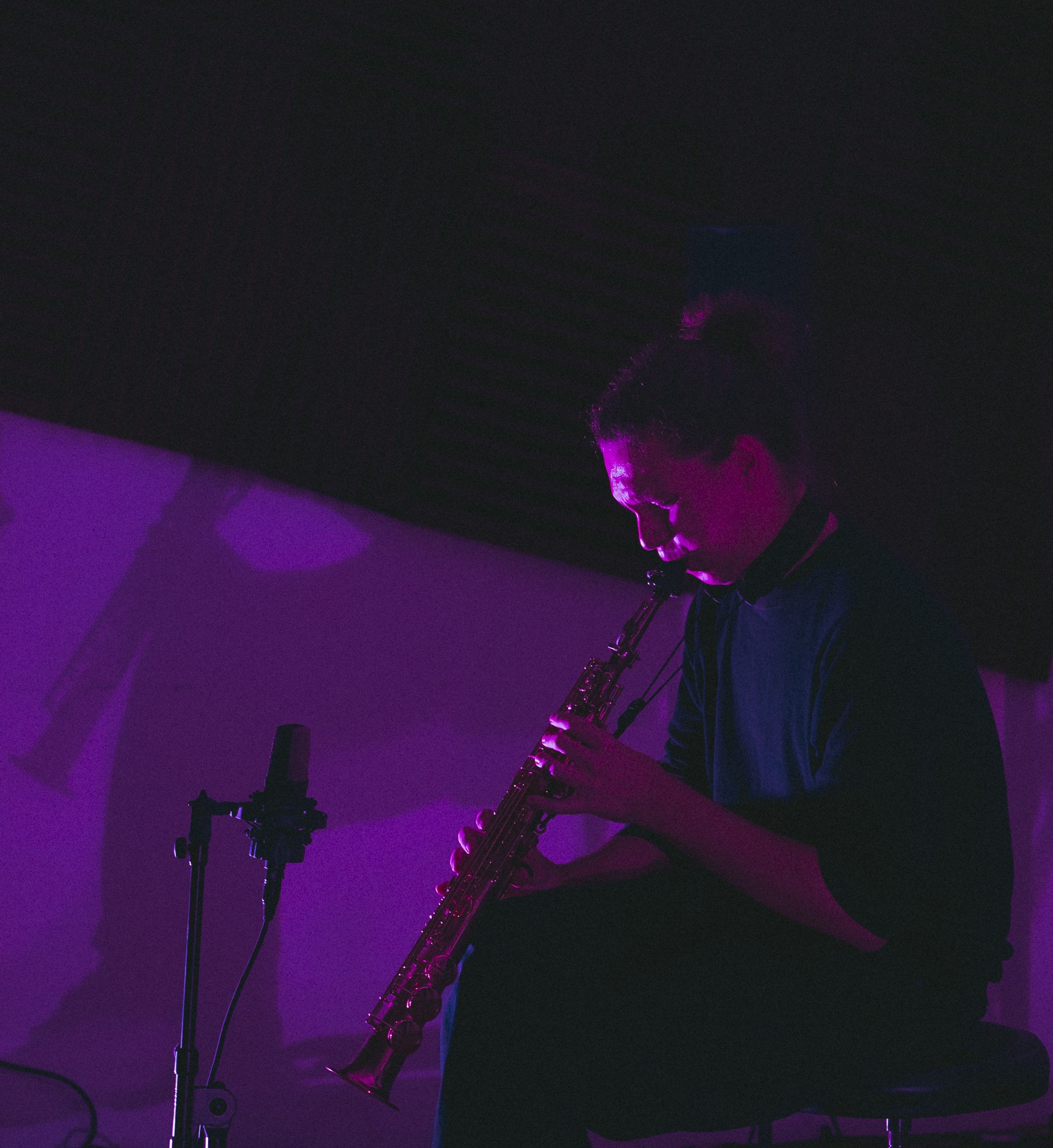
Occupation: Soprano saxophone player, improviser, composer.
Current release: Cosimo Fiaschi has three new releases out: Variazioni (PANG28), Wunderkammer (granny 43), Reminiscenze (ZMY 074).
If you enjoyed this Cosimo Fiaschi interview and would like to know more about his work, visit him on Instagram.
If we forget about streaming numbers, target audiences, social media followers, and sales - why are you drawn to sound and music as a creator and listener? What is it that you give and receive through it?
Well, I guess it’s necessary to forget about numbers and sales; otherwise, I (or probably all of us) should do something else, something more concrete.
It’s banal to say, but I thrive and offer only sounds; nothing more, nothing less. It’s always difficult to balance your role as a musician with your role as a listener.
Sometimes I feel that I tend to listen to music very similar to what I make. Of course, a musician’s ear is always analytical, but I think it’s important to develop a more neutral way of listening, especially for live concerts and performances.
Late producer SOPHIE said: “You have the possibility [...] to generate any texture, and any sound. So why would any musician want to limit themselves?” What's your take on that?
It’s an interesting point, and considering that many “experimental” musicians use all sorts of setups, it’s a popular path.
Personally, I prefer to create and listen to music with a specific sound; something purposeful and goal-oriented. This often involves strict limitations.
However, I’ve often been amazed by the diverse solutions and combinations possible within very limited musical material. What seems like a glass of water can turn as deep as the ocean.
Tell me about one or two of your early pieces that you're still proud of (or satisfied with) – and why you're content with them.
Even though it was released only in summer ’24, the piece Reminiscenze was composed and recorded during spring/summer ’20. So, it could be classified as an “early piece” of mine. I’m very fond of that recording. Together with Polish sound artist Michał Biel, I managed to create a few choral lines leveraging the contingency between multiphonics and “tonal” harmonies.
Apart from this, I believe the piece, as well as coda, the second one on that Zoomin’ Night release, successfully achieves its goal: translating the sound quality of Renaissance vocal music into acoustic saxophones through the use of multiphonics.
Additionally, I cannot fail to mention the group Sonoria with Live in Pisa and Le Jardin Sonore, released by Evil Rabbit in ’20 and ’22 and both recorded in spring ’19.
These releases resulted from deep improvisational practice with a quartet including Nicholas Remondino (drums, electronic), Emanuele Guadagno (electric guitar), and pianist Alessandro Giachero, who sadly passed away in fall ’22.
I also participated in Alea, which is dedicated to Alessandro, led by Andrea Giordano and published by SOFA. Despite their aesthetic differences, these projects share a similarity in their musical process: trial and error, constant rehearsals, and a clear path to follow.
[Read our Nicholas Remondino interview]
What is your current studio or workspace like? What instruments, tools, equipment, and space do you need to make music?
I’m very lucky in this regard. I play soprano saxophone and just need a quiet room that’s not too small, some paper, and a pencil.
Obviously, this doesn’t include recording. Since the music I make requires serious expertise in sound engineering, I prefer to collaborate with friends and colleagues.
From the earliest sketches to the finished piece, tell me about the creative process for your current release, please.
The process varies significantly from one release to another. For Wunderkammer, published by Granny Records in December ’24, I assembled a septet with trusted musicians for a single day of recording. The group had never rehearsed, and some members had never even met before.
We recorded four different versions of the piece, and I chose the third one for two reasons: the coherence of its form, achieved by balancing pitch/noise and full/empty textures, and the appearance of rain that overpowers the septet at the end. I think that these elements made this version magical.
It's also important to keep in mind how the group chose their sounds a priori, without agreeing on them beforehand; that's why I keep thinking how little chance there was of playing a version with so many unisons in both pitch and tempo.
Obviously, during the months before the recording session, I thought and wrote a lot about the piece. So, in this case, the composing process was pretty long while the time of the recording was very limited.
Conversely, in my latest release, Variazioni, a duo recording with long-time collaborator Nicolò Francesco Faraglia (electric guitar) published by Superpang, we had the chance to involved a substantial practice, both individually and together. This project is focused on developing a syntax that incorporates serialism into improvisation.
The result is twenty very short, sharp improvisations, possibly my edgiest release yet.
Currently, I’m working on a solo recording project planned for release between ’25 and ’26. The process has been challenging yet inspiring, and I’ve reshaped the concept multiple times. However, the core idea remains intact.
What role and importance do rituals have for you, both as an artist and a listener?
Since I’m deeply attached to my soprano saxophone, what seems routine has become a necessary ritual.
Taking the instrument out of its case, finding a good reed, and warming up with long tones is not just practical (the instrument plays better after some minutes of blowing); it’s also crucial for focus and carries a spiritual connotation.
Many people perceive classical music and contemporary composition as having high barriers of entrance, both for listeners and musicians. What have your own experiences been in this regard?
I have been fascinated by contemporary music ever since I started playing. In many ways, it was easier for me to approach the new rather than the old.
That said, let’s not be mistaken: although contemporary music (especially the historical avant-garde) is often perceived as difficult and distant for many reasons, I believe it’s actually easier to approach than early music, simply because it’s closer in time.
Recently, I gave general music lessons to middle school classes and played some Harrison Birtwistle for them: they didn’t even flinch! Perhaps there’s more resistance to the “new” from musicians and festivals than from audiences.
Music has become a lot more global, and incorporating elements from other parts of the world or the musical spectrum is commonplace. Do you still think there are city scenes with a distinct, unique sound? How does your local scene influence your work?
Music today has a decidedly global scope. For example, composers from the Wandelweiser group, who are very dear to me, have a central base of operations in Haan (Germany), but they live on different continents. It’s also worth noting that they did not write a manifesto, yet similar poetic traits can still be discerned among them. This contrasts sharply with how geography influenced music less than a century ago.
Distance has led to atomization and fragmentation; while one can glimpse trends, it’s difficult for members of a homogeneous movement to live in the same urban centre. Despite this, making music always contends with what is possible, and one inevitably relates to their environment.
Fortunately, my surroundings are rich. Living in Rome, I’m involved in several projects, including the quartet Al Niente with Beatrice Miniaci (flute, bass flute), Luca Venitucci (accordion, objects), and Gabriele Pagliano (double bass, objects) with whom I recorded this summer.
I frequently spend time in Siena, where I’m working on a composition for gong and soprano saxophone by Pierluigi Foschi, who also plays drums in the band G.E.A alongside Stefano Zambon on double bass.
Working with long forms, complex concepts, or new vocabulary is potentially more challenging today because they require us to remember things that happened minutes ago—while most of us struggle to focus even on the present. Both as a composer and listener, how do you deal with this?
As a listener, I’m very fond of long forms. Some of my best musical experiences include attending live performances of Einstein on the Beach by Glass/Wilson and Vexations by Erik Satie.
The former lasts 4–5 hours with no interruptions, while the latter features a very short phrase traditionally repeated 840 times, even though this is not explicitly stated in the score. These live performances are unforgettable.
As a saxophonist and composer, I mostly work with long forms, though not as long as the examples above. While my recent release Variazioni comprises very short pieces (as brief as 17 seconds), most of my music is built from a simple idea that requires time to transform and generate transitions between sounds.